


The Problem Worth Solving First

China’s healthcare system has a structural imbalance baked in. The best specialists, the best equipment, the best diagnostic infrastructure — all concentrated in major cities. For elderly patients in smaller towns or rural areas, getting care means a long bus ride, a crowded waiting room, and the quiet anxiety of not knowing whether a symptom is worth the trip.
That last part is the real bottleneck. Not treatment. Triage.
For millions of older adults, the hardest question isn’t what do I need? It’s should I even bother a doctor with this? AI tools are beginning to answer that question at home, before anyone puts on their coat.
What “Triage at Home” Actually Looks Like

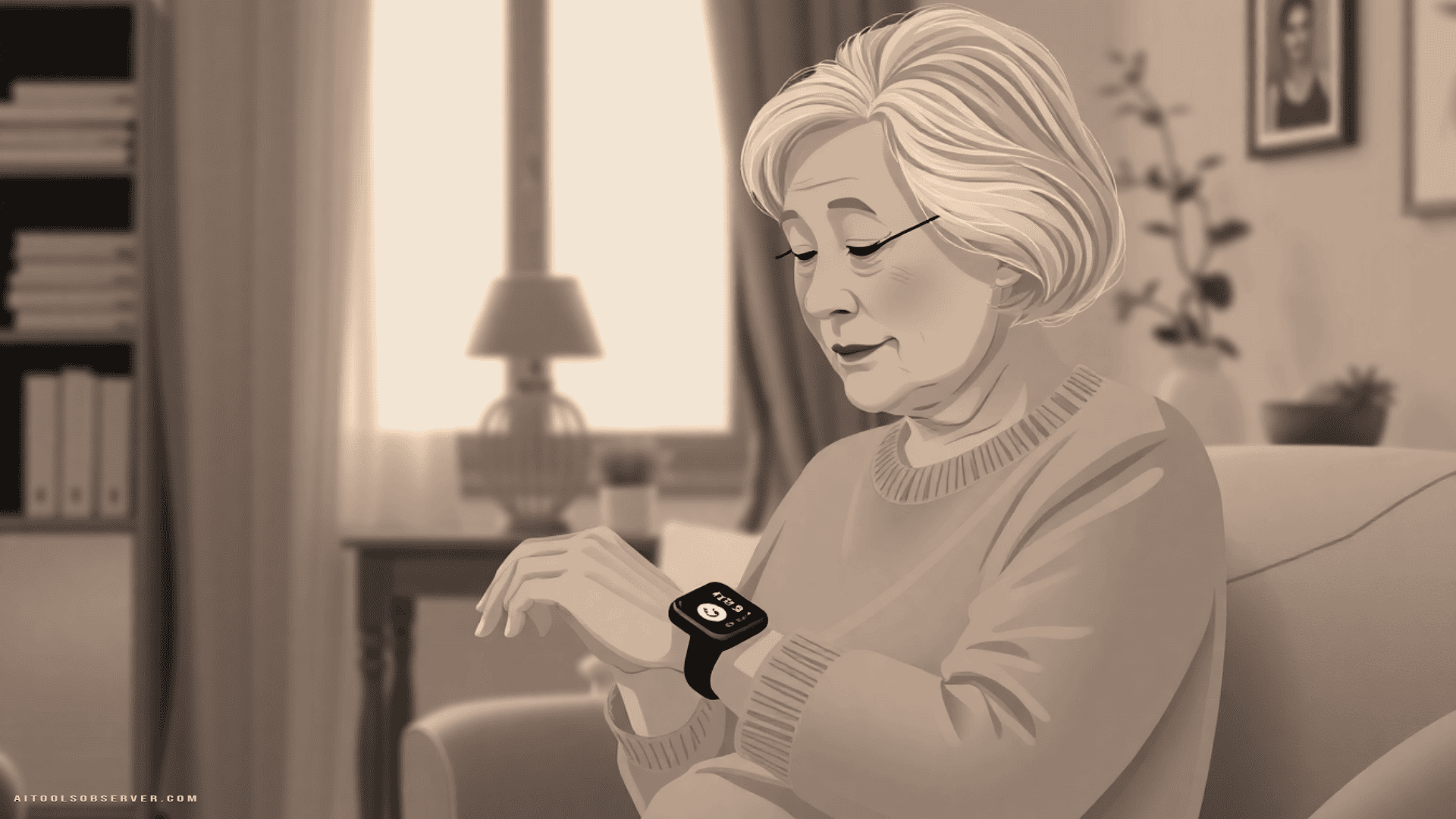
Meet Ye Cuihua, 79, living in Wuhan. When she feels a flutter in her chest, she doesn’t call a taxi. She checks her wrist.
Her smartwatch syncs with an app called Ant AQ, which reads her blood pressure, cross-references her health history, and delivers a clear verdict: slightly elevated, reduce salt, keep monitoring, call your doctor if it persists. No waiting room. No bus. No uncertainty spiral.
“It feels like having someone at home who can always answer,” she said.
That’s the use case in its simplest form — a wearable device feeding real-time data into an AI health app that returns actionable, plain-language guidance. The workflow looks like this:
Symptom noticed → wearable captures biometric data → AI cross-references health records → preliminary guidance delivered → user decides next step
It won’t diagnose a rare condition. It won’t replace a cardiologist. But it can turn a vague worry into a concrete decision — and for elderly users managing chronic conditions alone, that’s genuinely valuable.
Wearables as the Front Door

Smartwatches and health bands serve as the primary data layer. Blood pressure, heart rate, sleep quality, activity levels — all logged passively, all available for AI analysis without the user doing much of anything. The friction is low by design.
AI Health Apps as the Triage Layer

Apps like Ant AQ (developed by Ant Health) sit on top of that data and do the reasoning. They cross-reference symptoms with health records, flag anomalies, and deliver guidance in plain language. Ant AQ recently introduced a dedicated elderly mode — simplified interface, voice commands, and crucially, dialect recognition. Because many older Chinese users don’t speak standard Mandarin, and a tool that can’t understand you is a tool that doesn’t get used.
Companion Robots and Digital Assistants

At care facilities like Kangyuxuan in Beijing and Taikangzhijia in Wuhan, residents interact with digital assistants for medication reminders, sleep logging, and general health queries. These aren’t dramatic sci-fi robots. They’re conversational interfaces that respond, remind, and reassure — consistently, patiently, without ever being in a hurry.
The Workflow for Care Facilities

For operators running senior care homes, AI tools are reshaping daily care routines in practical ways.
Morning check-in → residents log vitals via wearable or kiosk → AI flags anything outside normal range → caregiver reviews alerts and prioritizes follow-up.
Medication management → digital assistant sends reminders → logs compliance → escalates missed doses to staff.
Symptom triage → resident describes discomfort to app or assistant → AI provides preliminary guidance → caregiver or physician consulted if threshold is met.
Cai Juan, a caregiver at Taikangzhijia, put it plainly: residents who once ignored mild symptoms or panicked over minor ones now consult a digital tool first. “It doesn’t replace the doctor, but it eases the anxiety and sometimes catches things that would have been left too long.”
That’s a meaningful workflow improvement — fewer unnecessary escalations, faster response to genuine concerns, and calmer residents.
The Emotional Layer Nobody Talks About

Here’s something the efficiency metrics miss: for elderly people living alone, these tools aren’t just useful. They’re present.
In a country where family structures are shifting rapidly and millions of seniors have minimal daily company, an AI that responds — always, without impatience, without distraction — fills a real gap. Residents at Kangyuxuan have built daily routines around their digital assistants. Not because they have to. Because they want to.
“They are not just using a tool,” said caregiver Cui Xiaohan. “They are getting used to being responded to.”
That’s a subtle but important observation. Care, as older people actually experience it, is increasingly hybrid — part human, part machine. The technology doesn’t replace relationships. It holds space between them.
Where It Still Breaks Down

None of this is seamless. A few friction points worth naming:
- Digital literacy gaps — Internet penetration among Chinese adults aged 60+ reached 53.7% by end of 2025. That means nearly half still aren’t online. And being online doesn’t mean being comfortable navigating a cluttered health app.
- Interface design — Most health apps were built for younger users. Small text, complex menus, unfamiliar interaction patterns. A brilliant algorithm behind a confusing UI is still a failed product. Simplified layouts, voice-first design, and dialect support aren’t nice-to-haves — they’re the difference between adoption and abandonment.
- Trust in algorithms — Ye Cuihua reads what Ant AQ tells her. Then she calls her doctor anyway. “I still need a doctor to confirm,” she said. For most elderly users, AI carries useful information but not final authority. It’s a first step, not a verdict.
The success of health AI for seniors may depend less on how smart it gets, and more on how accessible it is to use. That’s a UX problem as much as a technology problem.
What “Access” Means Now

For decades, healthcare access was measured physically — hospitals per capita, distance to the nearest clinic, doctor-to-patient ratios. AI is adding a digital dimension to that definition.
Can a person obtain health information at home? Can they understand it? Can they act on it?
For elderly populations, this opens real possibilities — medical knowledge delivered directly to the wrist, reducing the need for travel and the anxiety of uncertainty. But it also risks creating new exclusions. Those who can’t navigate the technology don’t just miss a convenience. They miss the triage layer entirely.
The gap between the digitally fluent elderly and the digitally excluded elderly could become a meaningful health equity issue — one that better interface design and dialect-aware AI can help close, but only if someone prioritizes it.
The Takeaway for AI Adopters

If you’re building or evaluating AI tools for healthcare — especially for older or less tech-native users — the lesson from China’s elder care experiment is clear:
The bottleneck isn’t intelligence. It’s usability.
Voice interfaces, simplified layouts, local language support, and low-friction wearable integration aren’t edge features. They’re the core product for this audience. Get those right, and the AI underneath can actually do its job.
The future of AI in elderly care isn’t replacement — it’s coexistence. Algorithms alongside physicians. Digital tools alongside lived experience. Wearables alongside human judgment.
Ye Cuihua used to wait and see. Now she checks first.
That’s a small behavioral shift with a large systemic implication. And it’s already happening — one smartwatch glance at a time.



Comments (0) No comments yet
Want to join this discussion? Login or Register.
No comments yet. Be the first to share your thoughts!