


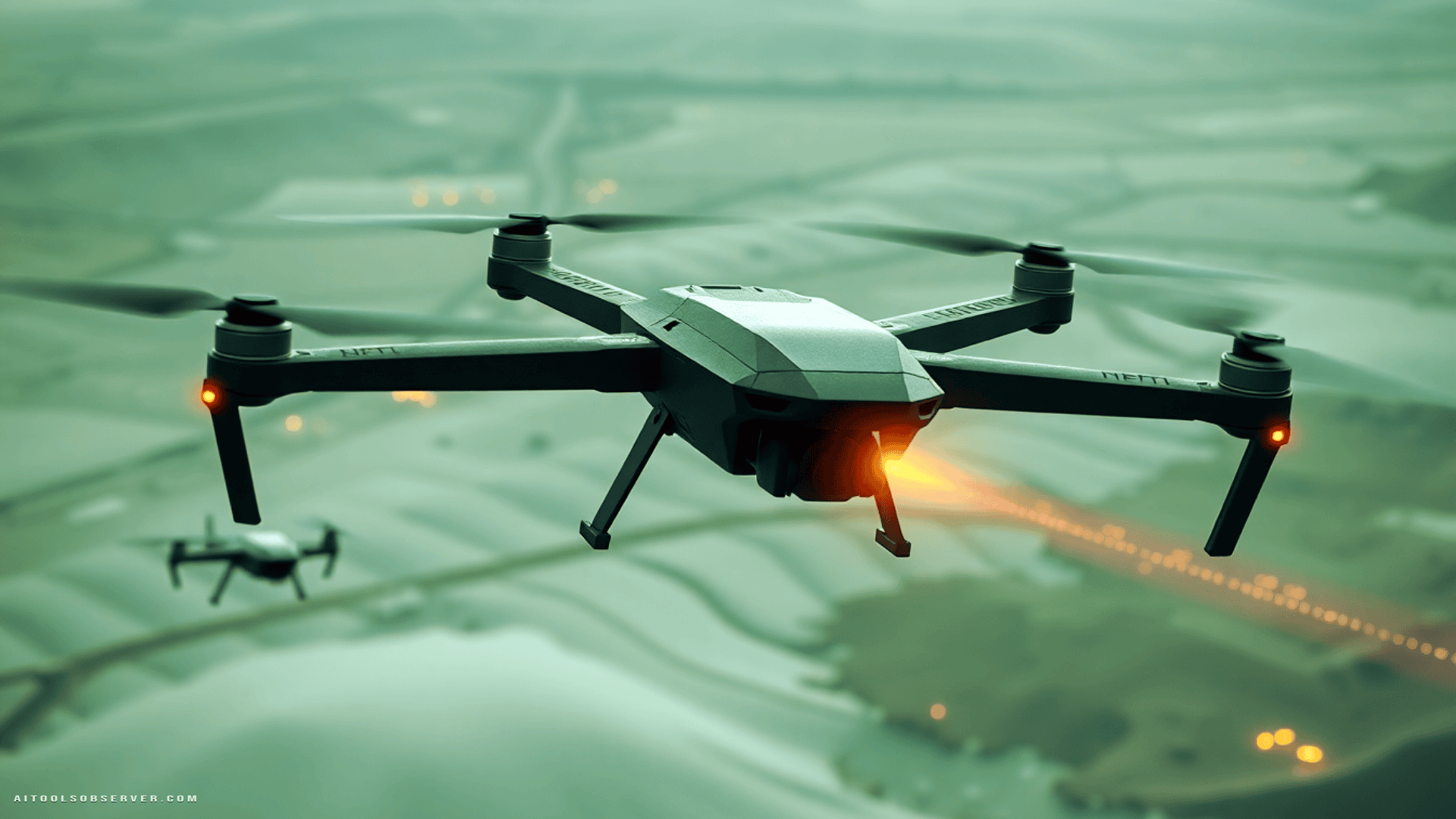
From Kamikaze Quadcopter to Smart Munition

First-person-view drones entered the conflict as relatively crude weapons: a pilot, a video feed, an RPG warhead, and a collision. Effective, but limited. The operator needed line-of-sight control, a stable signal, and enough skill to guide a fast-moving airframe into a target under pressure.
That baseline is now being systematically replaced. Add-on autonomy modules — most notably the TFL-1 from The Fourth Law — convert a standard FPV into a terminal-guidance munition. The drone locks onto a target and completes the engagement independently, even when jamming severs the operator’s control link.
The performance delta is significant. Manufacturers report hit rates climbing from roughly 40% under manual control to approximately 80% with AI guidance enabled. A TFL-1-equipped FPV costs around $442. Some experimental configurations run on hardware as inexpensive as a Raspberry Pi Zero. At those price points, scale is not a constraint — Ukraine has announced a production target of seven million FPVs for 2026.
The EFP Warhead: Why It Changes the Calculus

Standard FPV warheads — repurposed RPG shaped charges or fragmentation rounds — detonate on contact. That design logic has driven a predictable countermeasure arms race: wire cages, netting, slat armor, and the now-iconic “turtle tank” configurations that encase vehicles in improvised protection.
An Explosively Formed Projectile warhead breaks that logic entirely.
Unlike a conventional shaped charge, which must detonate within roughly one meter of a target to be effective, an EFP converts a heavy metal liner into an aerodynamic slug capable of traveling tens to hundreds of meters after detonation. The drone does not need to make contact. It detonates at standoff distance — in the reported cases, approximately 20 meters — and the slug covers the remaining distance at high velocity.
The tactical implication is direct: cages, netting, and turtle configurations offer no meaningful protection against a standoff EFP strike. The slug penetrates an inch of steel with ease. For vehicle crews and infantry alike, the physical barrier that previously offered a survival margin is rendered irrelevant.
The tradeoff is precision. An EFP must be detonated at the correct distance and aimed with far greater accuracy than an impact-fuzed warhead. That requirement — previously a significant operator skill burden — is precisely what AI terminal guidance is designed to solve.
Thermal Imaging and Facial Targeting: The Contested Frontier

Russian military bloggers and Telegram channels have reported a further capability layer: thermal imaging combined with AI-driven facial detection, allegedly enabling drones to identify and target individual soldiers by face and heat signature. Video evidence circulating in May 2026 appears to show a Russian soldier struck with what analysts describe as a precise head-level impact from a drone detonating at standoff distance.
The claim cannot be independently verified. Several important caveats apply.
Standard firearms doctrine emphasizes center-of-mass targeting, not head shots, because the probability of a hit is substantially higher. A single video showing an apparent head-level strike may reflect chance geometry rather than deliberate facial targeting. The distinction between operator-guided precision and autonomous facial recognition is impossible to confirm from available footage alone.
What is not in dispute is the underlying technical plausibility. Facial detection software is mature, computationally inexpensive, and already integrated into consumer camera systems globally. Combining it with a thermal sensor — to isolate human heat signatures in low-visibility conditions — and a terminal guidance module is an incremental engineering step, not a fundamental breakthrough. The components exist. The integration pathway is straightforward.
Whether Ukraine has completed that integration at scale remains an open question. That Russian forces are treating the threat as real is itself a data point worth noting.
The Production and Doctrine Context
Ukraine’s Unmanned Systems Forces commander Robert “Magyar” Brovdi has stated publicly and repeatedly that a central strategic objective is attriting Russian manpower faster than Moscow can replace it — a threshold he places at over 30,000 casualties per month. Recent drone kill statistics, by Ukrainian accounts, suggest that threshold is being approached or exceeded.
The arithmetic of AI-guided FPVs supports that ambition in a way that manual-control drones cannot. Higher hit rates mean fewer drones expended per kill. Lower unit costs mean higher sortie volumes. Standoff EFP capability means fewer drones lost to last-ditch countermeasures — the helmets, rifles, and improvised projectiles that Russian soldiers have used to intercept incoming FPVs in close-range engagements.
The combination of thermal targeting, AI terminal guidance, and EFP warheads does not represent a single weapon system. It represents a convergence of three independently mature technologies into a configuration that is qualitatively more lethal than the sum of its parts.
What the Slaughterbots Moment Reveals About AI Adoption Curves

In 2017, computer science professor Stuart Russell produced a short film called Slaughterbots as an explicit warning: autonomous micro-drones with facial recognition and head-seeking warheads, initially developed for counterterrorism, proliferating into a low-cost weapon of mass destruction. The film was intended to shock policymakers into action.
Nine years later, the technical architecture it depicted is operational — not in the hands of terrorists, and not fully autonomous, but present on a conventional battlefield at industrial scale.
This compression of the science-fiction-to-deployment timeline is the most important signal for anyone tracking the AI tools ecosystem. The components that enable lethal autonomous behavior — computer vision, edge inference hardware, terminal guidance algorithms, low-cost sensors — are the same components that power commercial AI applications. The cost curves are identical. The accessibility is identical.
The Ukrainian FPV program did not require classified research or defense-industry exclusivity. It required commodity hardware, open-source computer vision libraries, and engineering integration. The TFL-1 module costs $442. The Raspberry Pi Zero costs $100. The barrier to entry for AI-guided precision lethality has dropped to the price of a mid-range smartphone.
The Countermeasure Problem Has No Easy Answer
Russian forces are already exploring responses. Masks to defeat facial recognition. Remaining motionless against cover to break tracking. Curling into a ball to conceal the head profile. None of these are reliable, and all of them degrade combat effectiveness in ways that compound the tactical disadvantage.
Reinforced helmets and body armor are not viable solutions against EFP slugs. Electronic jamming — previously the primary countermeasure against FPVs — is neutralized by AI terminal guidance that completes the engagement autonomously after the control link is severed.
The asymmetry is structurally unfavorable for the defending force. Countermeasures that worked against earlier-generation FPVs require re-engineering against this configuration, and the attacking force can iterate faster and at lower cost than the defending force can adapt.
The Broader Signal for AI Adoption

For observers of the AI tools ecosystem, the Ukrainian FPV program is not primarily a military story. It is a case study in what happens when AI capability becomes cheap, modular, and composable.
The same dynamic — commodity hardware, accessible models, low integration cost, dramatic performance uplift — is visible across commercial AI adoption. The 80% versus 40% hit-rate differential mirrors the productivity differentials reported when knowledge workers adopt AI-assisted workflows versus manual processes. The TFL-1 module mirrors the AI add-on layer being bolted onto existing software platforms across every industry vertical.
The lesson is consistent regardless of domain: the performance gap between AI-augmented and non-augmented systems is widening faster than most organizations are prepared to act on. The tools are inexpensive. The integration is achievable. The delay is a choice.
Ukraine’s drone engineers made that choice under existential pressure. The rest of us have the luxury of making it deliberately.




Comments (0) No comments yet
Want to join this discussion? Login or Register.
No comments yet. Be the first to share your thoughts!