


What Build Actually Is
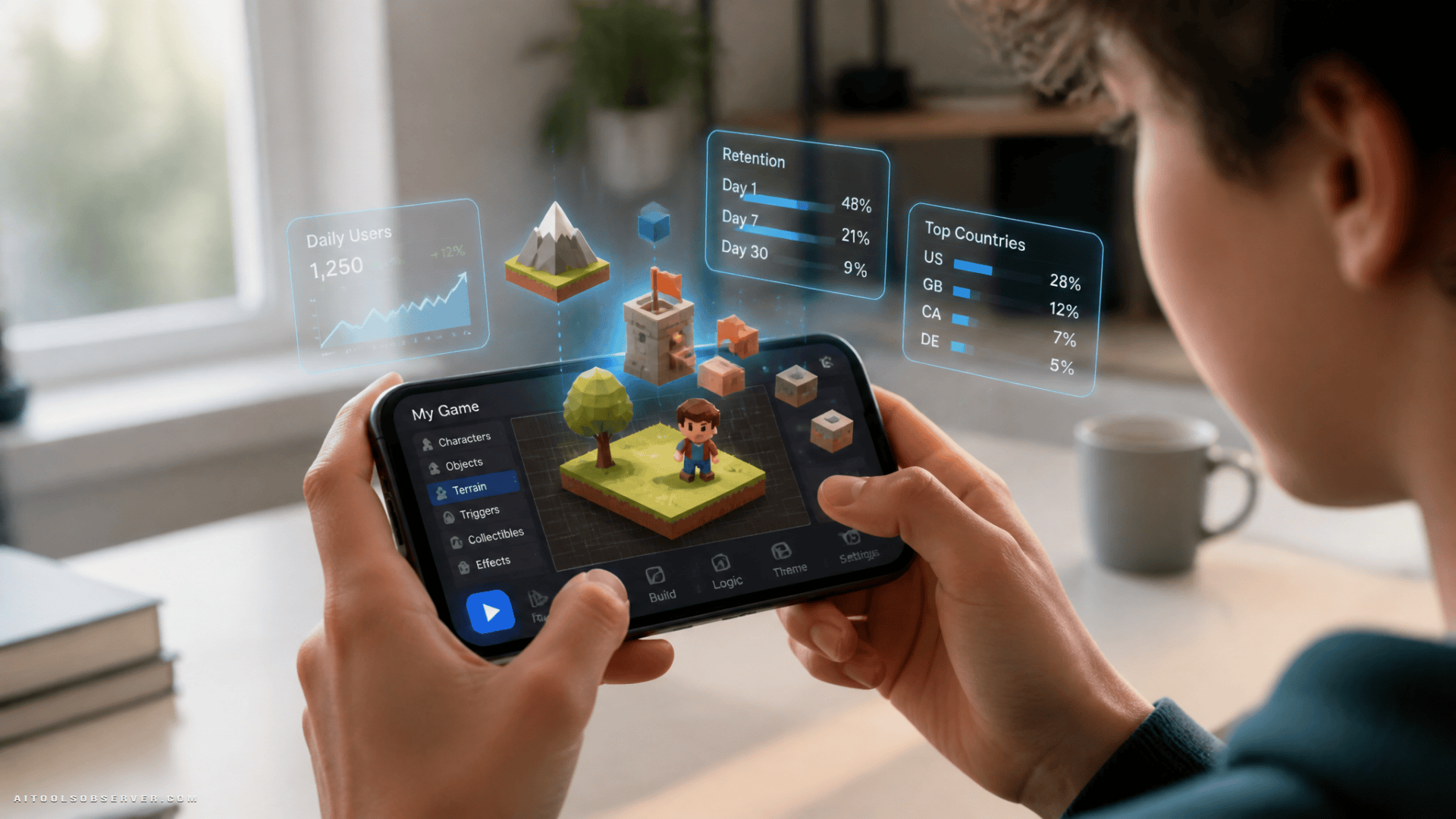
Build is a set of AI tools integrated directly into Roblox Studio via a new mobile-first tab in the Roblox app. It allows users to generate game environments, characters, visual styles, gameplay mechanics, and sound using natural language prompts — no prior development knowledge required.
The toolset is powered by a combination of third-party AI models and Roblox’s own proprietary models, which are trained on a large corpus of 3D assets and gaming data. That training focus matters: the goal is not just to generate visuals, but to produce fully functioning 3D models and scenes that behave correctly inside a game context.
Beyond generation, Build includes:
- Playtesting — iterate on creations before publishing
- Bug testing via AI agents — automated identification of issues
- Analytics explanation — AI that interprets game performance data in plain language
- Engagement and monetization experimentation — tools to help creators optimize their games
Rollout and Access
A test phase begins July 28, 2026, with a phased regional rollout. Publishing capabilities will initially be limited to select users, with New Zealand named as part of the first wave. Roblox expects broader creator and regional access in the months following.
Build will be available to age-verified users 9 and older. Published games that pass safety checks will be accessible to users 16 and older. Games targeting the Roblox Kids or Select catalogs go through an extended review process.
On pricing, Roblox plans to offer a free base tier with paid options for power users at a later stage. No specific pricing has been announced yet.
The Strategic Logic
Roblox has long operated as a platform rather than a traditional game publisher — its most popular titles are user-generated. By lowering the technical barrier to creation, the company is expanding its potential creator base beyond those who already know how to use Roblox Studio in its current form.
This is a deliberate platform growth move. More creators means more content, which means more reasons for the existing 132 million daily users to stay engaged. The AI tooling is the mechanism; the goal is supply-side expansion of the content catalog.
The Quality Problem — and How Roblox Is Addressing It
Lowering the barrier to creation also lowers the barrier to low-quality output. Roblox is clearly aware of this tension. The company has stated that its discovery systems are designed to filter out low-quality output: games that don’t attract players simply won’t surface on the homepage.
That’s a meaningful design choice. Rather than relying solely on pre-publication review, Roblox is using engagement signals as a quality filter. Whether that proves sufficient at scale remains to be seen, but it reflects a more platform-native approach than manual curation alone.
Who This Is For
Build is positioned for a specific type of user: someone with a game concept but without the technical skills to execute it in traditional Roblox Studio. It’s not a replacement for experienced Roblox developers — it’s an on-ramp for the much larger group of users who have never created anything on the platform.
For that audience, the mobile-first approach is the right call. If the creation workflow requires a desktop, the barrier remains high for a user base that is predominantly mobile.
The practical takeaway: if you’re watching the intersection of generative AI and user-generated content platforms, Build is a concrete example of how that combination gets deployed at scale — with real constraints around safety, quality control, and phased access built in from the start.





Comments (0) No comments yet
Want to join this discussion? Login or Register.
No comments yet. Be the first to share your thoughts!