



What Actually Happened
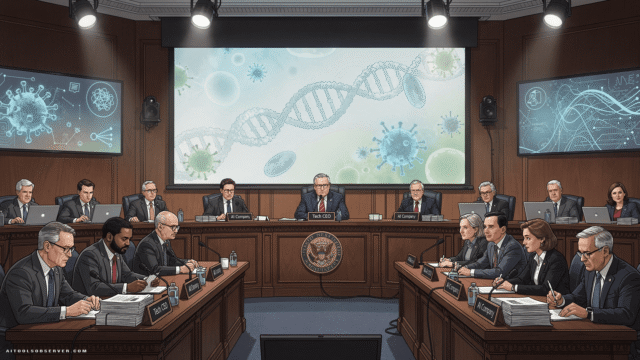
A genome language model called Evo 2 was used to design viral genetic sequences. Think of it like a large language model, but instead of learning patterns in text, it learned patterns in DNA—trained on trillions of genetic building blocks from across the tree of life.
The result: AI-generated blueprints that, when physically synthesized, produced functional viruses.
Evo 2’s developers did take precautions. They deliberately excluded viruses that infect humans, animals, and plants from the training data. Testing confirmed the model performed poorly on human-infecting viral proteins. That’s a meaningful safeguard—but it’s also one that future, more capable models may not inherit automatically.
The Safeguard Stack (And Where It’s Thin)
Biosecurity here isn’t a single gate. It’s a layered system, and each layer has gaps worth understanding.
1. The Model Itself
Training data exclusions are a reasonable first line of defense. But as biological AI tools become more capable and more widely distributed, “the model wasn’t trained on dangerous sequences” becomes a weaker guarantee. Safeguards built into models need to be tested, updated, and treated as living systems—not set-and-forget configurations.
Evo 2 was released openly, including the underlying code. Open science accelerates discovery and democratizes access. It also makes post-release control nearly impossible.
2. DNA Synthesis Screening
When a digital sequence becomes physical DNA, there’s a checkpoint. Synthesis companies can screen both the requested sequence and the requester for security concerns.
The problem: current screening is largely built to recognize sequences that resemble known dangerous pathogens. If AI generates something genuinely novel—functional but unfamiliar—pattern-matching against existing threat libraries may not catch it. Researchers are already arguing that screening needs to evaluate what a sequence does, not just what it looks like.
International coordination on screening standards is still uneven. That’s a gap.
3. Lab and Institutional Oversight
Before risky experiments begin, institutional review processes can assess containment, access controls, and whether the expected benefit justifies the risk. Research funders can add another layer—the UK’s UKRI, for example, has built infrastructure specifically to help researchers identify security risks in collaborative work.
This layer works reasonably well in well-resourced research environments. It works less well everywhere else.
4. Outbreak Detection and Public Health Preparedness
If biological design becomes faster and more accessible, the ability to detect unusual outbreaks quickly becomes more valuable. Programs like the UK’s mSCAPE use metagenomic surveillance—analyzing genetic material from samples without needing to know in advance what pathogen you’re looking for.
That approach is well-suited to a world where novel organisms might appear. It’s not specifically designed for AI-created threats, but the underlying logic applies: detect the unexpected, not just the familiar.
The Uncomfortable Trade-Off
Heavy restrictions slow useful research. Bacteriophages, for instance, are a serious candidate for treating antibiotic-resistant bacterial infections—a problem that kills hundreds of thousands of people annually. Locking down the tools that could help solve that problem has real costs.
Weak safeguards let capability outrun governance. That’s also a real cost, just one that’s harder to see until something goes wrong.
There’s no clean resolution here. The honest answer is that biosecurity needs to operate at every layer simultaneously—model design, DNA synthesis, lab oversight, and public health surveillance—while remaining flexible enough to update as the technology evolves.
The Global Preparedness Gap
One of the clearest vulnerabilities isn’t technical. It’s geographic. Some countries have mature systems for detecting and responding to biological risks. Many don’t. Biological threats don’t respect borders, which means a strong biosecurity posture in one country is only as useful as the weakest link in the international chain.
The same gap exists in vaccine regulation and diagnostic capacity. Building those capabilities internationally isn’t just an equity issue—it’s a practical security requirement.
What This Means Right Now
The bacteriophage study doesn’t demonstrate that AI can design a pandemic pathogen. What it demonstrates is that AI can design complete, functional viral genomes. That’s the capability that matters, and it’s already here.
The window to build responsible governance frameworks while the technology is still relatively limited is open—but it won’t stay open indefinitely. Waiting for more dangerous capabilities to emerge before designing safeguards is exactly the wrong sequence.
For anyone tracking the AI tools ecosystem: biological AI is no longer a future category. It’s an active one, and the governance infrastructure around it is the most important thing to watch.











Comments (0) No comments yet
Want to join this discussion? Login or Register.
No comments yet. Be the first to share your thoughts!