


What changed
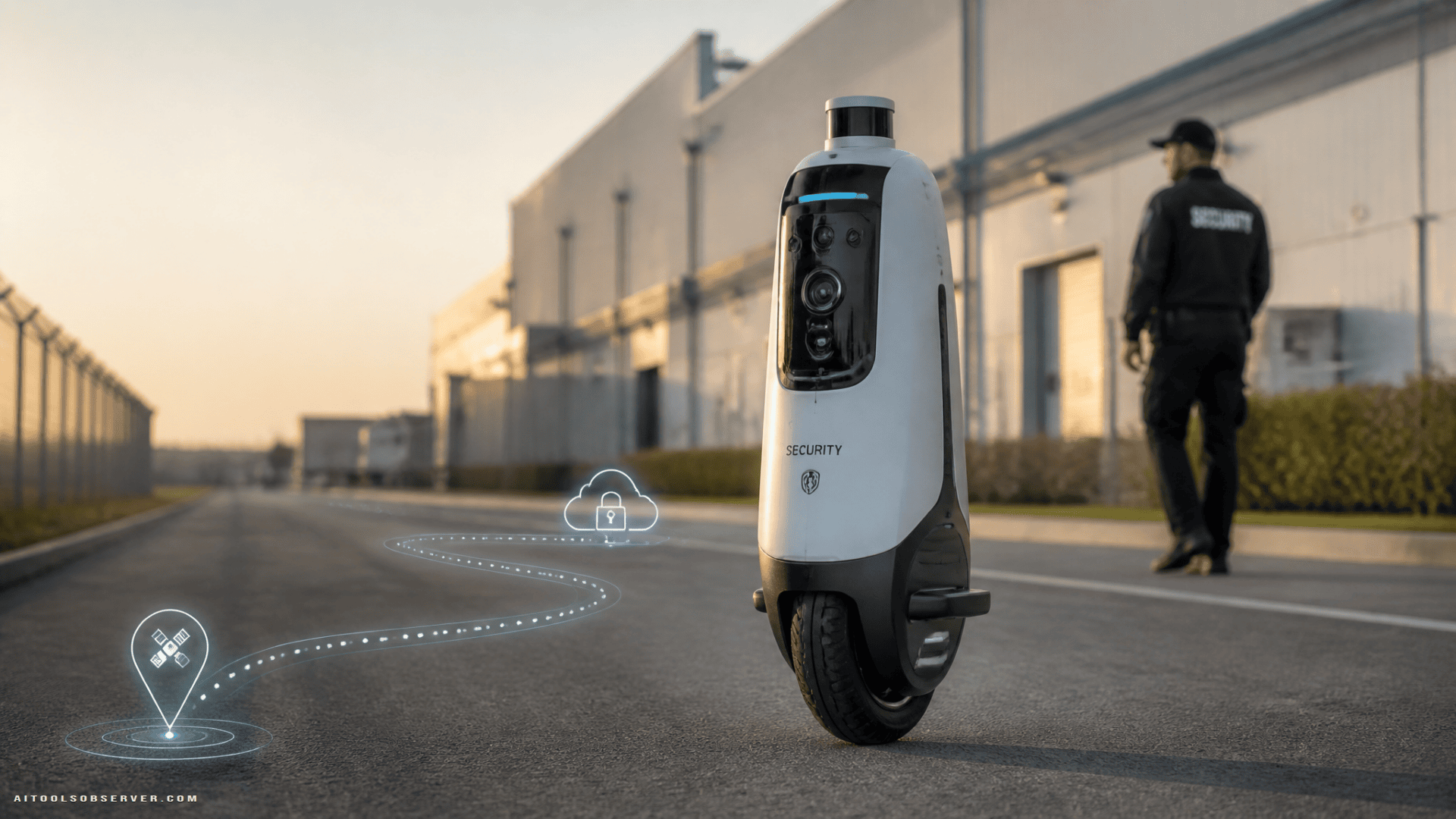
1 Rollo is positioned as a one-wheeled AI security robot for autonomous property patrols. It uses 360-degree vision, RTK GNSS positioning, wireless connectivity, and a cloud management layer so human operators can monitor patrols and respond when something looks off.
The company appears to be targeting places like:
- Warehouses
- Campuses
- Industrial sites
- Large private properties
It is still a prototype, which matters. The concept is real enough to watch, but not yet a finished proof that the patrol model works in messy, crowded, weather-filled reality.
Why the design matters
The single-wheel setup is not just for drama. A narrow robot can move through tighter paths than a bulky patrol cart or vehicle, which could make it useful in corridors, access roads, and perimeter routes where width is a constraint.
There is also a practical tradeoff hiding in that sleek profile. Narrow is good. Balance is hard.
Rollo Robotics says the robot stays upright using an internal spinning flywheel system. Clever? Yes. Also a reminder that elegant hardware on a product page still has to survive slopes, potholes, ramps, and the occasional very determined curb.
The useful tech here is not the wheel
The most meaningful parts of 1 Rollo are the sensing and control systems around the wheel.
360 vision
A 360-degree vision system gives the robot continuous environmental awareness while it moves. For patrol work, that matters because a rolling device with tunnel vision is less a guard and more a liability.
This setup also fits anomaly detection better than a fixed camera. A stationary camera watches one zone. A mobile camera system can inspect a route, revisit a checkpoint, and potentially notice changes across a larger area.
RTK GNSS
RTK GNSS is one of the more practical details in the description. Standard GPS can be fuzzy. Patrol robots need something less vague than “somewhere near the fence.”
More precise positioning could help with:
- Staying on mapped patrol routes
- Logging repeatable patrol paths
- Returning to known checkpoints
- Reducing route drift across large outdoor properties
For warehouses, yards, and campus perimeters, that precision is likely more important than the headline-friendly one-wheel design.
Connectivity and remote response
1 Rollo can reportedly send alerts over Wi-Fi or 4G/5G, then let a human operator review the situation. That human-in-the-loop setup is key.
Security teams usually do not need a robot to make the final call. They need a machine to handle repetitive movement, surface possible issues, and let a person decide whether an incident is real, harmless, or worth escalating.
Where it could fit well
The strongest use case is not “replace security staff.” It is “give staff a rolling set of eyes for repetitive patrols.”
That makes 1 Rollo easier to picture in a few environments.
Warehouses and industrial sites
These sites often have long routes, repeated checks, and areas that are empty most of the time until they very much are not. A patrol robot could cover perimeter roads, loading areas, or low-traffic exterior zones while humans stay available for response.
If the robot can consistently handle weather, route accuracy, and obstacle avoidance, this is probably its clearest lane.
Campuses and office parks
Large campuses have a familiar problem: lots of ground, uneven attention. A mobile patrol unit could help monitor parking areas, pathways, and building exteriors without requiring a guard to physically walk every loop.
The appeal here is coverage. The risk is perception. Employees and visitors may see a moving camera very differently from a static one.
Private sites with defined boundaries
Properties with fixed patrol routes and predictable operating conditions are often friendlier to autonomy than chaotic public spaces. The clearer the map, the better the robot’s chances of looking useful instead of confused.
The specs sound solid, but the field test is the truth
Based on the available description, 1 Rollo is listed at about 100 pounds, up to 19 mph, with up to eight hours of battery life and autonomous wireless charging.
On paper, that suggests a patrol system designed for long-ish shifts and faster-than-foot-patrol movement. That speed can be a feature for covering ground, but it also raises a simple product question: how does it behave around people?
A robot moving quickly through active property routes needs to be boringly safe. Not excitingly capable. There is a difference.
The same applies to terrain. The concept may work well on paved, mapped routes. It may be less happy on steep slopes, broken surfaces, or environments that treat wheels as suggestions.
Cloud management is the real business model story
The robot itself gets attention. The fleet layer is where the operational value likely lives.
A cloud platform for route planning, live monitoring, alert review, and multi-robot oversight is what turns a robot from a demo into a service. Security buyers are not just evaluating a machine. They are evaluating workflow.
If operators can:
- Assign routes
- Review alerts
- Watch live feeds
- Speak through the robot
- Manage multiple units from one place
then the robot becomes part of an actual security process, not a novelty object with a camera.
That is also why the Robotics-as-a-Service angle matters. Subscriptions can lower upfront cost and bundle updates, support, and hardware access. Convenient, yes. Also a reminder that buyers should inspect the total operating cost, not just the lack of a big initial invoice. Teams trying to operationalize AI in physical security will recognize that workflow often matters as much as hardware.
Privacy is not a side note here
A moving surveillance device changes the social math of a site. People tend to ignore fixed cameras after a while. A roaming robot is harder to forget.
That raises a few immediate questions for any potential buyer:
- What is recorded, and when?
- Who can access the live feed?
- Where is footage stored?
- How long is it retained?
- How are employees and visitors informed?
If a company deploys a robot like this without clear policy, the privacy issue will arrive before the ROI story does.
Thermal cameras, night vision, microphones, speakers, and remote operators may improve coverage, but they also widen the scope of what is being sensed and who is doing the sensing. That deserves plain-language rules, not a hidden PDF.
Cybersecurity is part of physical security now
Connected patrol robots do not just watch gates. They are also networked endpoints with cameras, sensors, software, and remote access features.
So the buyer checklist should include the unglamorous questions:
- How are video feeds encrypted?
- How are operator accounts secured?
- What happens if connectivity drops?
- Can the robot continue avoiding people and obstacles offline?
- How are software and firmware updates delivered?
- What protections exist against unauthorized control?
A patrol robot that is weak on cybersecurity is a strange kind of guard. It may secure the property while quietly enlarging the attack surface.
The bigger pattern: autonomy is becoming layered, not fully hands-off
1 Rollo fits a broader shift in AI robotics. The market is not only chasing fully autonomous machines that replace people. Many systems are being designed to do the repetitive, observable part of the job while humans keep judgment and escalation.
That is a much more believable operating model.
For security, that means the robot patrols, observes, flags anomalies, and gives a remote operator context. The person decides what comes next. Less robo-cop, more mobile sensor tower with wheels and opinions.
What to watch before taking it seriously
The concept is strong enough to follow, but buyers should wait for proof in a few practical areas:
Operational reliability
Can it complete patrols across long shifts without frequent rescue, recalibration, or manual intervention?
Terrain limits
How well does the one-wheel format handle uneven surfaces, ramps, weather, and route changes?
Detection quality
Does the AI produce useful alerts, or just a steady stream of digital false alarms?
Fleet workflow
Is the cloud management layer actually efficient for security teams, or does it add another dashboard nobody wants?
Privacy and cyber controls
Are data handling, access control, retention, and update policies clear and usable?
What this means for AI tool buyers
For founders, operators, and tech teams watching AI tools, 1 Rollo is a good reminder that the interesting part of an AI product is often not the flashy hardware. It is the stack around it: sensing, routing, remote oversight, alerts, policies, and integration into a real workflow.
If you are evaluating autonomous security tools, compare them like systems, not gadgets.
Look at:
- Patrol coverage
- Human oversight model
- Connectivity resilience
- Deployment constraints
- Privacy posture
- Security update process
- Total service cost
The wheel gets the headline. The operating model gets the contract.
Takeaway
1 Rollo appears to be a smart test case for autonomous property patrols: narrow design, precise positioning, remote oversight, and a service-based deployment model. The appeal is obvious for large sites that want more consistent coverage without putting people everywhere at once.
But the buyer decision should come down to something less cinematic: can it patrol reliably, alert usefully, and fit within clear privacy and cybersecurity rules? If the answer is yes, this category gets more practical fast. If not, it is just surveillance that learned to roll.


Comments (0) No comments yet
Want to join this discussion? Login or Register.
No comments yet. Be the first to share your thoughts!