


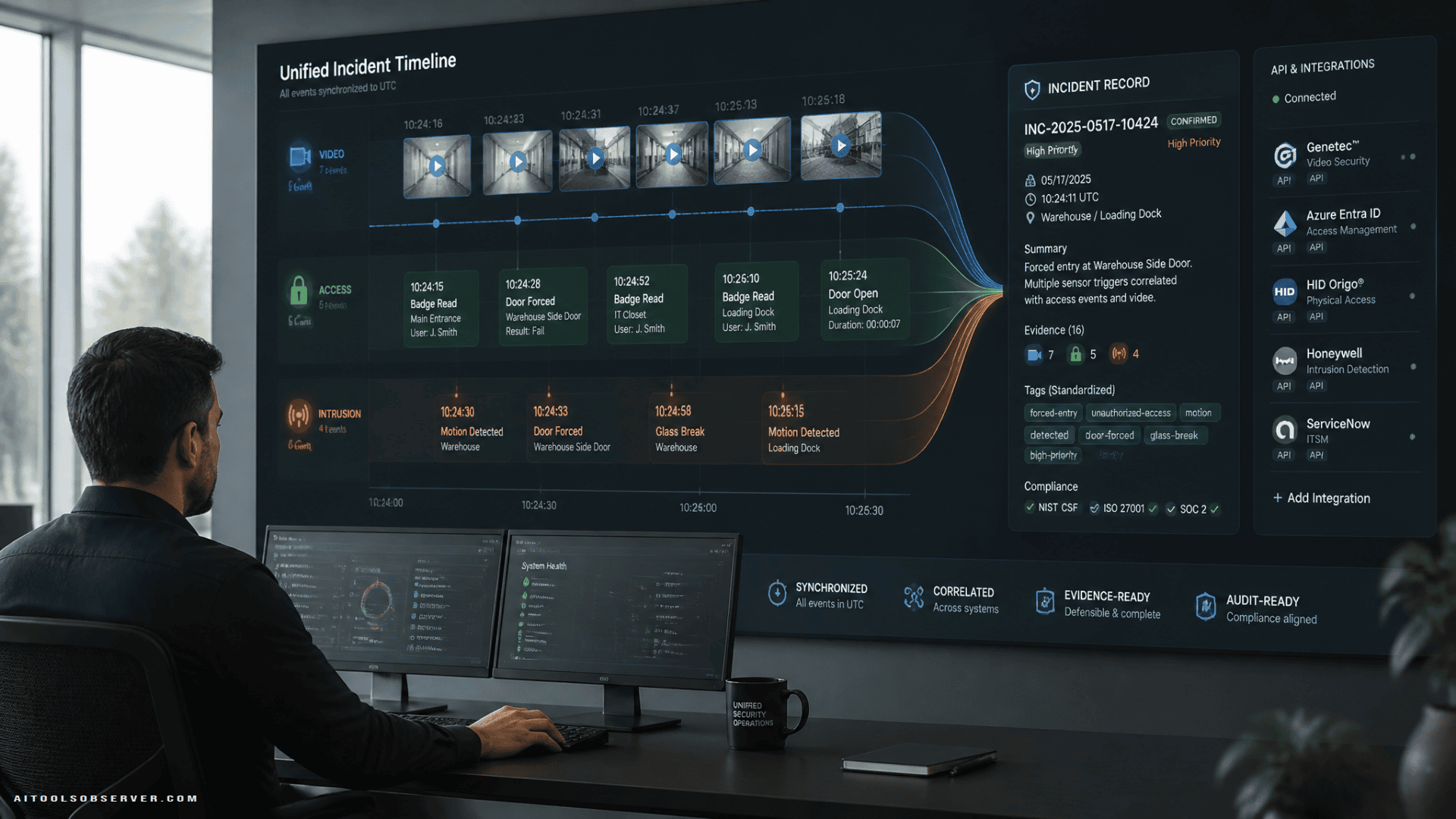
The “Missing Middle” Problem
The core issue is structural. Physical security technology has historically been shipped as siloed, single-purpose tools. A significant share of enterprise organizations still run completely separate systems for video surveillance and access control, with no unified data layer underneath.
This fragmentation creates what might be called the “missing middle” — the gap between systems that can describe isolated events and systems that can explain incidents in context. An organization stuck in this gap can detect a threat but cannot validate it, contextualize it, or package the evidence in a defensible way.
That is not just an operational inconvenience. In regulated industries, fragmented incident data is a compliance liability.
Step 1: Assess Where You Actually Stand
Before deploying anything new, security leaders need an honest assessment of their current operational maturity. A useful model maps security operations across five levels: Detect, Describe, Explain, Recommend, and Act.
Most enterprise security organizations currently operate at the Detect or Describe levels. That is a legitimate foundation — but it is not a destination. The critical question is whether there is a deliberate plan to advance beyond it.
This mirrors a broader pattern in enterprise AI adoption: a large share of organizations use AI only at a surface level, without changing the underlying processes that would make it effective. Physical security is no exception.
Step 2: Connect Systems to Build Defensible Incident Records
Moving from reactive alerting to proactive operations requires more than faster detection. It requires systems that can cross-reference data from video, access control, and intrusion sources simultaneously — not sequentially, and not manually.
When an incident occurs in a connected environment, the system does three things at once: validates the threat, clarifies the cause, and packages the evidence. That combination is what makes an incident record legally and operationally defensible.
This matters because compliance and governance requirements are increasingly driving technology replacement decisions. Organizations that cannot produce structured, corroborated incident records face real regulatory exposure — not just operational friction.
Step 3: Fix the Data Layer Before Adding AI Features
This is the step most organizations skip, and it is the one that determines whether everything else works.
Advanced AI capabilities — automated response, predictive analytics, cross-sensor reasoning — all depend on a clean, consistent data foundation. If video, access control, and intrusion data are formatted differently and stored in separate databases, no AI layer can reliably reason across them.
The practical requirements are specific:
- Documented, standards-based APIs for every system in scope
- Normalized event taxonomies so that an “access denied” event means the same thing across all platforms
- Structured data schemas that automated tools can parse without custom translation logic
The test for any system is not whether it uses open or proprietary architecture. The test is whether it can participate in a shared data environment. Systems that cannot meet this standard become bottlenecks regardless of their individual capabilities.
Getting this right is what enables the shift from manual, shift-based monitoring to automated operations management — where security personnel move from real-time execution to strategic oversight.
Step 4: Build a Phased AI Roadmap Tied to Data Readiness
Not all AI use cases are equally ready to deploy. Security leaders should evaluate each use case against two criteria: business impact and data readiness. High-impact use cases built on poor data will underperform. Lower-impact use cases with clean data can still deliver measurable value quickly.
A practical phased approach looks like this:
Phase 1 — Data infrastructure: Prioritize API documentation, event normalization, and schema standardization. Resist deploying advanced AI features until the backend can reliably detect and describe incidents within individual systems. This phase is unglamorous and essential.
Phase 2 — System integration: Connect siloed systems to enable cross-functional, multi-sensor reasoning. At this stage, tools can cross-reference data in real time and explain complex incidents — not just report them.
Phase 3 — Automated operations: Once the data layer is solid and systems are connected, advanced AI can move from explaining past events to forecasting future ones, recommending interventions, and executing automated incident-response runbooks at scale.
Each phase builds on the previous one. Skipping Phase 1 to reach Phase 3 faster is the most reliable way to produce an expensive system that does not work as expected.
What This Framework Actually Delivers
Organizations that complete this progression gain more than faster threat detection. They gain incident records that hold up under legal and regulatory scrutiny. They gain security operations that scale without proportional headcount growth. And they gain a security function that can demonstrate measurable contribution to enterprise resilience — not just cost.
The AI capabilities needed to do this already exist. The work is integration, not acquisition. Security leaders who understand that distinction are the ones positioned to close the operational gap rather than widen it.


Comments (0) No comments yet
Want to join this discussion? Login or Register.
No comments yet. Be the first to share your thoughts!