


What Asoma Actually Does
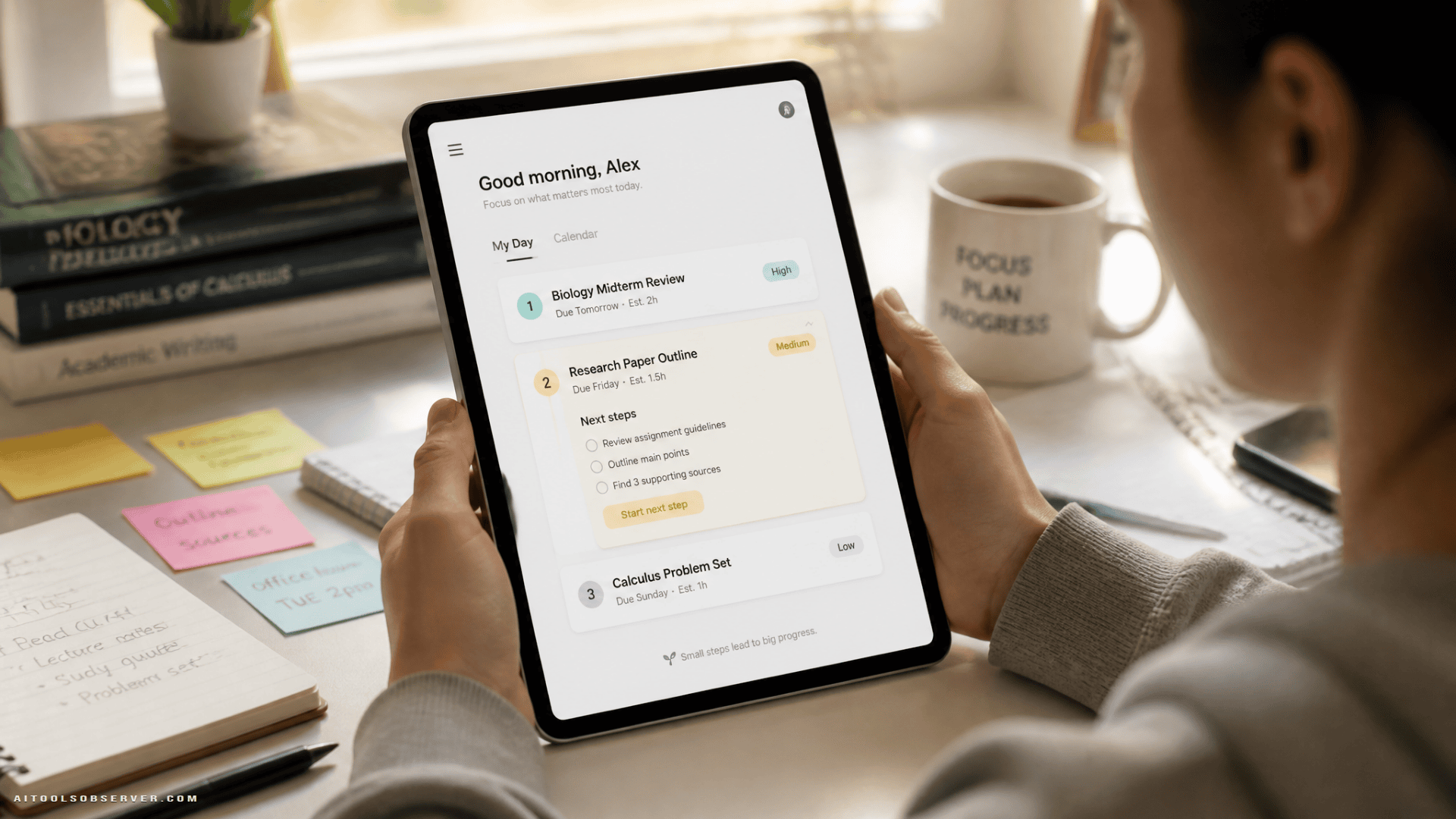
At its core, Asoma automatically gathers a student’s assignments and narrows them down to three priority tasks. That single design choice matters more than it sounds.
For students with ADHD, an open-ended to-do list isn’t motivating — it’s paralyzing. Seeing 15 tasks at once triggers avoidance, not action. By surfacing only three priorities, Asoma reduces the cognitive load that typically stops students before they start.
From there, the app uses AI to break larger assignments into smaller, sequential steps. Instead of “write a 10-page research paper,” a student sees the next concrete action they can actually take right now.
Why ADHD-Specific Design Matters
There’s a meaningful difference between a productivity app that can be used by someone with ADHD and one that’s built for how the ADHD brain works.
Asoma appears to have made deliberate choices on that front. According to the available context, the app avoids features like overdue counters — a common element in productivity tools that tends to increase shame and guilt rather than motivation. For students already struggling with emotional regulation, that kind of friction can derail a study session entirely.
The three core challenges Asoma targets are worth understanding:
- Task initiation paralysis — the difficulty of starting a task even when you know it needs to be done
- Time blindness — a poor internal sense of how long tasks take or how much time has passed
- Emotional regulation — the tendency for frustration, anxiety, or shame to interrupt focus
Most general productivity tools don’t account for any of these. Asoma appears to be designed around all three.
Who’s Testing It Right Now
Asoma is currently in beta testing at Georgia Tech, UCLA, and Emory University. That’s a meaningful signal — university pilots tend to involve real feedback loops with students and academic support teams, not just passive usage data.
It’s early stage, which means the feature set and user experience are likely still evolving. But the institutional validation suggests the concept is being taken seriously in academic environments where ADHD support is a real operational concern.
Pricing: Free and Paid Options
Asoma offers both a free tier and a premium plan priced at approximately $25 per month. That positions it in a similar range to other AI-powered productivity and learning tools, though whether the free tier offers enough functionality to be genuinely useful is something prospective users would need to evaluate directly.
For students managing ADHD without institutional support, $25 a month is a real cost. For those who’ve tried and abandoned multiple productivity systems, it may be worth testing against the free option first.
How Asoma Compares to General Productivity Apps
It’s worth being direct about the tradeoffs here.
General tools like Notion, Todoist, or even Apple Reminders can be configured to support ADHD workflows — but that configuration requires executive function skills that many ADHD students don’t have consistent access to. You’re essentially asking someone to build a system to manage the very thing that makes building systems hard.
Asoma’s value proposition is that the structure is already built in. The AI does the prioritization. The steps are already broken down. The shame-inducing features are already removed.
That’s a different product philosophy, and for the right user, it’s a more honest one.
Practical Takeaway
If you’re a student with ADHD — or supporting one — Asoma is worth watching. It’s not trying to be a universal productivity platform. It’s trying to solve a specific, well-documented problem: getting students with ADHD from “overwhelmed” to “working on the next step.”
The beta rollout at major universities suggests it’s past the concept stage. The ADHD-specific design choices suggest the team understands the problem they’re solving.
Start with the free tier. Test it against your actual workflow. The best study app isn’t the one with the most features — it’s the one you’ll actually open when things feel impossible.






Comments (0) No comments yet
Want to join this discussion? Login or Register.
No comments yet. Be the first to share your thoughts!