



The Problem With Percentage-Based Commissions
On a $1.5 million home, a 3% buyer-agent commission is $45,000. For a buyer who already did most of the legwork, that’s a steep invoice for offer drafting and a few phone calls.
A Q2 2026 ResiClub survey cited by TurboHome found that 77% of US homeowners said they found their most recent home themselves. Only 22% credited their agent. The commission structure, meanwhile, hasn’t moved much.
How the Flat-Fee AI Model Works
TurboHome, which launched in late 2024, charges a flat fee at closing instead of keeping the full buyer-agent commission. When a seller pays a commission above that flat fee, TurboHome rebates the difference to the buyer.
The mechanics are straightforward:
- Seller agrees to pay a 3% buyer-agent commission on a $1.5M home → $45,000
- TurboHome keeps its flat fee (e.g., $12,000)
- Buyer receives the remaining $33,000 as a rebate, applicable to closing costs, mortgage rate buydown, or in some cases cash
On a $1.125M home in Texas, one buyer received a $21,750 rebate. On a $410,000 home in Houston, another received a $6,150 closing credit. On a $625,000 home in California, a buyer estimated she saved roughly $10,000 through a reduced total commission.
The savings scale with the purchase price. The flat fee doesn’t.
What the AI Actually Does
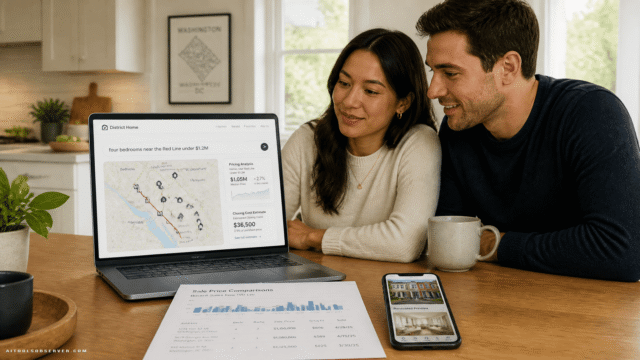
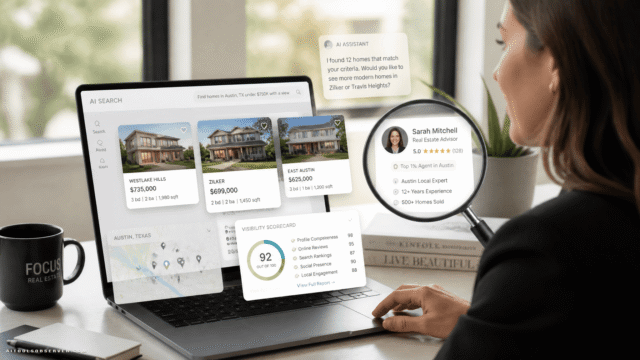
The platform automates the parts of the transaction that don’t require a human in the room: comparable sales analysis, disclosure reviews, property recommendations, and valuation tools. Buyers can search listings using conversational queries, request comps, book tours, and start drafting offers through a single dashboard.
Human agents handle offers, negotiation, contracts, and closing. They’re still licensed brokers. They’re just not spending weekends driving buyers to showings.
TurboHome’s CEO describes the goal as having “the fewest agents possible doing the most deals” while using technology to deliver a full-service experience. Its agents reportedly close between 30 and 50 transactions annually — compared to the 70% of traditional agents who, according to a Consumer Federation of America study cited by the company, sold five or fewer homes in a 12-month period. This shift sits alongside broader changes in AI tools for real estate agents.
Who This Actually Works For
The buyers who’ve used TurboHome share a common profile: they knew what they wanted, had already done their research, and needed expertise on contracts and negotiation — not someone to find the house for them.
One buyer, purchasing remotely in Texas, said the model gave him “the best of both worlds” — a rebate plus a real human to handle the paperwork. Another closed in 15 days. A third, a repeat buyer in California, said the communication was faster and more responsive than her experiences with traditional agents.
The platform appears less suited to first-time buyers who want hand-holding through every step, or anyone who genuinely needs an agent to run the search process.
The Hybrid Isn’t a Compromise — It’s the Point
One traditional broker quoted in coverage of TurboHome made a useful distinction: AI won’t eliminate real estate agents, but it will force them to justify what they charge. Lower-priced, straightforward transactions may migrate toward flat-fee models. Complex, high-stakes deals may still warrant full-service human expertise.
That’s not a threat to the industry so much as a sorting mechanism. The agents who survive will be the ones who can articulate what their judgment is actually worth beyond finding listings on Zillow, especially as more agents use AI tools.
A Note on Privacy
Real estate transactions involve sensitive financial data, and that’s worth flagging. TurboHome states it uses third-party AI models but does not use consumer data to train them, and does not share identifying information like names, emails, or phone numbers with outside entities. As more of the homebuying process moves through AI-native platforms, how that data is stored and protected deserves scrutiny — not panic, but attention.
The Practical Takeaway
If you’re a buyer who already knows what you want, has done the research, and just needs professional help crossing the finish line, the flat-fee AI model is worth a serious look. The savings are real, the tradeoff is clear, and the technology handles the tedious middle layer so humans can focus on the parts that actually require judgment.
If you need someone to spend six weekends showing you houses, the traditional model still exists. It’ll just cost you a percentage.













Comments (0) No comments yet
Want to join this discussion? Login or Register.
No comments yet. Be the first to share your thoughts!