


The Core Philosophy: Real First, AI Second
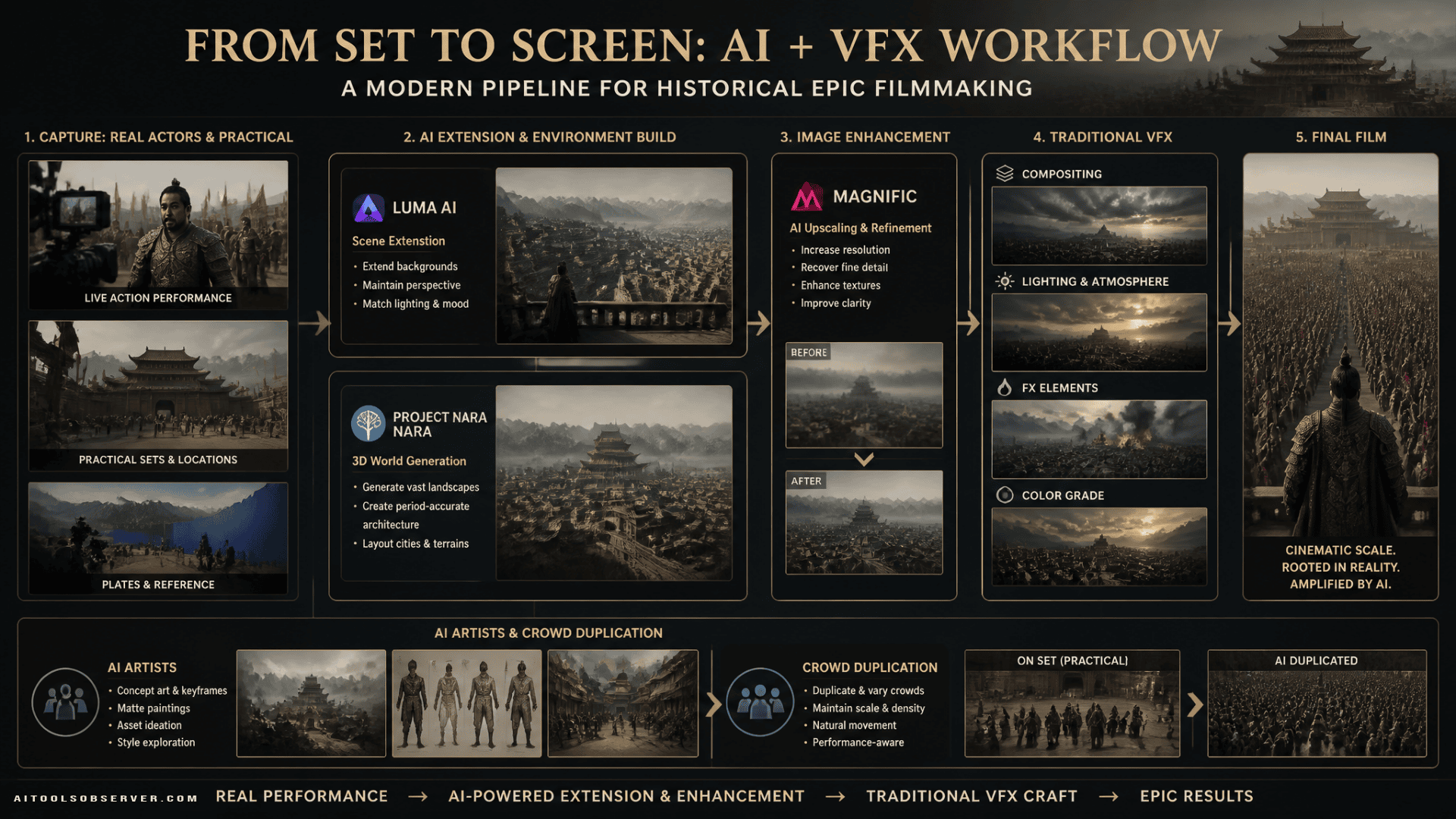
Erwin’s rule is simple enough to tattoo on a slate: do everything you can for real, then use AI to amplify.
That framing matters. It’s not “use AI because it’s cheaper.” It’s “use AI because the alternative is putting actors in freezing water or flying a crew to a different continent.” The distinction shapes every decision downstream.
For the drowning-in-an-icy-river sequence, the crew built a 50-foot pool in Ireland, filmed close-ups with real actors, real props, real water — just not cold water. AI then extended those tight shots into wider, more expansive frames. The actors were present. The danger wasn’t.
That’s a genuinely useful use case: AI as a safety net, not a shortcut.
The Actual Stack
Erwin didn’t build this on one tool. The production used a combination of platforms, including:
- Luma AI — Erwin co-founded AI production company Innovative Dreams with Luma, so this integration runs deep
- Amazon’s Project Nara — Amazon MGM Studios has a working relationship with Erwin through House of David and The Old Stories: Moses
- Magnific — used for image enhancement and upscaling within the pipeline
Five dedicated AI artists worked on the film, alongside an AI producer. That’s a real crew, not a prompt-and-pray workflow.
For crowd duplication in wide shots, Erwin leaned on traditional VFX — a reminder that “AI production” doesn’t mean AI for everything. It means knowing which tool fits which problem.
The Costume Trick That Saved a Scene
One of the more telling examples: a scene featuring British soldiers that Erwin didn’t capture during principal photography.
His solution? Film two Wonder Project employees in street clothes, then use AI to dress them in period-accurate uniforms and place them on horseback. It’s not glamorous. It’s practical. And it worked.
This is the kind of use case that rarely makes headlines but represents the real value of generative AI on set — rescuing shots that would otherwise require expensive reshoots or get cut entirely.
Where AI Ends and VFX Begins
Some viewers flagged shots as AI-generated that were actually traditional visual effects. Erwin’s response was measured: you might not like the shots, but they’re the same techniques the industry has used for thirty years.
This is worth noting for anyone evaluating AI tools in creative workflows. Audience perception of AI is not the same as actual AI usage. The backlash to Young Washington partly targeted conventional VFX. That’s a communication problem as much as a production one.
Erwin’s approach to his cast — Ben Kingsley, Andy Serkis, Mary-Louise Parker — was transparency. Show them the tools. Demonstrate the output. Let them see that AI can give actors more agency over their digital performance, not less.
The Democratization Argument
Erwin draws a direct line from the shift from film to digital cameras to the current AI moment. When film cameras were dominant, he couldn’t get work. Digital leveled the playing field. He adapted early, competed harder, and built a career on it.
His bet is that AI does the same thing for scope and scale — that filmmakers who previously couldn’t afford period epics, wide battle sequences, or location shoots across multiple countries will now be able to tell those stories.
That’s a reasonable argument. It’s also one that depends heavily on how the tools are used, which is exactly what Young Washington was designed to demonstrate.
What This Means If You’re Building a Production Workflow
You don’t need to be making a historical epic to take something useful from this.
The production stack here — real capture first, AI extension second, traditional VFX for crowd work, dedicated AI artists rather than ad hoc prompting — is a replicable model. The key decisions were:
- Define the problem before choosing the tool. Cold water = safety risk = AI-extended wide shots.
- Staff for it properly. Five AI artists and a dedicated AI producer is a real investment.
- Know where AI stops. Crowd duplication went to traditional VFX because it was the better fit.
- Communicate the workflow to stakeholders. Cast buy-in came from transparency, not assumption.
The tools Erwin used — Luma, Magnific, Project Nara — are accessible. The discipline around when to use them is the harder part to copy.











Comments (0) No comments yet
Want to join this discussion? Login or Register.
No comments yet. Be the first to share your thoughts!