


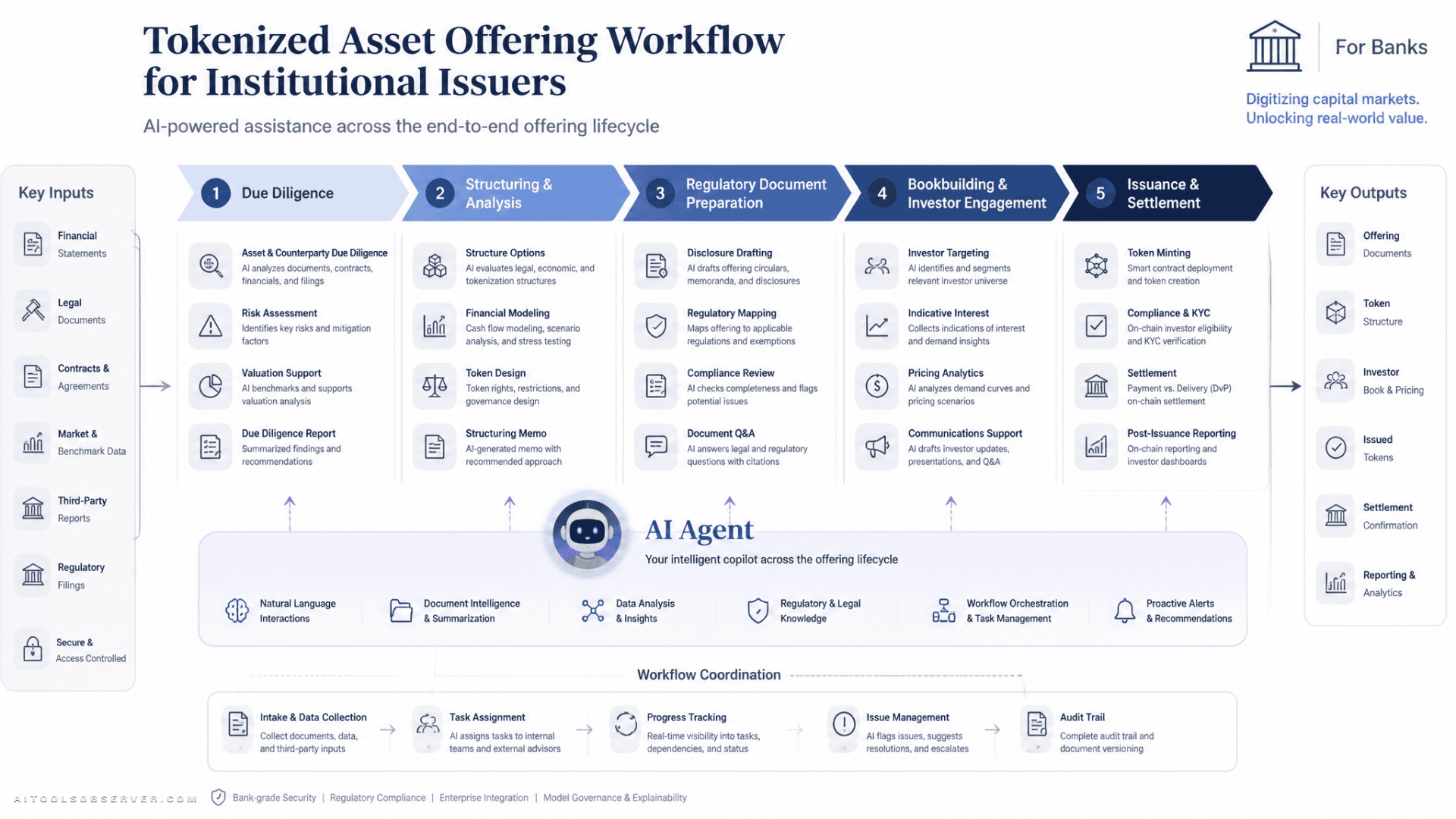
What CapMark AI Agent Does
CapMark addresses a specific and well-defined problem: the manual burden that banks and financial institutions face when structuring, documenting, and launching tokenized securities products. The agent handles due diligence support, structuring analysis, regulatory document preparation, bookbuilding, and workflow coordination — functions that traditionally require significant human effort and time.
The tool is built for a defined set of use cases: fundraising, tokenized securities, tokenized funds, and other blockchain-based financial products. This focus on structured financial workflows distinguishes it from general-purpose AI assistants that lack domain-specific depth.
Integration with Tokenization Cloud
CapMark does not operate in isolation. It is integrated directly into Akemona’s existing Tokenization Cloud infrastructure, connecting with Issuer Hub, Investor Portal, and OnchainTA — the company’s digital transfer agent. This means institutions already working within the Akemona ecosystem can extend their existing setup rather than adopting a standalone product.
That integration matters practically: a tokenized securities offering involves multiple parties, document flows, and compliance checkpoints. Having an AI agent embedded across these touchpoints reduces the coordination overhead that typically slows compliant product launches.
Compliance Architecture
Akemona has made deliberate design choices around data handling. The platform removes chat logs after 30 days, avoids storing personal information on blockchain networks, and retains off-chain records for six years to meet regulatory requirements. These are not incidental features — they reflect the compliance expectations that financial institutions operate under and that any tool serving this sector must accommodate.
This approach suggests the product was designed with institutional procurement requirements in mind, not retrofitted for compliance after the fact.
Who This Is For
CapMark is positioned for financial institutions that are actively building or scaling tokenized asset programs — banks, asset managers, and issuers working with digital securities. It is not a retail or SME tool. The complexity of the workflows it addresses, and the regulatory environment it operates within, place it firmly in the institutional fintech space.
For teams currently managing these processes manually or through fragmented tooling, the case for automation is straightforward: faster time-to-launch, reduced documentation risk, and more consistent compliance output.
The Broader Signal
The launch reflects a broader pattern in fintech: AI being applied not to replace financial judgment, but to systematize the procedural and documentary work that surrounds it. Tokenized asset offerings involve layers of structured process — diligence, structuring, regulatory filing, investor onboarding — that are well-suited to automation precisely because they follow defined rules and sequences.
The practical takeaway for institutions evaluating this space: CapMark is worth examining if tokenized securities issuance is already on the roadmap and the bottleneck is operational rather than strategic. The integration with an existing transfer agent and investor portal infrastructure reduces the implementation friction that often stalls AI adoption in regulated environments.













Comments (0) No comments yet
Want to join this discussion? Login or Register.
No comments yet. Be the first to share your thoughts!