


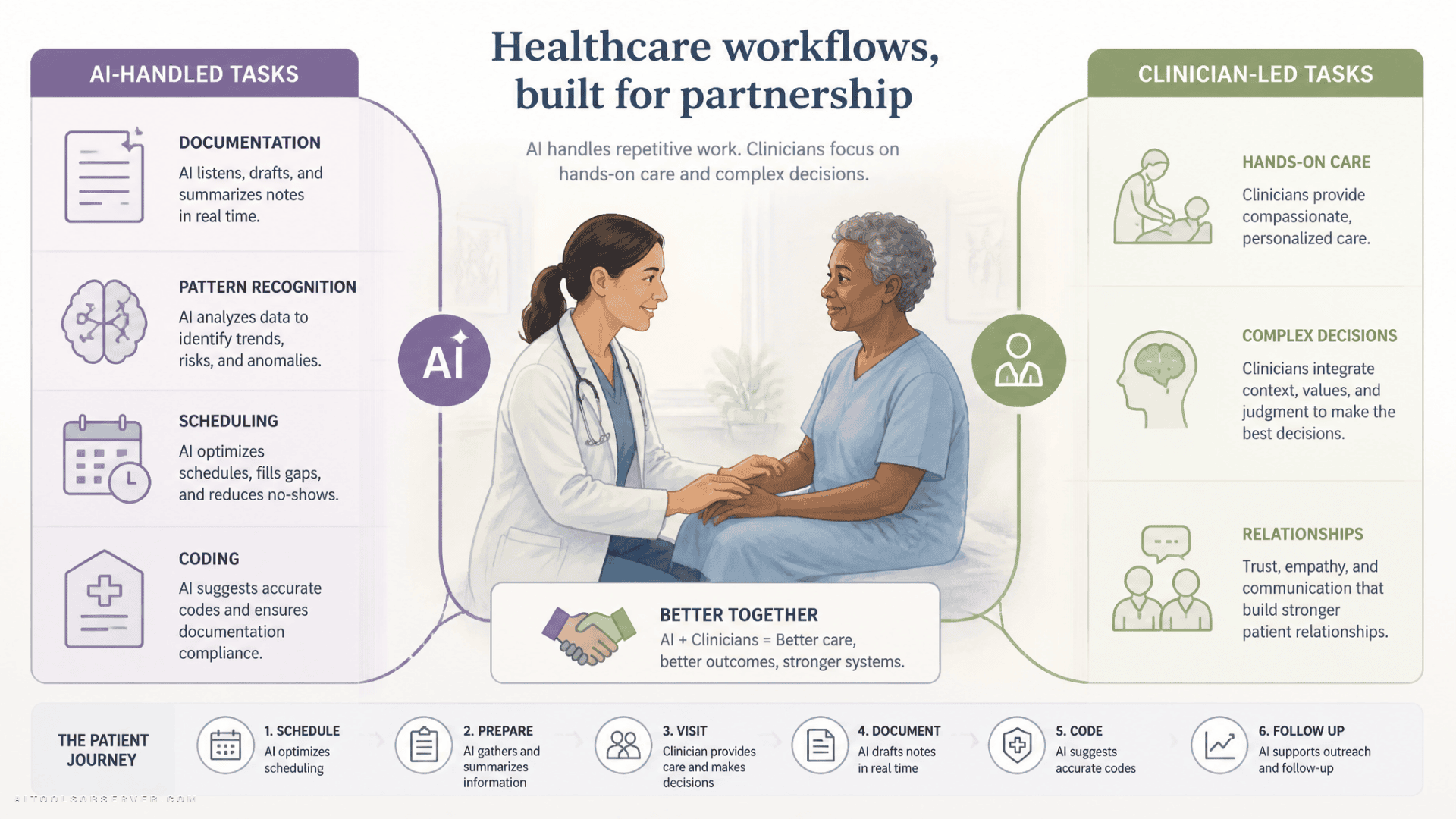
How AI Moves Through Healthcare
AI doesn’t replace healthcare workers the way a factory robot replaces an assembly line worker. It replaces tasks—and when enough tasks in a role get automated, the headcount shrinks.
The tasks AI handles best share a common profile: pattern recognition, data lookup, rule-based decisions, and documentation. Feed it enough labeled data and a clear objective, and AI will outperform humans on speed and consistency every time.
That’s why the disruption isn’t uniform. A radiologist reading a chest X-ray faces a different threat than a surgeon managing a complication mid-operation. A medical coder assigning ICD-10 codes faces a different future than a nurse managing a frightened family at 2 a.m.
Understanding which tasks define your role is the most important career question you can ask right now.
Medical Scribe
AI scribes now listen to a patient encounter in real time and produce a structured clinical note—no human in the loop. Human scribes are already being downsized at health systems that have deployed ambient documentation tools. The remaining work is shifting toward editing and quality-checking AI output rather than creating notes from scratch.
Average salary: around $56,000/year. The role as it exists today is shrinking.
Medical Coder
Coding is essentially pattern-matching between clinical language and standardized code sets like ICD-10 and CPT. AI tools can read a chart and assign codes faster and more consistently than most humans. Autonomous coding is already live for high-volume, lower-complexity billing scenarios.
That said, coders who can handle ambiguous documentation, defend against audits, and fight claim denials still have a role. The volume of straightforward coding work, however, is contracting.
Appointment Scheduler and Front Desk Receptionist
Booking a visit is a structured, rules-based task. Conversational AI and self-service portals now handle scheduling, rescheduling, cancellations, and routine patient questions. Check-in kiosks and pre-visit smartphone workflows capture demographics and insurance information before a patient even walks through the door.
These roles aren’t disappearing overnight, but the headcount required to run a front desk is declining.
Insurance Verification Specialist
Verifying coverage means querying payer systems, reading benefit details, and flagging what’s covered. That’s repetitive lookup work. Automated eligibility checks can run against payer databases in seconds and surface coverage gaps before a service is delivered. This is one of the cleaner automation targets in healthcare administration.
Pharmacy Technician
Automated dispensing systems already count, sort, and bottle medications in high-volume settings. The tasks that remain harder to automate—answering patient questions, managing inventory exceptions, supporting clinical pharmacist work—are the ones that will keep some technicians employed. But the overall demand for technicians doing purely mechanical dispensing tasks is under pressure.
Healthcare Jobs That Are Safe from AI
The roles most insulated from AI replacement share a different profile: they require physical presence, fine motor skill, sustained therapeutic relationships, or rapid decision-making in unpredictable environments. These are exactly the conditions where AI performs poorly.
Registered Nurse
Nurses deliver hands-on care, administer medications, monitor conditions, and coordinate across care teams. AI can chart, flag deteriorating vitals, and predict which patients are at risk—but it cannot start an IV, reposition a frail patient, or read the room when a family is in crisis. Nursing is also one of the most chronically understaffed professions in healthcare. AI is more likely to reduce administrative burden for nurses than to reduce the number of nurses needed.
Surgeon
Robotic systems assist in the operating room, but they’re tools steered by a surgeon—not replacements for one. Operations rarely go exactly as planned. The value of a surgeon lies in real-time adaptation, weighing risk against benefit on the fly, and owning the consequences of those decisions. That’s not something AI can take over in any near-term scenario.
Emergency Physician
Patients arrive undifferentiated, sometimes without a clear chief complaint, often unable to give a history. Emergency physicians have to act on incomplete information under time pressure across the full spectrum of acute illness. That environment is the antithesis of what AI handles well.
Mental Health Counselor and Therapist
Chatbots can offer scripted coping tips. They cannot provide a meaningful therapeutic relationship. The evidence base for talk therapy rests on the experience of being genuinely understood by another person—something that requires human presence, attunement, and trust built over time. Mental health professionals are among the most protected from displacement.
Paramedic and EMT
Emergency response involves unpredictable environments, incomplete information, physical extraction, and life-or-death decisions made in seconds. There is no automation pathway for the work of stabilizing a patient in the back of an ambulance on a highway.
Home Health Aide and Certified Nursing Assistant
The work of lifting a person out of bed, noticing they seem more confused than yesterday, and improvising in a cluttered apartment is exactly what robots and software cannot do. These roles are physically demanding, contextually complex, and deeply human. They’re also in high demand as the population ages.
Dentist and Dental Hygienist
AI can read dental X-rays. The actual clinical work—drilling, filling, scaling, extracting—demands fine motor control and constant micro-adjustment that robotic systems are nowhere near replicating in a general dental practice.
New AI-Driven Jobs Emerging in Healthcare
This is the part of the conversation that gets less attention than it deserves. AI isn’t just displacing roles—it’s creating new ones at the intersection of clinical knowledge and technology. The talent pipeline for these positions is badly underdeveloped relative to demand.
Clinical AI Implementation Specialist
These professionals act as translators between technology teams and clinical stakeholders, overseeing deployment, adoption, and ongoing evaluation of AI tools. The role typically requires a clinical background—nursing, pharmacy, allied health—combined with training in health informatics and change management.
Salary range: roughly $70,000–$100,000/year. Health systems are actively struggling to find people who understand both the clinical context and the technical tools well enough to implement AI responsibly.
Healthcare AI Ethics and Governance Analyst
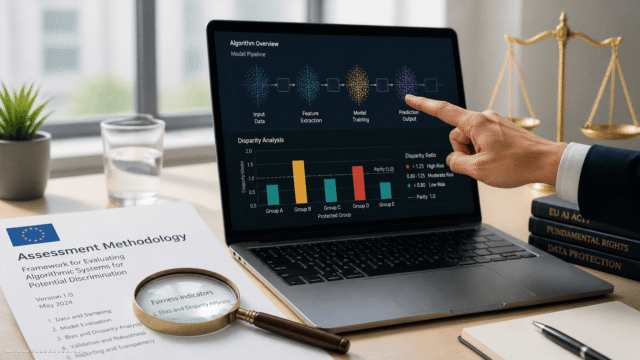
As AI systems take on consequential clinical and administrative roles, health systems need dedicated professionals to evaluate those systems for bias, fairness, safety, and regulatory compliance. This means reviewing algorithm performance across patient subpopulations, maintaining documentation for regulatory audits, and advising leadership on risk.
Average salary: around $141,000/year. This role barely existed five years ago.
Health AI Data Scientist and Clinical Data Engineer
Health systems generate enormous volumes of clinical data—EHR records, imaging studies, device data, claims, genomics. Turning that into validated AI models requires specialized expertise. Clinical data scientists with healthcare knowledge are among the most sought-after technical professionals in the sector right now.
These roles require proficiency in Python or R, SQL, machine learning frameworks, and a working understanding of clinical terminologies like SNOMED, LOINC, and HL7 FHIR. Average salary: around $122,000/year.
The AI Skills Healthcare Professionals Need Right Now
You don’t need a computer science degree to stay relevant. You need AI literacy—a working understanding of how AI tools function, where they fail, and how to critically evaluate their outputs.
Practically, that means a few things:
- Seek out continuing education in clinical informatics or health data.
- Volunteer to participate in AI pilot programs at your institution.
- Learn to read algorithm performance metrics—sensitivity, specificity, positive predictive value.
- Become the person on your team who understands not just that the AI flagged something, but why.
Professionals who combine clinical excellence with comfort navigating technology will be the most adaptable over the next decade. The goal isn’t to become a data scientist. It’s to stop being passive about the tools entering your workspace.
The Realistic Picture
A complete AI takeover of healthcare is not happening. But significant workforce disruption in specific roles is already underway, and it will accelerate.
In the next three to five years, the impact will be most pronounced in medical coding, transcription, and administrative scheduling. Clinical roles requiring physical presence, procedural skill, or sustained therapeutic relationships will be largely augmented rather than displaced.
Over the next decade, the trajectory depends heavily on regulatory frameworks, liability law, and public trust in autonomous medical AI. None of those factors are resolved.
What’s certain is this: healthcare professionals who engage proactively with AI as a tool—rather than waiting to see what it does to them—will navigate this transition from a position of strength. The anxiety is understandable. The passivity is optional.











Comments (0) No comments yet
Want to join this discussion? Login or Register.
No comments yet. Be the first to share your thoughts!