


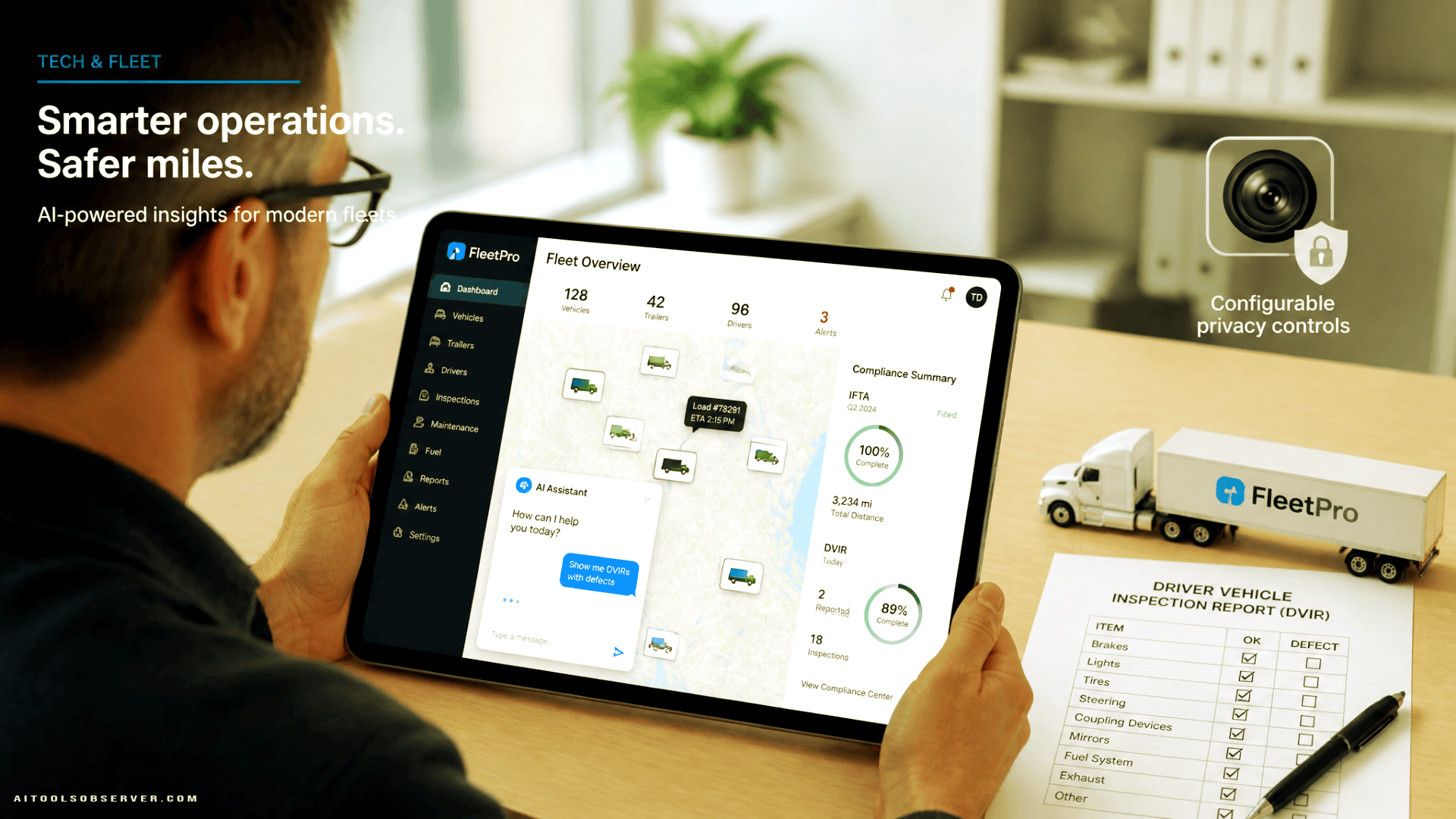
The Fleet AI Assistant: Natural Language Meets Operations Data
The most notable addition is the Fleet AI Assistant, which lets users ask plain-language questions about drivers, vehicles, maintenance, compliance, and safety events.
This matters because most fleet platforms require you to know where to look before you can find anything useful. A natural-language interface lowers that barrier — a dispatcher or safety manager can query the system conversationally rather than navigating through dashboards and filters.
The practical value depends heavily on the quality of the underlying data and how well the assistant handles edge cases. But as a direction, it reflects where fleet software is heading: less clicking, more asking.
Safety Enhancements Worth Noting
Beyond the AI assistant, LytxOne adds several targeted safety features:
- Configurable camera privacy controls based on schedules or geofences — useful for fleets operating in jurisdictions with strict privacy requirements or for managing driver trust
- Risk detection without video recording — flags safety events without capturing footage, which addresses a common driver pushback point
- Picture-in-picture incident review — allows reviewers to see multiple camera angles simultaneously
- Speed context for safety events — adds situational detail to incidents so managers can assess severity more accurately
The privacy controls in particular appear to be a deliberate response to growing regulatory and workforce pressure around in-cab surveillance. Giving fleets configurable options rather than an all-or-nothing approach is a practical tradeoff.
Asset Tracking and Dispatch Tools
LytxOne now extends tracking beyond vehicles to trailers, containers, tools, and other equipment. For fleets that manage mixed assets, this closes a visibility gap that often requires a separate tracking solution.
Two other operational additions stand out:
- Vehicle proximity search helps dispatchers quickly identify the nearest available vehicle to a job or location
- Multiple trips view lets fleets compare routes side by side using summarized performance metrics
These are the kinds of features that reduce the back-and-forth between dispatchers and drivers — small efficiency gains that compound across a large fleet.
Compliance Automation: IFTA, DVIR, and Audit Readiness
The compliance additions are arguably where fleets will feel the most immediate relief. LytxOne now includes:
- Automated IFTA reporting
- Integrated driver vehicle inspection reports (DVIR)
- Fuel reporting and mileage tracking
- Unified compliance management for audits and roadside inspections
IFTA reporting alone is a significant administrative burden for fleets operating across multiple states or provinces. Automating it within the same platform that handles safety and operations removes a common pain point that often requires dedicated staff time or third-party software.
What This Means for Existing Lytx Customers
Lytx has confirmed it is integrating its Driver Safety Program into LytxOne, but existing DriveCam and Lytx+ customers will retain access to their current capabilities and platform options. That’s a meaningful signal — the company appears to be consolidating toward LytxOne without forcing an abrupt migration.
For fleets evaluating whether to consolidate tools, this update makes LytxOne a more credible single-platform option than it was before. The combination of AI-assisted querying, asset tracking, and compliance automation in one environment reduces the integration overhead that comes with stitching together multiple point solutions.
The Bottom Line
LytxOne’s latest updates aren’t about adding flashy features — they’re about closing the gaps that force fleet operators to manage multiple systems. If the Fleet AI Assistant delivers reliable answers and the compliance automation holds up under real audit conditions, this platform update could meaningfully reduce the operational overhead for mid-to-large fleets.
The smarter question for fleet managers isn’t whether AI belongs in fleet management. It’s whether a single platform can actually execute across safety, compliance, and operations without forcing tradeoffs. LytxOne is positioning itself as that answer — and the feature set now makes that claim worth taking seriously.





Comments (0) No comments yet
Want to join this discussion? Login or Register.
No comments yet. Be the first to share your thoughts!