


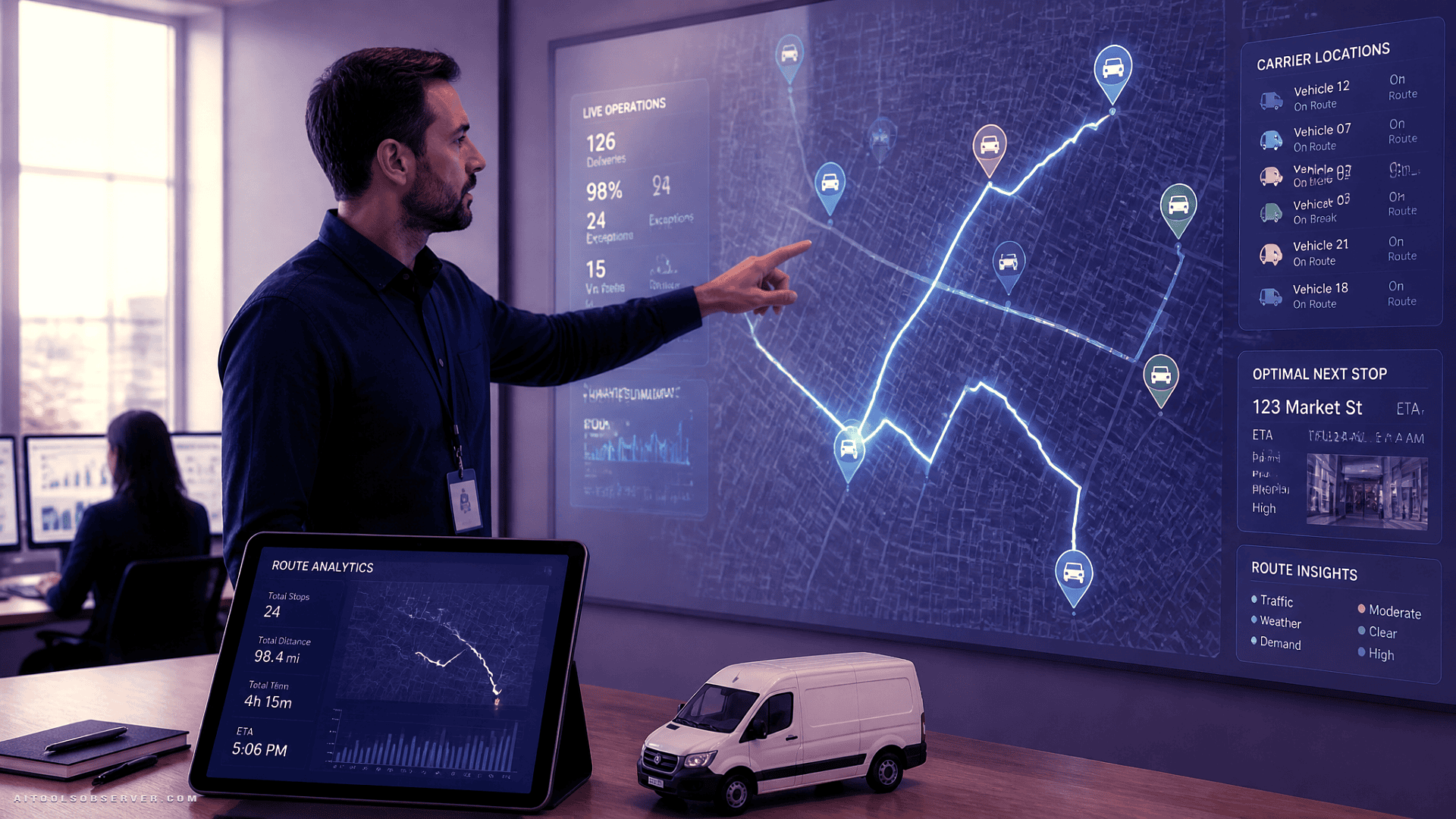
What OmniStar is designed to do
OmniStar is positioned as an AI decision layer for last-mile logistics. Instead of relying on static rules or manual planning, it appears to assess available delivery options for individual orders in real time.
Based on the available description, the platform focuses on three high-value tasks:
- Routing orders more efficiently
- Selecting the right carrier or delivery mode
- Improving delivery cost and margin outcomes
For ecommerce and retail operators, those are not minor workflow improvements. They sit at the center of customer experience, cost control, and delivery speed.
Why this matters now
Retailers are under pressure from both sides. Customers expect fast, flexible delivery, while operators are trying to protect already-thin margins.
The challenge is that last-mile operations are often fragmented. Decision-making can be spread across internal retail teams, carriers, dispatch systems, and logistics partners. That makes it harder to respond quickly when demand spikes or conditions change.
OneRail’s launch matters because it aims to compress the time it takes to make those decisions. According to the company, a routing choice that may have taken around 20 minutes can be reduced to about 2.5 minutes using AI.
That time difference can matter a lot when you are processing orders at scale.
Where Nvidia fits in
Nvidia’s role here is not just branding. The launch suggests OmniStar uses Nvidia’s AI software and hardware to support rapid decisioning at scale.
That matters because logistics optimization is not just about having data. It is about evaluating many possible scenarios quickly enough to make useful decisions before the order window closes.
For retailers, that can translate into practical gains like:
- Faster response to changing delivery conditions
- More scenario testing across carriers and delivery modes
- Better cost-service balance without slowing operations
In simple terms, faster compute helps turn complex delivery planning into something operationally usable.
The real differentiator: decision speed with operational data
Plenty of companies talk about AI in logistics. The more interesting part here is the combination of decision speed and OneRail’s proprietary delivery network data.
OneRail said its models are trained using data from a network that includes more than 12 million drivers and over 1,000 logistics partners. If that data is as central as described, OmniStar’s value may come less from generic AI claims and more from being trained on real delivery conditions and real marketplace constraints.
That is an important distinction.
In logistics, AI is only useful if it can make decisions that reflect actual carrier availability, route realities, cost tradeoffs, and service expectations. A system that looks smart in theory but cannot act on live operational complexity does not help much.
What retailers may actually gain
The strongest use case for OmniStar is not just automation. It is better decision quality under pressure.
For retailers, the platform appears aimed at improving:
Delivery speed
Faster decisioning can help teams move orders through fulfillment and dispatch more quickly, especially when same-day or urgent delivery options are involved.
Carrier selection
Choosing the wrong carrier can create downstream cost and service problems. AI-assisted carrier selection could help teams avoid overpaying or missing service targets.
Margin protection
Last-mile delivery is expensive. Even small improvements in routing, batching, or carrier choice can make a meaningful difference over time.
Operational scale
As order volumes grow, manual logistics planning becomes harder to maintain. Tools like OmniStar are clearly designed for retailers that need more automation without losing control over economics.
Why smaller retailers should pay attention
OneRail says OmniStar can help smaller retailers better compete with larger players like Amazon and Walmart on delivery speed and efficiency. That is a bold framing, but the logic is easy to understand.
Large retailers have long benefited from scale, infrastructure, and logistics sophistication. Smaller brands and regional operators often have to work with fewer resources and less integrated systems.
If OmniStar can make complex delivery optimization more accessible, that could narrow part of the operational gap. Not by turning smaller retailers into logistics giants overnight, but by giving them better decisioning tools than static rules and spreadsheet-heavy workflows.
That may be the most practical angle of this launch.
Early traction and what it signals
OneRail said OmniStar has already been deployed with some customers. It also pointed to a large tire distributor as an early example, saying the platform helped generate significant projected savings through more efficient resource use.
It is smart to treat any early customer outcome carefully, especially without deeper implementation detail. Still, the signal is useful: OneRail is not presenting OmniStar as a lab experiment. It is presenting it as an operational platform already in use.
That matters for buyers who are tired of AI announcements that sound impressive but are not yet embedded in real workflows.
The bigger trend behind this launch
This release fits into a broader shift happening in supply chain software. More logistics platforms are moving beyond dashboards and alerts toward real-time decisioning.
That means the software is not just showing teams what is happening. It is actively helping decide what to do next.
In last-mile delivery, that shift makes sense because conditions change constantly:
- Carrier availability moves
- Delivery windows tighten
- Costs vary by route and mode
- Customer expectations keep rising
A static system cannot keep up with that very well. A dynamic AI layer is a more logical fit, assuming the underlying data and operational connections are strong enough.
Who OmniStar looks best suited for
Based on the launch details, OmniStar looks especially relevant for:
- Retailers with growing ecommerce delivery complexity
- Operators managing multiple carriers or delivery modes
- Teams under pressure to improve same-day or fast-delivery performance
- Businesses trying to reduce manual logistics planning
- Mid-market retailers that want more enterprise-grade delivery decisioning
It may be less relevant for businesses with very simple delivery operations or low order volume, where the cost and complexity of advanced orchestration may not be as urgent.
What to watch next
The main question is not whether AI can help with delivery decisions. It can. The bigger question is how well OmniStar performs across different retail environments, order densities, and carrier networks.
A few practical things to watch:
- How deeply the platform integrates into retailer operations
- Whether savings come from better carrier choice, routing, or both
- How it handles edge cases like peak periods and same-day delivery pressure
- Whether smaller retailers can adopt it without major process overhead
Those details will determine whether OmniStar becomes a useful logistics layer or just another optimization promise.
Bottom line
OmniStar is a practical AI launch because it targets a real retail bottleneck: making fast, profitable last-mile delivery decisions at scale.
If OneRail can consistently turn fragmented delivery choices into quicker, better routing and carrier decisions, the value is clear. For retailers, especially those trying to improve delivery performance without operating like Amazon, this is the kind of launch worth watching closely.








Comments (0) No comments yet
Want to join this discussion? Login or Register.
No comments yet. Be the first to share your thoughts!