



The Catalyst: Two Models That Changed the Calculus

Anthropic’s Mythos was rolled out last month under strict controlled access, limited to a select group of companies — including Palo Alto Networks, CrowdStrike, Amazon, Apple, and JPMorgan — specifically to test and remediate vulnerabilities before adversaries could exploit them. The fact that Anthropic chose to gate the model behind a vetted consortium rather than release it broadly signals how seriously the capability is being treated.
OpenAI’s GPT-5.5-Cyber, announced last week and accompanied by the Daybreak cyber initiative, represents a parallel track. OpenAI is building dedicated offensive-security-aware models, which means the tooling for AI-assisted vulnerability discovery is now bifurcating into both defensive and potentially adversarial applications.
Klarich’s assessment is unambiguous: these models are not merely capable of finding known vulnerabilities faster. They are demonstrably better at discovering previously unknown attack surfaces than initial estimates suggested. The question of whether the industry was overstating model capabilities has been answered — it was, if anything, understating them.
Speed of Exploitation Is the Core Problem

Traditional vulnerability management operates on a cycle: a flaw is discovered, a CVE is issued, a patch is developed, and organizations deploy it — often over weeks or months. AI-assisted exploitation compresses the adversarial side of that cycle dramatically.
When a model can autonomously scan codebases, identify logic flaws, and generate working exploits faster than human researchers, the patch window shrinks to a fraction of its historical length. The asymmetry between attack speed and defense speed becomes structurally dangerous.
The Ransomware Industry Is Already Adapting

Ransomware operations are not static criminal enterprises — they are organized, iterative, and increasingly well-resourced. Integrating AI tooling into their workflows is a natural evolution, not a leap. The infrastructure for monetizing exploits already exists; AI simply lowers the skill floor and raises the throughput ceiling.
Google’s recent intervention — stopping an attempt to use AI for a mass exploitation event — confirms that this is not a hypothetical future scenario. Attempts are already underway. The three-to-five-month window refers to when such attempts become routine and scalable, not when they begin.
From Periodic Patching to Continuous Defense

The traditional patch-on-schedule model is no longer adequate as a primary defense posture. When AI models can identify and weaponize zero-day vulnerabilities faster than quarterly patch cycles can respond, the entire rhythm of vulnerability management must shift.
Klarich specifically called for virtual patching capabilities — the ability to deploy protective controls at the network or application layer before a formal software patch is available. This is not a new concept, but it is now a baseline requirement rather than an advanced option.
Industrywide Coordination Is No Longer Optional

The controlled rollout of Mythos to a vetted consortium is instructive. It reflects a recognition that the most capable AI models require coordinated disclosure and collaborative hardening before general availability. This model — where AI developers, security vendors, and major enterprises work in parallel to stress-test capabilities — may become the standard operating procedure for frontier model releases with dual-use potential.
The White House meetings with bank leaders and technology executives signal that this coordination is moving beyond the private sector. Regulatory and policy frameworks for AI-assisted cyberattacks are likely to accelerate alongside the threat itself.
A New Category Is Forming

The emergence of models like Mythos and GPT-5.5-Cyber is not just a threat signal — it is a market signal. Dedicated AI security tooling is rapidly differentiating into two distinct subcategories: offensive AI (used by red teams, penetration testers, and, inevitably, adversaries) and defensive AI (used for continuous monitoring, automated patching, and threat intelligence synthesis).
Tools that straddle both — enabling organizations to simulate AI-powered attacks against their own infrastructure — will become essential for any serious enterprise security program. The demand for AI-native vulnerability scanners, autonomous patch prioritization engines, and real-time exploit detection platforms is about to accelerate sharply.
Evaluation Criteria Are Shifting
For security teams evaluating tools in this space, the relevant questions are changing. It is no longer sufficient to ask whether a tool detects known threats efficiently. The new baseline questions are: Can it identify novel attack patterns generated by AI models? How quickly can it deploy virtual patches? Does it integrate threat intelligence that accounts for AI-assisted adversarial behavior?
Platforms that cannot answer these questions credibly will lose relevance quickly as the threat landscape shifts.
What Founders and Security Leaders Should Do Now

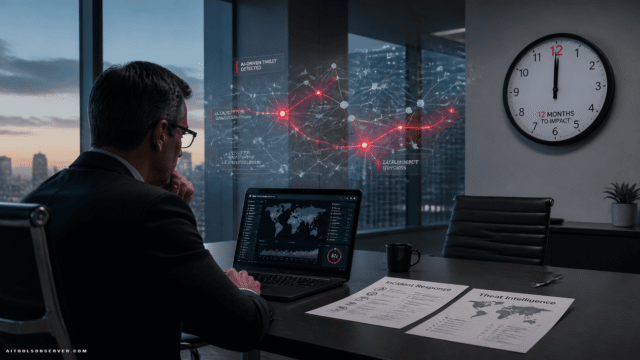
The three-to-five-month window is tight enough to demand immediate prioritization, but structured enough to allow deliberate action. Three areas warrant immediate attention.
Audit your patch latency. Understand precisely how long it takes your organization to move from vulnerability disclosure to deployed fix. Any gap longer than days — not weeks — is a structural exposure in an AI-accelerated threat environment.
Evaluate virtual patching capabilities. Whether through your existing security stack or a dedicated solution, the ability to apply protective controls at the network layer without waiting for vendor patches is now a critical capability gap to close.
Engage with AI security tooling early. The vendors building in this space — and the models being tested within controlled consortia — are generating intelligence that will not be publicly available for months. Establishing relationships with those ecosystems now positions your organization to act on that intelligence before it becomes common knowledge.
The Deeper Shift: AI as Both Threat and Defense Infrastructure

There is a structural irony in this moment that deserves acknowledgment. The same model families that are raising the stakes for enterprise security — Mythos, GPT-5.5-Cyber — are also being deployed by the organizations best positioned to defend against them. Palo Alto, CrowdStrike, and their peers are not passive observers of this threat; they are active participants in shaping how these models are tested, constrained, and ultimately deployed defensively.
This dual-use dynamic will define the AI security landscape for the foreseeable future. The organizations that understand it clearly — and build their tool stacks accordingly — will be the ones that navigate the coming exploit wave with the least damage.
The window is narrow. The models are more capable than expected. The time to act is not after the first major AI-driven breach makes headlines — it is now, while the margin still exists.







Comments (0) No comments yet
Want to join this discussion? Login or Register.
No comments yet. Be the first to share your thoughts!