


The Structural Problem With Proxy-Based Inspection
Traditional SASE architectures depend on a specific mechanism: backhaul traffic to a cloud proxy, decrypt it, inspect it, enforce policy, then forward it. The assumption is that the proxy can see everything worth seeing.
Modern internet protocols were designed, deliberately, to prevent exactly that.
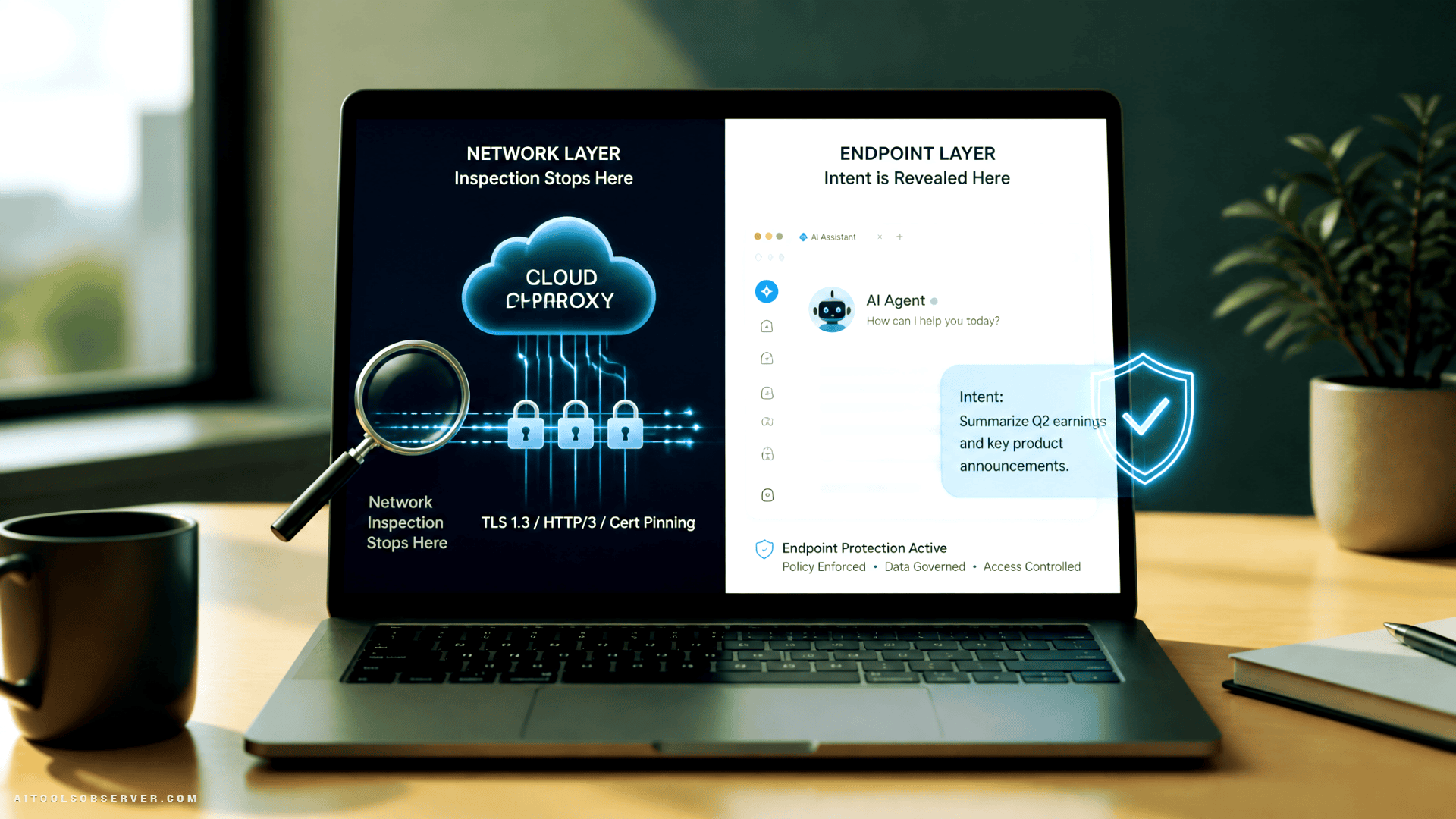
TLS 1.3 and HTTP/3 were engineered to resist man-in-the-middle interception. Certificate pinning goes further, allowing client applications to reject connections from proxies attempting forced decryption. When a cloud proxy tries to intercept a pinned TLS 1.3 session, the client application drops the connection entirely.
The practical consequence is predictable. To keep business-critical tools running, network teams write bypass exceptions. Then more exceptions. Over time, organizations accumulate large exemption lists that quietly hollow out their security perimeter—not through a breach, but through operational necessity.
The Performance Cost Compounds the Problem
Beyond the security gap, proxy-based inspection introduces latency. Routing sessions through distant cloud inspection infrastructure adds what might reasonably be called a detour tax: slower applications, stuttering video calls, degraded user experience.
When security infrastructure makes essential tools noticeably slower, users find workarounds. Shadow IT expands. The attack surface grows. The security model undermines itself.
Where AI Workflows Break the Model Entirely
Generative AI tools and autonomous agents have made the architectural gap impossible to ignore or defer.
A traditional network proxy sees a valid, encrypted HTTPS connection to an LLM provider. That is all it sees. It cannot inspect payload intent. It cannot detect that an autonomous AI agent is using model context protocol (MCP) tool calls to pull proprietary source code or internal documentation and pass it to an external model.
This is the core problem: by the time data reaches a network inspection point, the interaction has already occurred. The moment of intent has passed.
Security teams are left with a binary choice that neither option resolves cleanly:
- Block AI tools entirely, which drives users toward unsanctioned alternatives and accomplishes little beyond friction.
- Allow AI tools unrestricted, which accepts complete opacity over what data is being processed, by whom, and in what context.
Employees routinely paste intellectual property into public LLMs for code assistance. Automated agents query internal systems and move data across platforms at machine speed. These interactions happen at the presentation layer—inside an application tab, inside a browser, inside an agent workflow—where network-centric architectures were never designed to look.
What Enforcement at the Endpoint Actually Means
If the interaction happens at the device, enforcement needs to happen at the device. This is the architectural shift that addresses what proxy inspection cannot reach.
Evaluating policy at the endpoint—in the browser and on the device itself—changes the enforcement model in several meaningful ways.
Contextual data protection becomes possible. Copy, paste, and prompt content can be inspected locally before data leaves the device. The inspection happens at the moment of intent, not after the fact at a network chokepoint.
Modern encryption protocols function natively. TLS 1.3, HTTP/3, and certificate pinning no longer require bypass exceptions because there is no forced decryption workflow to conflict with them. The security model aligns with the protocol rather than fighting it.
Traffic routing becomes selective rather than universal. Trusted traffic takes a direct path to its destination. Cloud inspection is invoked only when a session requires additional verification. This eliminates the detour tax for the majority of traffic while preserving deep inspection capability where it genuinely matters.
This approach is sometimes described as a “Perfect Packet” architecture—a model that evaluates context at the endpoint before routing decisions are made, rather than routing everything through inspection infrastructure by default.
The Practical Implication for Security Teams
The gap in traditional SASE is not a configuration problem or a vendor shortcoming. It is structural. Network-centric enforcement cannot govern what happens inside an application tab, inside a browser extension, or inside an AI agent workflow operating over encrypted channels.
Closing that gap requires moving the enforcement boundary closer to where interactions actually occur—the endpoint and the browser—while preserving the ability to invoke network-level inspection selectively and efficiently.
For organizations evaluating their security architecture against modern SaaS, agentic AI, and browser-native workflows, the relevant question is no longer whether the proxy can see the traffic. It is whether enforcement is positioned at the moment and location where data decisions are actually made.
That moment is increasingly on the device. The architecture needs to follow it there.
















Comments (0) No comments yet
Want to join this discussion? Login or Register.
No comments yet. Be the first to share your thoughts!