
What Is Hopsworks?
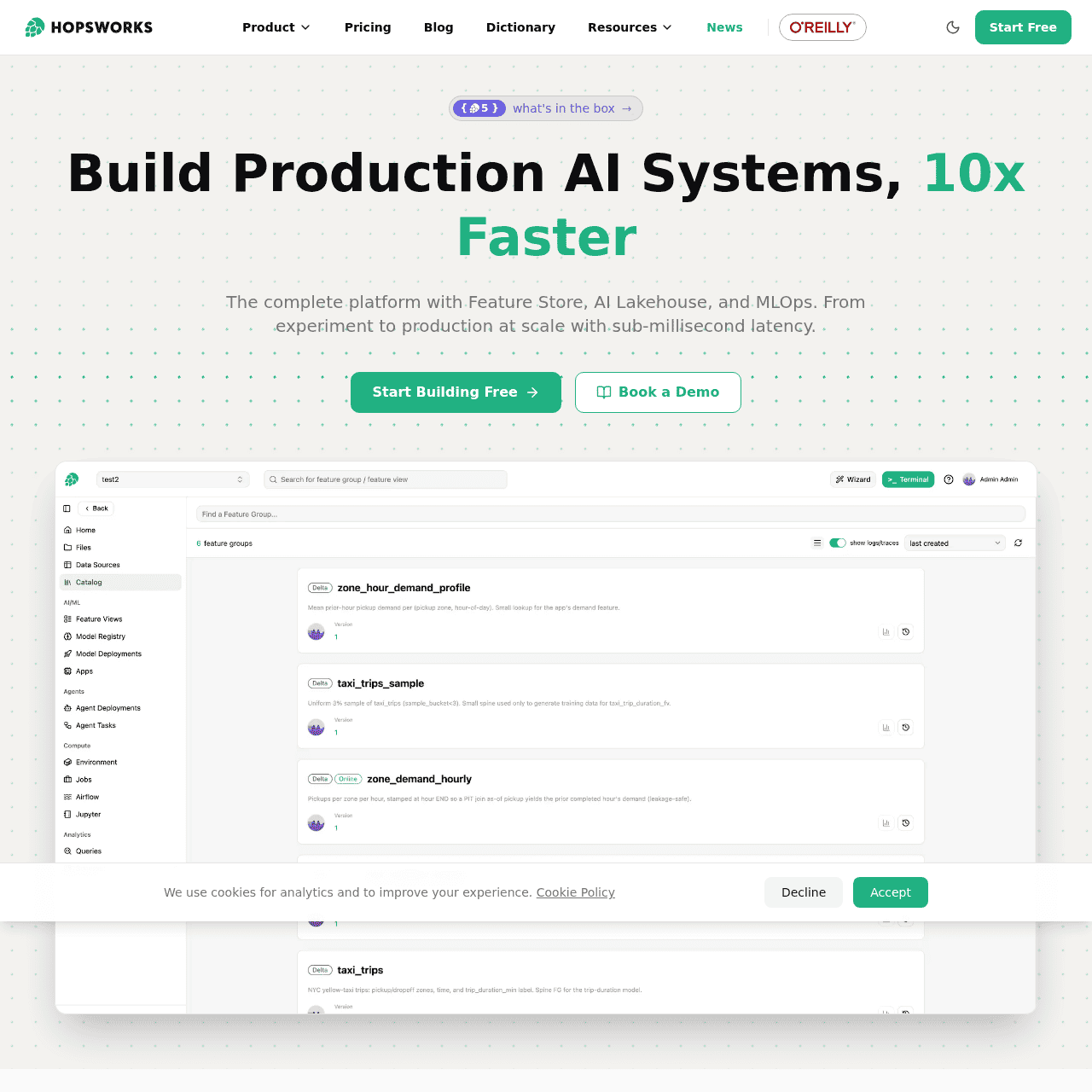
Hopsworks is a modern AI Lakehouse platform designed to support the full lifecycle of production machine learning, from data ingestion and feature engineering to deployment and monitoring. It offers a unified feature store, model registry, and MLOps tooling so teams can build, share, and reuse features efficiently across projects.
With real-time pipelines, low-latency feature access, and support for open table formats, Hopsworks is well-suited for demanding workloads like fraud detection, personalization, and LLM-powered applications. The platform serves industries such as financial services, retail and e-commerce, and government and defense, with SaaS, on-premises, and air-gapped deployment options.
Built for reliability, security, and scalability, Hopsworks helps organizations standardize AI infrastructure, accelerate time-to-production, and increase the impact of their ML investments.
Quick Snapshot
Hopsworks unifies feature store, model registry, and model serving in a single AI Lakehouse so teams can build, deploy, and scale real-time ML systems faster. It standardizes AI infrastructure, improves reliability, and helps organizations move models to production with lower risk and cost.
- Works on
-
- Web
- Linux
- API
- Pricing Model
- Freemium — Hopsworks provides a free tier with one project, feature store, and model registry and no credit card required. SaaS pricing is pay-as-you-go with usage-based billing, and enterprise plans offer custom on-premises and air-gapped deployments with dedicated support.
- Fits on
- Affiliate Program
- We could not identify an affiliate program.
- API Availability
- Hopsworks has an API available.
- Key Features
-
- Unify features, models, and serving in one lakehouse
- Power real-time ML with low-latency feature access
- Deploy securely across SaaS, on-prem, air-gapped
- Audience
-
- data scientists
- machine learning engineers
- MLOps engineers
- data engineers
- AI platform teams
- enterprise IT teams
- financial services organizations
- retail and e-commerce companies
- government and defense agencies
- startups building AI products
Screenshot

Key Features of Hopsworks
AI Lakehouse architecture
Provides a unified AI Lakehouse that integrates data, features, models, and MLOps workflows to support end-to-end production ML.
Unified feature store
Lets teams build, share, and reuse features across multiple models and projects with real-time and batch access patterns.
Model registry
Stores and manages machine learning models alongside their associated features to streamline deployment and lifecycle management.
Real-time pipelines
Supports real-time data and feature pipelines with low-latency access, enabling applications like fraud detection and personalization.
Model serving
Enables deployment and serving of models in production, integrated with the feature store for consistent and reliable predictions.
Enterprise deployment options
Offers SaaS, on-premises, and air-gapped deployments to meet security, compliance, and infrastructure requirements across industries.
Security and reliability
Built with enterprise-grade security and reliability in mind, helping organizations manage sensitive data and mission-critical ML workloads.
Support for open formats
Works with open table formats, giving teams flexibility in how they store and manage data used for features and models.
Use Cases for Hopsworks
Real-time fraud detection
Use low-latency feature access and real-time pipelines to power fraud detection models that respond to suspicious activity as it happens, improving risk control for financial services.
Personalization at scale
Centralize user and product features in the feature store to drive personalized recommendations and offers across retail and e-commerce channels in real time.
LLM and AI applications
Feed high-quality, reusable features into large language model and AI applications, standardizing data access and improving reliability across teams.
Enterprise MLOps standardization
Unify feature store, model registry, and serving in one platform so AI platform teams can create consistent MLOps workflows across business units and environments.
Government and defense analytics
Deploy machine learning workloads in secure on-premises or air-gapped environments while maintaining a modern AI Lakehouse architecture for sensitive data.
Frequently Asked Questions
What is Hopsworks used for?
Hopsworks is used to build and operate production machine learning systems by combining an AI Lakehouse, feature store, model registry, and model serving in a single platform.
Who should use Hopsworks?
Hopsworks is designed for data scientists, ML engineers, MLOps engineers, data engineers, AI platform teams, and enterprises in sectors such as financial services, retail, and government that need reliable, real-time ML infrastructure.
Does Hopsworks support real-time machine learning?
Yes, Hopsworks supports real-time pipelines and low-latency feature access, making it suitable for use cases like fraud detection, personalization, and other real-time AI applications.
Can Hopsworks be deployed on-premises or air-gapped?
Yes, Hopsworks offers on-premises and air-gapped deployment options in addition to SaaS, addressing strict security and compliance requirements.
Is there a free version of Hopsworks?
Yes, Hopsworks offers a free tier with one project, feature store, and model registry, and no credit card is required to get started.
Does Hopsworks provide an API?
Yes, Hopsworks includes APIs that allow teams to integrate its feature store, model registry, and MLOps capabilities into their existing data and ML workflows.
What industries does Hopsworks support?
Hopsworks supports multiple industries including financial services, retail and e-commerce, and government and defense, especially where real-time and secure ML workloads are required.
Hopsworks · Our Verdict
Hopsworks stands out as a focused platform for teams that need a serious feature store and real-time ML infrastructure rather than a generic data lake. Its combination of an AI Lakehouse, model registry, and model serving in one environment makes it particularly attractive for enterprises standardizing their MLOps stack.
For regulated or security-sensitive industries, the availability of on-premises and air-gapped deployments adds practical flexibility that many cloud-only tools lack.
Hopsworks ·
-

Codiga
Customizable static code analysis that follows you everywhere.
AI Developer Tools - Freemium
Agentset
The retrieval layer for reliable AI answers
AI Developer Tools -
Grok 2
Self-host the Grok 2 xAI model on GPUs
Open Source AI Models - One-Time
BooBar
Your daily tools, one native Dynamic Island surface.
Productivity & Automation AI - Subscription
Memori
Agent-native memory for production AI agents
AI Developer Tools - Your Ad Here
- Freemium Featured
HTML Pub
Publish AI-generated HTML pages in seconds
No-Code AI App Builders - Subscription
Papers
Discover, organize, and cite in one place
Academic & Research Writing