
What Is Mozaik?
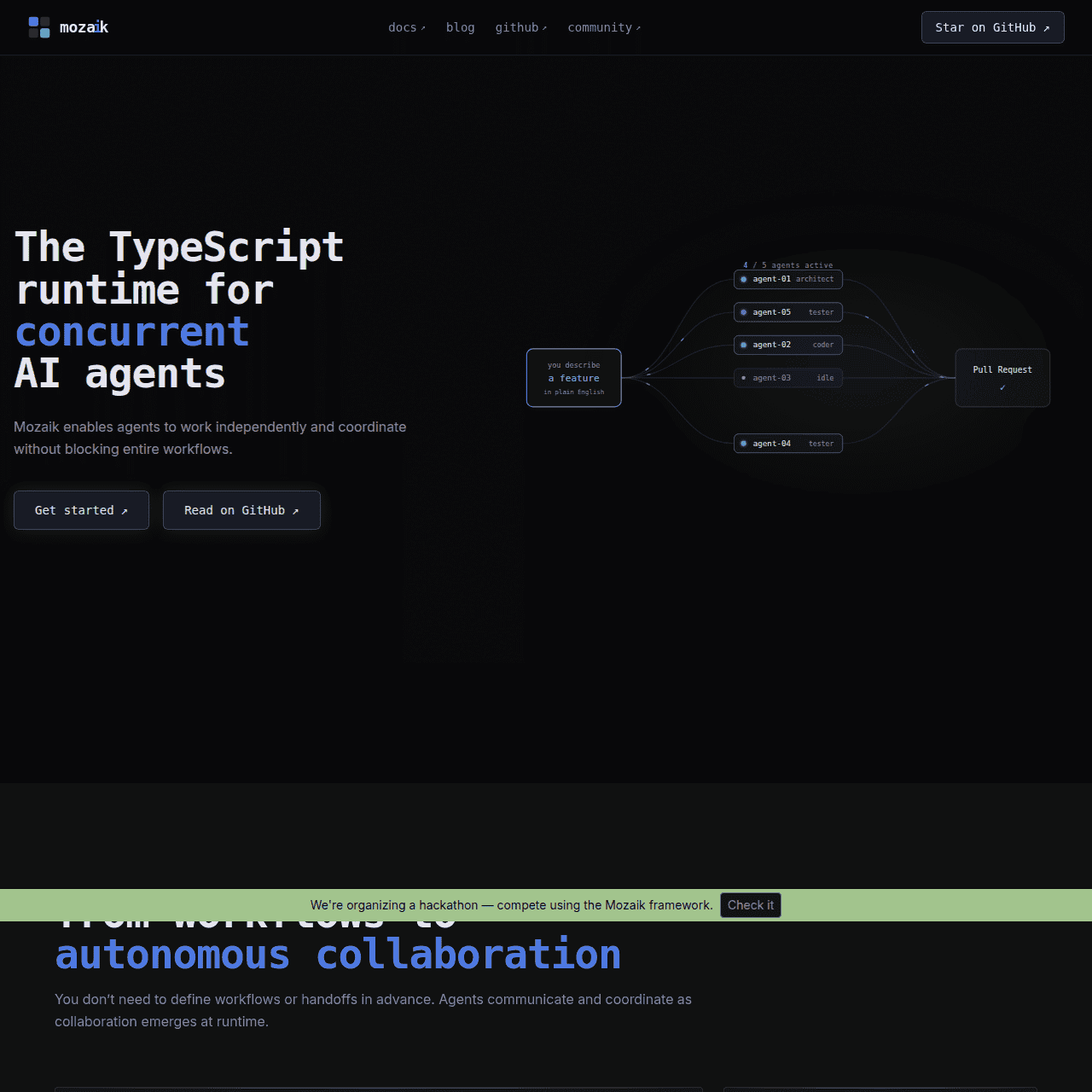
Mozaik is a TypeScript runtime designed for building concurrent, event-driven AI agents that communicate via semantic events rather than fixed, linear workflows. Each agent runs independently and coordinates over an event bus, allowing systems to adapt dynamically as conditions change.
The framework introduces concepts like agent awareness, intelligent communication, and intelligent recovery so agents can detect each other, share context, and recover from failures without blocking the entire system. Parallel execution and adaptive runtime coordination are emphasized to scale complex agent swarms and production-grade agentic applications.
Mozaik is aimed at AI engineers and TypeScript developers who want to build self-organizing, autonomous AI teams without hardcoding orchestration logic.
Quick Snapshot
Mozaik lets you build concurrent, event-driven AI agents that coordinate through semantic events instead of rigid workflows. This enables more scalable, maintainable, and fault-tolerant multi-agent systems using familiar TypeScript tooling.
- Works on
-
- Web
- API
- Other
- Pricing Model
- Cannot determine the price.
- Fits on
- Affiliate Program
- We could not identify an affiliate program.
- API Availability
- Mozaik has an API available.
- Key Features
-
- Build concurrent TypeScript-based AI agent systems
- Coordinate agents via semantic, event-driven communication
- Design self-organizing, resilient multi-agent runtimes
- Audience
-
- AI engineers
- TypeScript developers
- backend developers
- startups building AI products
- researchers working on multi-agent systems
- platform teams building agent frameworks
Screenshot

Key Features of Mozaik
TypeScript runtime
Provides a TypeScript-native runtime so developers can build, type-check, and maintain AI agents within familiar tooling and language constructs.
Event-driven agents
Enables agents to communicate via semantic events over an event bus instead of fixed workflows, allowing more adaptive and decoupled coordination.
Concurrent execution
Runs agents in parallel by default, supporting scalable, concurrent multi-agent behavior for complex applications and swarms.
Agent awareness
Introduces mechanisms for agents to detect and become aware of each other, enabling richer collaboration patterns and dynamic teaming.
Intelligent recovery
Supports recovery mechanisms so agents can handle failures without blocking or crashing the entire multi-agent system.
Adaptive coordination
Focuses on runtime-level coordination that adapts as events flow through the system, instead of requiring hardcoded orchestration logic.
Use Cases for Mozaik
Autonomous AI backends
Build backends where multiple AI agents run concurrently, coordinate via events, and adapt to changing inputs without relying on rigid orchestration logic.
Multi-agent research
Prototype and iterate on self-organizing agent swarms and coordination strategies using a TypeScript runtime that emphasizes parallel execution and semantic communication.
Production agent frameworks
Power internal or external agent platforms with a runtime that supports agent awareness, context sharing, and intelligent recovery for more resilient systems.
AI product orchestration
Replace brittle workflow pipelines with event-driven coordination between specialized agents, improving maintainability as your AI product grows in complexity.
Frequently Asked Questions
What is Mozaik used for?
Mozaik is used to build concurrent, event-driven AI agent systems in TypeScript, where agents communicate via semantic events to create adaptive, self-organizing multi-agent applications.
How does Mozaik differ from traditional workflow orchestrators?
Unlike traditional orchestrators that rely on predefined workflows, Mozaik lets agents coordinate through semantic events on an event bus, making systems more flexible, decoupled, and resilient to change.
Which programming language does Mozaik support?
Mozaik is built for TypeScript, allowing developers to define and manage AI agents using familiar TypeScript tooling and type safety.
Is Mozaik suitable for production multi-agent systems?
Yes, Mozaik is designed for production-grade agentic applications, emphasizing parallel execution, intelligent recovery, and adaptive coordination across multiple agents.
Does Mozaik provide an API?
Yes, Mozaik offers an API that developers can use to integrate the runtime and manage event-driven AI agents within their applications.
Are pricing details for Mozaik publicly available?
No, specific pricing information for Mozaik is not provided in the available materials, so you may need to contact the team for details.
Mozaik · Our Verdict
Mozaik takes a systems-first approach to agentic AI, focusing on concurrency, resilience, and semantic communication rather than yet another workflow builder. For teams already invested in TypeScript, it offers a pragmatic way to move from single-agent prototypes to production-grade, self-organizing multi-agent architectures.
Mozaik ·
-
 Freemium
 Agentset
The retrieval layer for reliable AI answers
AI Developer Tools - Subscription
Memori
Agent-native memory for production AI agents
AI Developer Tools - Subscription
Vibe Pocket
Run AI agents and cloud terminals anywhere.
AI Developer Tools - Freemium
Dopamine
Build lovable AI agents in seconds
No-Code & Workflow AI -
Sparks AI
100x your productivity with autonomous AI employees
Ai Agents - Your Ad Here
- Freemium
Logic
Write a spec, ship a production AI agent
Agent Builders & Frameworks -
Codiga
Customizable static code analysis that follows you everywhere.
AI Developer Tools