

What Is Logic?
Logic is a spec‑driven agent platform that lets teams define AI agents in natural‑language specifications instead of complex flowcharts or ad‑hoc scripts. From a single spec, Logic generates versioned, testable agents along with REST APIs and web UIs, so product and engineering teams can move quickly from prototype to production.
The platform includes validation, evaluation, approvals, and observability to ensure agents meet business, compliance, and performance requirements. Teams can describe tools and data sources, then optimize behavior with scoring and dynamic variants. With enterprise‑grade security and governance, Logic helps organizations standardize and scale reliable AI agents across products and workflows.
Quick Snapshot
Logic turns human‑readable specs into versioned, testable, and deployable AI agents with APIs, UIs, and observability built in. Teams ship production‑ready agents faster while maintaining control, compliance, and performance.
- Works on
-
- Web
- API
- Pricing Model
- Freemium
Starting at $49/month — Logic offers a Free plan for getting started and paid plans like Pro from $49/month, with higher‑tier Scale and custom enterprise options that add increased limits, capabilities, and advanced security and compliance. - Fits on
- Affiliate Program
- We could not identify an affiliate program.
- API Availability
- Logic has an API available.
- Key Features
-
- Design agents from plain-language specifications
- Deploy with auto-generated APIs and web UIs
- Gain observability, governance, and optimization controls
- Audience
-
- product managers
- software engineers
- data science teams
- AI engineers
- startups
- enterprise innovation teams
Screenshot

Key Features of Logic
Spec-driven agent design
Define AI agents in plain‑language specifications instead of complex flowcharts or custom orchestration code, improving clarity and maintainability.
Automatic APIs and UIs
Generate REST APIs and web UIs directly from your agent specs, enabling quick integration into products and internal tools.
Validation and evaluation
Validate and evaluate agents against defined requirements so teams can test behavior and quality before going to production.
Approvals and governance
Use approval workflows and governance features to ensure agents comply with business and regulatory standards.
Runtime observability
Monitor agents in production with built‑in observability, helping teams understand performance and debug issues.
Scoring and variants
Optimize agents using scoring and dynamic variants to compare behaviors and improve outcomes over time.
Enterprise-grade security
Leverage enterprise‑grade security and governance to safely deploy AI agents across large organizations.
Use Cases for Logic
Customer support agents
Design support agents via clear specs, then deploy them with built‑in observability and approvals so they align with compliance and service standards.
Internal workflow automation
Describe internal processes in natural‑language specs and turn them into governed AI agents that automate routine tasks while remaining auditable.
Productized AI features
Ship AI‑powered features inside products using versioned, testable agents exposed via Logic’s automatically generated REST APIs and UIs.
Experimentation and optimization
Run controlled experiments with scoring and dynamic variants to optimize agent behavior based on real‑world performance data.
Compliance‑ready AI deployments
Use validation, evaluation, and approvals to ensure AI agents meet business and compliance requirements before and after deployment.
Frequently Asked Questions
What is Logic and how does it work?
Logic is a spec‑driven AI agent platform where you describe an agent in plain‑language specs. It turns that spec into a versioned, testable, and deployable agent with generated APIs, UIs, and observability.
Who should use Logic for AI agents?
Logic is designed for product managers, software and AI engineers, data science teams, startups, and enterprise innovation teams that need reliable, governed AI agents in production.
How is Logic different from flowchart-based agent builders?
Instead of fragile visual flows, Logic uses structured, human‑readable specs that are easier to version, validate, test, and govern, while automatically generating APIs, UIs, and observability.
Does Logic provide an API for integrating agents?
Yes. Logic automatically generates REST APIs for your agents so you can integrate them into applications, workflows, or internal systems.
Is there a free plan for Logic?
Yes. Logic offers a Free plan for getting started, with paid Pro and Scale plans and custom enterprise deployments for advanced needs.
Can Logic help with compliance and governance?
Yes. Logic includes validation, evaluation, approvals, and observability to help ensure agents meet business and compliance requirements before and after deployment.
Logic · Our Verdict
Logic offers a structured, spec‑first approach that directly addresses the fragility and opacity of flowchart‑based agent builders. Its combination of validation, approvals, and built‑in observability makes it particularly suitable for teams that need governance and repeatability, not just quick demos. For organizations serious about running AI agents in production, Logic provides a pragmatic balance between flexibility and control.
Logic ·
-

Holoworld AI
AI engine for immersive character-driven storytelling
Ai Agents -
OpenClaw
The open-source AI that actually does things
Open Source & Self-Hosted AI -
Agor
The command center for AI teammates
Multi-Agent Workflows - Freemium
cto
Build your business with AI, free forever
Multi-Agent Workflows - Subscription
KiloClaw
Deploy OpenClaw in minutes with managed hosting
Autonomous Agents - Your Ad Here
-
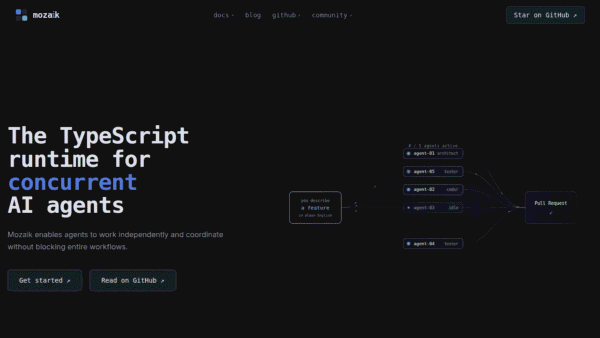
Mozaik
The TypeScript runtime for self‑organizing AI agents
Agent Builders & Frameworks -
Adobe Photoshop AI
AI-powered image editing for fast, stunning visuals
AI Photo Editors