
What Is Memori?
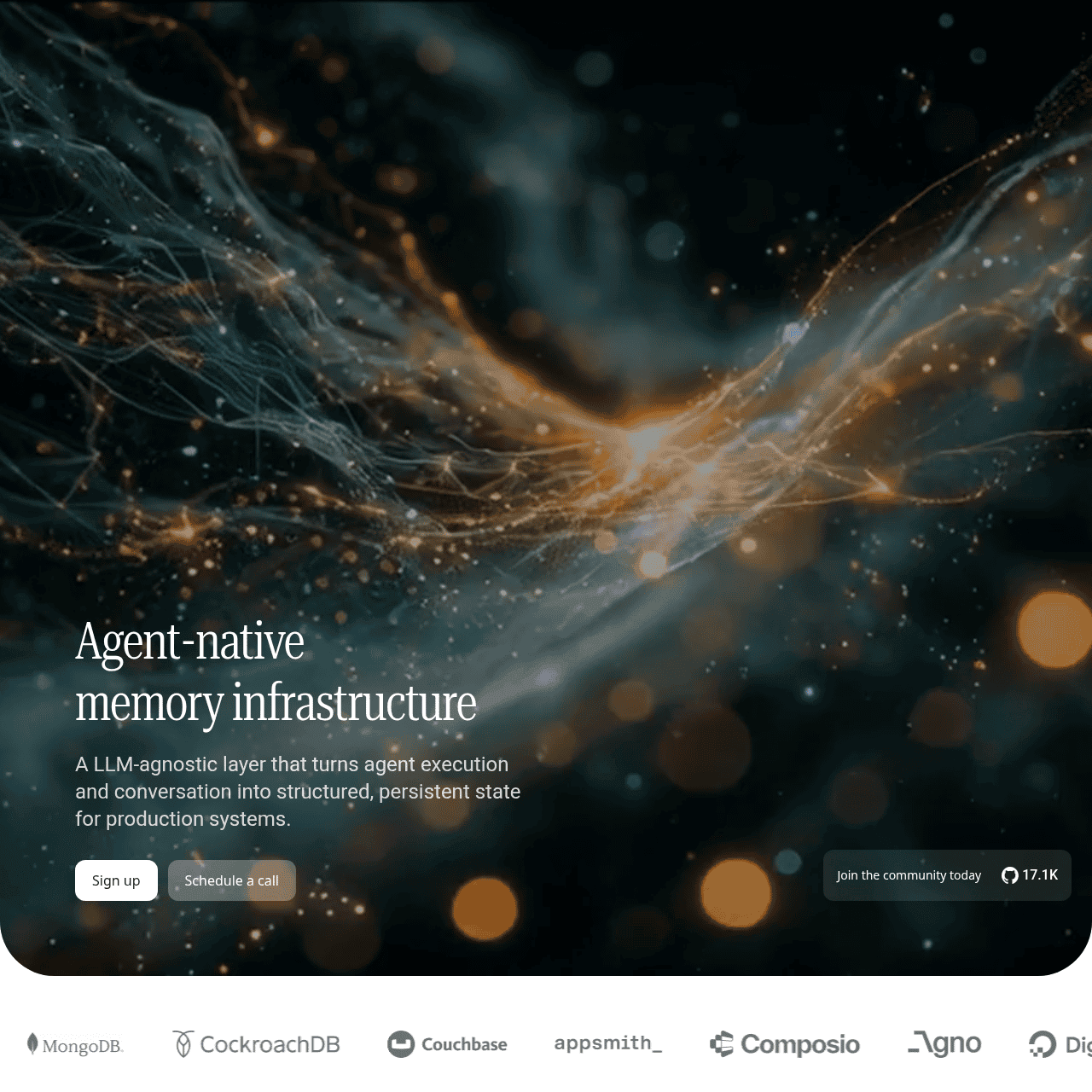
Memori is a memory infrastructure platform purpose-built for AI agents, converting their traces and conversations into long-term, structured memory on top of SQL databases. Teams can bring their own database and keep full data ownership while benefiting from intelligent recall, advanced augmentation, and trace-native execution. By making agents reason over what they actually do instead of just what they say, Memori improves reliability and decision quality in production environments.
The platform is LLM-agnostic, integrates with popular agent frameworks, and offers both open-source and managed cloud options. Production plans add observability, pooling, access control, and enterprise-grade security to support large-scale, multi-agent deployments.
Quick Snapshot
Memori gives AI builders a production-grade, SQL-native memory layer that reliably captures and recalls agent context without locking you into a specific LLM. It centralizes long-term memory with observability and governance so enterprises can deploy safer, smarter agents at scale.
- Works on
-
- Web
- API
- Pricing Model
- Subscription
Starting at $60K/year — Memori provides a free open-source self-hosted option and a $0 managed Cloud Free tier for exploration. Production plans start at $60K per year for a single production agent, with Business and Enterprise tiers available for larger, multi-agent deployments. - Fits on
- Affiliate Program
- We could not identify an affiliate program.
- API Availability
- Memori has an API available.
- Key Features
-
- Turn agent traces into persistent structured memory
- SQL-native, LLM-agnostic memory with full observability
- Production-ready governance for enterprise AI agents
- Audience
-
- AI engineers
- machine learning engineers
- backend developers
- enterprise AI teams
- startups building AI agents
- platform and infrastructure teams
Screenshot

Key Features of Memori
Agent-native memory
Captures AI agent executions and conversations as structured, persistent memory, designed specifically around agent workflows rather than generic data storage.
SQL-native storage
Runs on top of SQL databases so teams can bring their own database, preserve data ownership, and integrate memory directly into existing infrastructure.
LLM-agnostic design
Works with different language models and frameworks, preventing lock-in and allowing you to evolve your LLM stack without rethinking memory.
Intelligent recall
Provides smart retrieval and augmentation so agents can access the most relevant past context, improving reasoning and response quality.
Trace-native execution
Enables agents to reason over what they actually did in past traces, not just conversational history, leading to more accurate and auditable behavior.
Observability and governance
Managed production plans include observability, pooling, access control, and enterprise security to monitor and control memory usage at scale.
Open-source and cloud
Offers both an open-source self-hosted option and managed cloud tiers, letting teams choose the deployment model that best fits their security and operational needs.
Framework integrations
Integrates with popular agent frameworks and tools so builders can plug in memory capabilities to existing AI stacks in minutes.
Use Cases for Memori
Production AI agents
Provide agents with reliable long-term memory of past actions and conversations so they can make more consistent, context-aware decisions in production environments.
Enterprise AI platforms
Centralize agent memory across teams with governance, access control, and observability, improving compliance and control over how AI systems use and store context.
Agent analytics and debugging
Leverage trace-native execution and observability to understand how agents reason over stored memory, making it easier to debug, audit, and improve their behavior.
Multi-agent systems
Use a shared, SQL-backed memory layer to coordinate multiple agents, enabling them to read and write consistent state and collaborate more effectively.
LLM-agnostic AI stacks
Maintain a stable memory layer independent of any single LLM provider, allowing you to switch or mix models without losing long-term context or needing to rebuild memory logic.
Frequently Asked Questions
What is Memori and who is it for?
Memori is an agent-native memory infrastructure that turns AI agent traces and conversations into structured, persistent state on SQL databases. It is built for AI engineers, ML engineers, backend developers, and enterprise AI teams deploying production agents.
How does Memori store and manage AI agent memory?
Memori converts agent executions and conversations into structured records stored on top of SQL databases, enabling teams to bring their own database while gaining intelligent recall, augmentation, and governance for agent memory.
Is Memori tied to a specific LLM provider?
No. Memori is LLM-agnostic, so you can use it with different language models and frameworks without being locked into a single provider or needing to redesign your memory layer.
Does Memori offer a free version?
Yes. Memori offers a free open-source self-hosted option and a $0 managed Cloud Free tier for exploration and early experimentation.
What are Memori’s paid pricing options?
Production plans start at $60K per year for a single production agent, with Business and Enterprise tiers designed for larger, multi-agent deployments that need advanced controls and support.
Can I keep full ownership of my data with Memori?
Yes. Memori is built on top of SQL databases, allowing you to bring your own database and maintain full ownership and control of your data and memory state.
How does Memori help with observability and governance?
Managed production plans include observability, pooling, access control, and enterprise security, enabling you to monitor, audit, and govern how agents read and write memory across your organization.
Memori · Our Verdict
Memori stands out as a focused, production-grade memory layer for AI agents rather than yet another generic vector store. Its SQL-native, LLM-agnostic approach with strong observability and governance makes it especially compelling for teams that care about reliability, data ownership, and scaling serious agent workloads beyond prototypes.
Memori ·
-

Codiga
Customizable static code analysis that follows you everywhere.
AI Developer Tools - Freemium
Agentset
The retrieval layer for reliable AI answers
AI Developer Tools -
Grok 2
Self-host the Grok 2 xAI model on GPUs
Open Source AI Models - One-Time
BooBar
Your daily tools, one native Dynamic Island surface.
Productivity & Automation AI - Freemium Featured
HTML Pub
Publish AI-generated HTML pages in seconds
No-Code AI App Builders - Your Ad Here
- Freemium
Theneo
AI-native API docs for humans and agents
AI Developer Tools - Subscription
KittensAI.com
Generate adorable custom kitten images with AI
AI Image Generation