


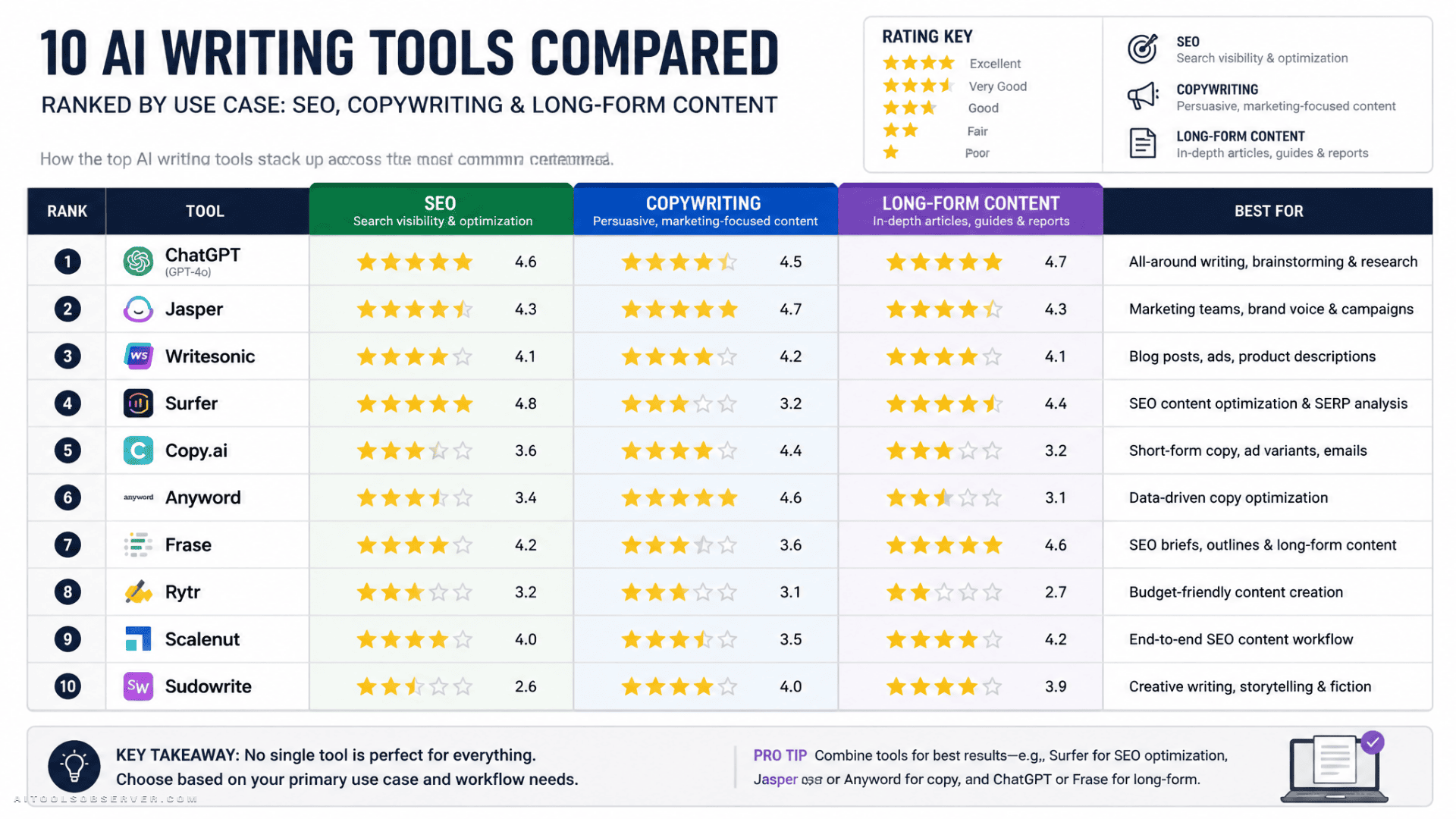
TL;DR — Top AI Writers at a Glance
If you need a fast answer before diving into the full analysis, here is where each tool lands:
- Jasper AI — Best for enterprise marketing teams and brand voice consistency. From $59/month.
- Surfer AI — Best for search engine visibility and on-page SEO optimization. From $99/month.
- KoalaWriter — Best for bulk blog post generation at low cost. From $9/month.
- Copy.ai — Best for social media campaigns and ad copy. From $29/month.
- Writesonic — Budget-friendly general content creation. From $79/month.
- Anyword — Best for predictive content performance scoring. From $49/month.
- Rytr — Best entry-level option for beginners. From $9/month.
- Claude — Best for natural tone and long-form reasoning. From $20/month.
- Google Gemini — Best for real-time research and Workspace integration. From $19.99/month.
- ChatGPT — Best all-round AI workflow tool with custom GPT support. From $20/month.
How We Tested and Ranked These AI Writing Assistants
Feature pages tell you what a tool claims to do. Real workflows tell you what it actually does under pressure. We tested each platform against practical content tasks rather than relying on marketing materials.
Real Writing Performance
We ran each tool through blog creation, short-form copy, content expansion, and rewriting tasks. The goal was to assess whether output quality held up consistently across different content types, not just in ideal conditions.
Output Quality and Accuracy
We examined sentence flow, factual consistency, and readability. We also noted whether any tool produced misleading or incoherent responses under longer prompts — a failure mode that becomes costly in publishing workflows.
Prompt Understanding
We tested how well each system interpreted both simple and layered prompts. Strong contextual understanding separates tools that require constant correction from those that produce usable first drafts.
SEO Content Capabilities
For search-focused workflows, we reviewed keyword placement, content structure, topical relevance, and whether built-in optimization features actually supported ranking-oriented publishing rather than just mentioning SEO as a feature.
Workflow Speed and Value
We measured how efficiently each platform produced drafts that required minimal editing, then weighed that against pricing to identify which tools offer the strongest long-term cost-to-output ratio.
Top AI Writing Tools for Content Creators & SEOs
Content teams now expect AI platforms to handle far more than text generation. Publishing workflows increasingly depend on speed, structural consistency, and search visibility. The tools in this section are built specifically for those demands.
1. Jasper AI — Best for Enterprise Marketing Teams & Brand Voice
Jasper AI launched in 2021 and established itself early as one of the few AI writing platforms designed explicitly for enterprise content operations. Built on OpenAI language models alongside proprietary brand intelligence technology, it addresses a problem that most general-purpose AI tools ignore: maintaining consistent messaging across large teams producing high volumes of content simultaneously.
What It Does Best
Jasper performs most reliably in structured, high-volume publishing environments:
- Maintaining consistent brand voice across distributed teams
- Generating long-form blog content with minimal prompting
- Creating campaign copy across multiple marketing channels
- Supporting collaborative workflows with multiple users
- Producing reusable templates for repetitive content tasks
Pricing
- Pro Plan: $59/month billed annually, or $69/month billed monthly
- Business Plan: Custom enterprise pricing
- Free access: 7-day trial available
Real-World Test
We prompted Jasper to write a 900-word article explaining how AI search engines are changing SEO strategy in 2026, using a professional editorial tone suitable for a technology publication. The output delivered a full-length draft with coherent structure, appropriate tone, and minimal editing required. For a first draft under time pressure, the result was genuinely usable.
Strengths
- Strong long-form content generation with structural coherence
- Reliable brand voice customization controls
- Built-in collaboration features designed for team environments
- Clean interface that supports workflow management rather than just writing
- Consistent output quality under longer, more complex prompts
Limitations
- Higher pricing compared to most competitors makes it a harder sell for individual creators
- Advanced features are clearly designed for enterprise users first
- Output still benefits from manual fact-checking before commercial publication
Best suited for: Marketing departments, content agencies, and enterprise teams managing brand-controlled publishing at scale.
2. Surfer AI — Best for Search Engine Visibility and On-Page Optimization
Surfer AI takes a different approach to content creation. Rather than starting from a blank prompt, it begins with SERP data. The platform combines natural language processing with semantic keyword clustering and competitor analysis to help writers structure content around actual ranking signals rather than assumptions about what search engines prefer.
What It Does Best
- Building SEO-focused content outlines grounded in SERP analysis
- Analyzing LSI and semantic keyword relevance
- Optimizing on-page content structure against ranking benchmarks
- Scoring content against competitors in real time
- Improving topical coverage for specific search intent
Pricing
- Essential Plan: Starting at $99/month
- Scale Plan: Higher usage limits for larger teams
- Enterprise pricing: Available on request
- Free plan: Not currently available
Real-World Test
We targeted the keyword “how to make money with AI” with a professional tone setting, auto-image insertion enabled, and analysis of the top 10 SERP competitors. Surfer scanned the results and built a data-driven outline before generating the draft. The final article achieved a Content Score of 86/100, incorporated semantic keywords naturally, and was structurally well-organized for search. The tone felt slightly mechanical in places and required light editing to read more naturally — but the platform eliminated hours of manual keyword research and outlining in a single workflow.
Strengths
- Advanced on-page SEO optimization built directly into the writing process
- Strong semantic keyword analysis grounded in live SERP data
- Useful content scoring system that provides clear optimization targets
- Well-structured outlines designed for search-focused publishing
- Purpose-built for content teams managing organic traffic strategy
Limitations
- Higher pricing than most writing tools in this category
- Limited usefulness outside SEO-specific workflows
- Not well-suited for casual writing, creative projects, or non-search content
- The structured output can feel rigid without manual editing for tone
Best suited for: SEO content teams, niche site publishers, and agencies managing organic search performance at scale.
3. KoalaWriter — Best for Bulk Blog Post Generation
KoalaWriter launched in 2023 targeting a specific and underserved segment: bloggers and niche website publishers who need to produce content at volume without proportional increases in cost or time. The platform combines OpenAI GPT models with Claude API integrations to support faster long-form article generation across SEO-focused publishing workflows.
What It Does Best
KoalaWriter performs well when production speed and cost efficiency are the primary constraints:
- Generating long-form blog posts quickly with minimal setup
- Producing articles in bulk with consistent structural formatting
- Building SEO-friendly blog structures without manual outlining
- Reducing time spent drafting repetitive informational content
- Supporting faster publishing schedules for content-heavy sites
Pricing
- Basic Plan: Starting at $9/month
- Higher tiers: Available for larger content volume limits
- Free plan: Not currently available
The entry-level pricing makes KoalaWriter one of the most accessible options for publishers managing frequent output without enterprise budgets.
Strengths
- Exceptionally low entry price for the output volume it supports
- Fast generation suited to bulk publishing workflows
- Reasonable SEO-friendly structure without requiring manual outlining
- Dual model integration adds flexibility across content types
Limitations
- Output quality does not match premium tools like Jasper or Surfer for polished editorial content
- Less suitable for brand-sensitive or high-stakes commercial publishing
- Limited collaboration and workflow management features
- Fact-checking remains essential before publication
Best suited for: Niche site builders, affiliate bloggers, and content publishers prioritizing volume and cost efficiency over premium editorial quality.
Top AI Writing Tools for Copywriting & Short-Form Content
Short-form content operates under different constraints than long-form publishing. Copy needs to convert, not just inform. The tools in this section are built around that distinction.
5. Writesonic — Budget-Friendly Content Creation
Writesonic positions itself as a broadly capable writing assistant at a mid-range price point. It covers blog posts, landing pages, ad copy, and product descriptions within a single platform, making it a reasonable option for smaller teams that need range without committing to multiple specialized tools.
The platform includes an AI article writer, a chatbot interface, and basic SEO features, though none of these match the depth of purpose-built tools like Surfer AI or Jasper.
Pricing: Limited free usage available; paid plans from $79/month.
Best suited for: Freelancers, small marketing teams, and early-stage businesses that need general-purpose writing support across multiple content types.
6. Anyword — Predictive Content Performance Scoring
Anyword differentiates itself through predictive analytics. Rather than simply generating copy, it scores content against predicted performance metrics before publication. This makes it particularly useful for teams running A/B testing workflows or managing paid campaigns where copy performance directly affects cost efficiency.
The scoring system adds a layer of data-driven decision-making that most AI writing tools do not offer at this price point.
Pricing: Limited trial access; paid plans from $49/month.
Best suited for: Performance marketers, paid media teams, and conversion-focused copywriters who want data to inform copy decisions rather than relying on intuition alone.
7. Rytr — Entry-Level AI Writing for Beginners
Rytr is the most accessible tool in this comparison by both price and learning curve. It covers the most common short-form writing tasks — emails, social posts, product descriptions, blog introductions — without requiring advanced prompting knowledge or workflow configuration.
Output quality is adequate for low-stakes content but does not compete with premium tools for complex or brand-sensitive work. For someone new to AI writing tools, it provides a low-risk starting point.
Pricing: Limited free usage available; paid plans from $9/month.
Best suited for: Individuals, students, and early-stage entrepreneurs who need basic writing assistance without a significant financial commitment.
Top AI Models for Power Users — Advanced Prompting and Reasoning
The tools in this section are not purpose-built content platforms. They are large language models with broad capability sets. For users who work with complex prompts, research-heavy content, coding support, or long-form reasoning tasks, these models often outperform specialized writing tools — provided the user knows how to work with them effectively.
8. Claude — Natural Tone and Long-Form Reasoning
Claude, developed by Anthropic, consistently produces some of the most naturally readable output among current large language models. Its handling of long-context documents, nuanced instructions, and extended reasoning tasks makes it particularly well-suited for long-form content that needs to sound like a human wrote it.
For writers who find that most AI output requires heavy editing to remove mechanical phrasing, Claude often reduces that workload significantly.
Pricing: Limited free usage; paid plans from $20/month.
Best suited for: Writers, researchers, and content strategists working on long-form projects that require coherent reasoning, natural prose, and reliable instruction-following across extended documents.
9. Google Gemini — Real-Time Research and Workspace Integration
Gemini’s primary advantage over other models in this comparison is its integration with Google’s broader ecosystem. For users already working within Google Workspace, the ability to pull real-time information and work directly within Docs, Sheets, and Gmail creates a workflow efficiency that standalone writing tools cannot replicate.
Its research capabilities make it particularly useful for content that requires current information rather than relying on a static training dataset.
Pricing: Limited free usage; paid plans from $19.99/month.
Best suited for: Google Workspace users, researchers, and content teams that need real-time information access integrated directly into existing productivity workflows.
10. ChatGPT — All-Round AI Workflows and Custom GPTs
ChatGPT remains the most widely used AI tool in this comparison for good reason. Its combination of broad capability, custom GPT functionality, code interpreter, and image generation within a single interface makes it the most versatile option for users who work across multiple content types and workflows.
Custom GPTs allow users to build specialized assistants tailored to specific tasks — a meaningful advantage for teams that want to standardize prompting behavior without rebuilding instructions from scratch each session.
Pricing: Limited free usage; paid plans from $20/month.
Best suited for: Power users, developers, content strategists, and teams that need a flexible, multi-functional AI assistant rather than a single-purpose writing tool.
Essential Features to Look For in an AI Content Generator
Not every feature listed on a pricing page translates into practical value. These are the capabilities that consistently make a measurable difference in real workflows.
Brand voice controls matter most for teams producing content across multiple writers or channels. Without them, output consistency degrades quickly at scale.
SEO integration separates tools built for search-focused publishing from those that treat keyword placement as an afterthought. Look for semantic keyword analysis, content scoring, and SERP-informed outlining rather than basic keyword insertion.
Long-context handling determines whether a tool can maintain coherence across a 2,000-word article or loses structural logic after the first few paragraphs. This is a significant differentiator between models.
Workflow integrations — with CMS platforms, project management tools, or existing productivity software — reduce the friction of moving content from generation to publication.
Collaboration features become essential the moment more than one person is involved in content production. Single-user tools rarely scale gracefully into team environments.
The Elephant in the Room: AI Content Detectors and SEO in 2026
Search engines have not penalized AI-generated content categorically. What they continue to penalize is low-quality, thin, or unhelpful content — regardless of how it was produced. The practical implication is that AI-generated content published without editorial review, fact-checking, or genuine added value carries real ranking risk.
AI content detectors have also become more sophisticated, though their accuracy remains inconsistent. Some platforms flag human-written content as AI-generated and vice versa. Treating detector scores as definitive quality signals is not reliable practice.
The more defensible approach is to use AI tools to accelerate drafting and structural work, then apply human editorial judgment to ensure accuracy, originality, and genuine usefulness before publication. That combination consistently outperforms either approach used in isolation.
Plagiarism and Copyright: Who Owns the AI Content?
This question does not yet have a fully settled legal answer, and the situation continues to evolve across different jurisdictions. What is clear is that AI-generated content is not automatically protected by copyright in the same way human-authored work is in many legal frameworks.
Platform policies vary significantly on data usage, training practices, and content ownership. Before publishing AI-assisted content commercially — particularly for clients or under contractual obligations — reviewing the specific terms of service for the platform you are using is not optional. It is a basic due diligence step.
Data privacy considerations also apply when inputting proprietary information, client data, or sensitive business content into third-party AI platforms. Enterprise plans from tools like Jasper typically offer stronger data handling commitments than consumer-tier subscriptions.
Final Verdict: Which AI Writer Should You Choose?
The right tool depends entirely on what your workflow actually requires — not on which platform has the most features or the highest-profile brand.
Choose Jasper AI if you manage a content team that needs brand consistency, collaborative workflows, and reliable long-form output at enterprise scale. The pricing reflects that positioning.
Choose Surfer AI if organic search performance is your primary metric and you need content built around real SERP data rather than general writing quality.
Choose KoalaWriter if you run a content-heavy publishing operation on a tight budget and need volume over premium editorial quality.
Choose Copy.ai or Anyword if short-form performance copy and campaign content are your core output, particularly if you want data-informed copy decisions.
Choose Claude or ChatGPT if your work involves complex reasoning, research-heavy content, or multi-step workflows that benefit from a flexible, high-capability model rather than a purpose-built writing tool.
Choose Rytr or Writesonic if you are early in your AI adoption, working with limited budget, and need a low-risk starting point before committing to a more specialized platform.
The tools that deliver the most value in 2026 are not the ones with the longest feature lists. They are the ones that fit cleanly into how you already work — and reduce the friction between thinking and publishing.
FAQs
Are AI writing tools good enough to replace human writers in 2026?
For high-volume, structured content like product descriptions, SEO articles, and templated marketing copy, AI tools have significantly reduced the need for full human drafting. For content requiring original research, expert judgment, brand nuance, or genuine creative voice, human editorial involvement remains essential. Most effective workflows combine both.
Will Google penalize AI-generated content?
Google’s stated position focuses on content quality and helpfulness rather than the method of production. Thin, inaccurate, or unhelpful AI content carries ranking risk. Well-researched, editorially reviewed AI-assisted content does not face categorical penalties based on how it was produced.
Which AI writing tool is best for SEO?
Surfer AI is the most purpose-built option for search-focused content, given its SERP analysis, semantic keyword integration, and content scoring system. For teams that also need brand controls and long-form capability alongside SEO features, Jasper AI is a strong alternative.
Is there a free AI writing tool worth using?
ChatGPT’s free tier offers meaningful capability for general writing tasks. Claude and Google Gemini also provide limited free access. Purpose-built writing platforms like Surfer AI and KoalaWriter do not currently offer free plans.
How should I handle fact-checking for AI-generated content?
Treat all AI-generated factual claims as unverified until confirmed against primary sources. This applies regardless of which tool you use. AI models can produce plausible-sounding but inaccurate information, particularly for recent events, statistics, and technical specifics.













Comments (0) No comments yet
Want to join this discussion? Login or Register.
No comments yet. Be the first to share your thoughts!