


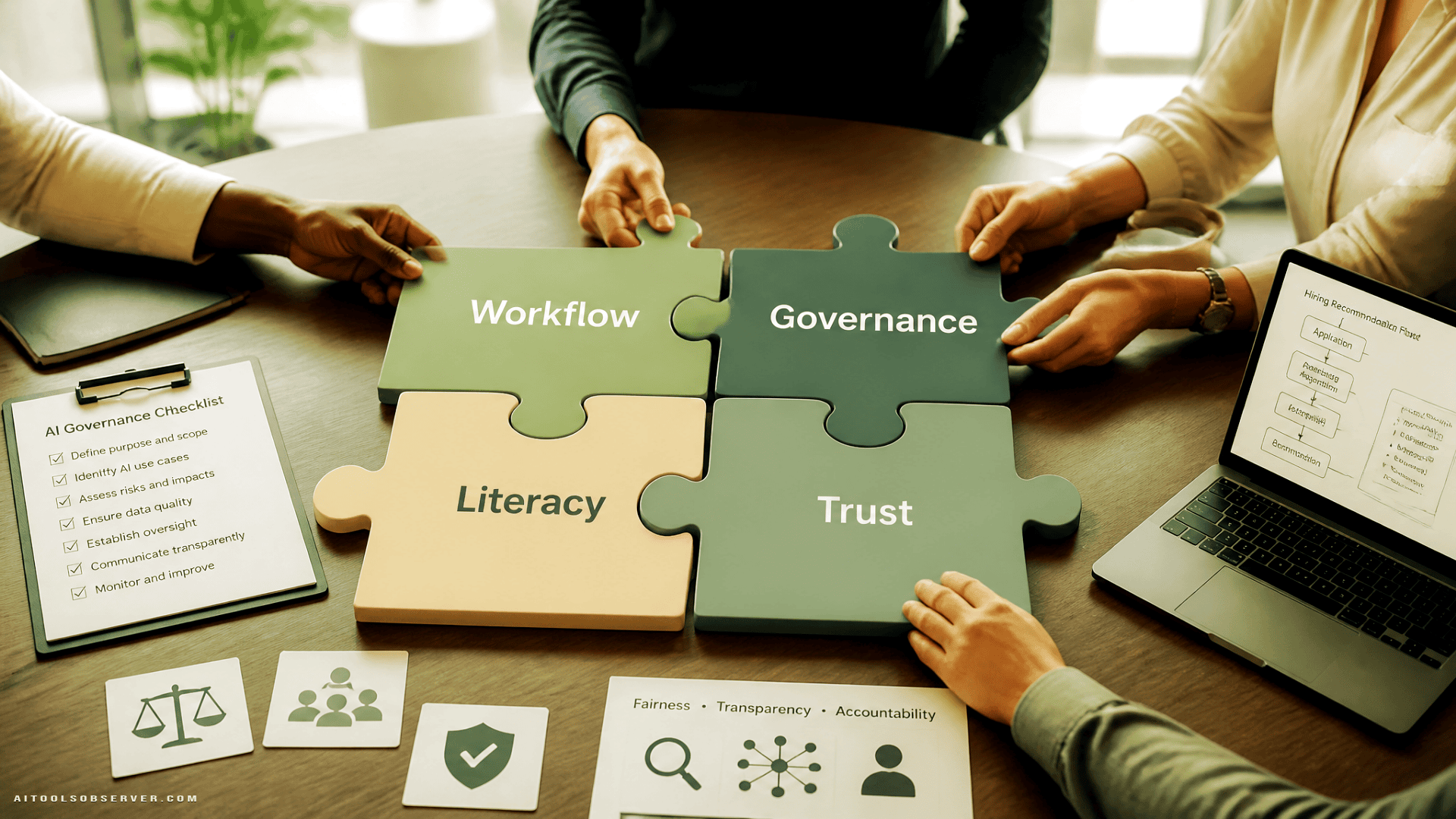
1. Reimagine the Workflow Before You Shop for Tools
The most common AI adoption mistake isn’t picking the wrong tool. It’s automating a broken process and calling it transformation.
Ask yourself: what problem are you actually trying to solve? Not “how do we use AI here,” but where does work slow down, where do errors happen, and where does human judgment get wasted on low-value decisions?
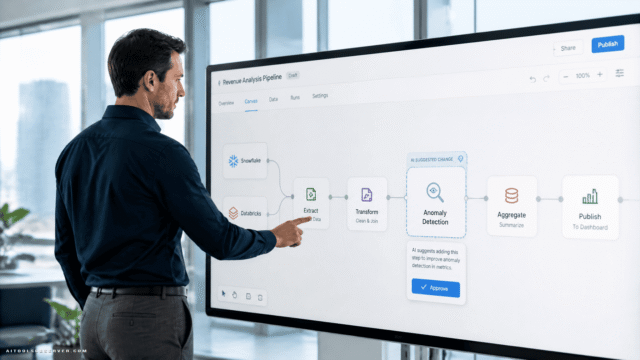
Take payroll as a concrete example. AI can detect variances before a run, escalate only what needs attention, and improve with each cycle. That’s a workflow redesign. A chatbot that mirrors an old approval chain isn’t—it just adds a new interface to an old problem.
Before evaluating any AI tool, check these:
- Have you mapped the current workflow end-to-end?
- Can any steps be eliminated entirely, not just automated?
- Are you solving a real bottleneck, or just adding a new layer?
- Does AI enhance human judgment here, or attempt to replace it?
If you can’t answer those clearly, you’re not ready to buy. You’re ready to think.
2. Build Governance Before You Scale
Governance sounds like a slowdown. It isn’t. It’s what keeps AI adoption from becoming a liability.
The pattern that creates problems is familiar: organizations rush to deploy, then scramble to build guardrails after something goes wrong. By that point, the cost—financial, reputational, or operational—is already real.
Good governance means knowing who owns each AI-driven decision, how outputs are monitored, and what happens when the system gets it wrong. For HR specifically, that scope is wide. Hiring, compensation, performance, workforce planning—these are high-stakes decisions that affect people directly.
Governance checklist before deployment:
- Is there a designated owner for each AI use case and its outputs?
- Do you have policies that cover data use, model behavior, and escalation paths?
- Are bias audits part of your review process, not an afterthought?
- Have you aligned AI policies across teams, not just within IT or legal?
- Are employees informed about what AI is doing and why?
Governance isn’t about control for its own sake. It’s about being able to trust what the system produces—and being able to explain it when someone asks.
Monitoring and accountability need to exist before scale, not after.
3. Assess Workforce AI Literacy Honestly
You can deploy the best AI tool available and still get poor results if the people using it don’t understand how it works or how to evaluate its outputs.
AI literacy gaps tend to be uneven. Some teams adopt quickly while others lag. Some employees are already using large language models on personal devices with varying levels of understanding about reliability and accuracy. That inconsistency creates risk.
Literacy also scales differently depending on organization size. An eight-person team and an eight-hundred-person company need different approaches—but both need one.
Readiness questions to ask before rollout:
- Do employees understand how the AI tool makes decisions or generates outputs?
- Are training resources available to non-technical roles—operations, frontline, onboarding?
- Is AI literacy framed as a career skill, not just a compliance requirement?
- Are you tracking literacy alongside adoption metrics?
- Do people know how to check AI outputs for accuracy?
One useful reframe: AI literacy isn’t a niche technical skill. It’s a baseline competency for anyone whose work will touch AI-powered tools—which, increasingly, is most people.
That matters for governance and decision quality alike.
4. Evaluate Employee Trust Before You Assume Buy-In
Speed of deployment is not the same as success. If employees don’t trust how AI is being used in decisions that affect them, adoption will be fragile—and resistance will be justified.
Trust in AI at work comes from a few specific things: transparency about what data is used and why, clear communication about how tools work, and visible human oversight for decisions that carry real consequences.
For HR, that last point matters most. Compensation, performance reviews, hiring decisions, workforce planning—these are exactly the use cases where human-in-the-loop checkpoints aren’t optional. They’re the difference between responsible deployment and a governance failure waiting to happen.
Trust checklist before going live:
- Have employees been informed about what AI tools are being used and what they do?
- Is there a clear explanation of what data feeds into AI-assisted decisions?
- Are there human review checkpoints for high-stakes outputs?
- Is there a channel for employees to raise concerns or flag errors?
- Has leadership modeled transparency about both the benefits and the limits of the tools?
The goal isn’t to get employees to accept AI. It’s to give them enough context and control that trust is earned, not assumed.
The Right Order of Operations
Here’s the short version of how to sequence AI adoption responsibly:
- Redesign the workflow first. Identify what can be eliminated, combined, or changed before deciding what to automate.
- Build governance before you scale. Define ownership, monitoring, and accountability before deployment, not after.
- Invest in literacy early and broadly. Make sure the people using AI tools understand how to use them well and how to catch errors.
- Earn trust through transparency. Communicate clearly, build in human oversight, and treat employee confidence as a prerequisite—not a nice-to-have.
Quick-Reference Evaluation Checklist
Use this before committing to any new AI tool or implementation:
Workflow
- [ ] Current process mapped and reviewed for elimination opportunities
- [ ] Clear problem statement defined (not just “use AI here”)
- [ ] AI embedded to support human judgment, not bypass it
Governance
- [ ] Decision ownership assigned for each AI use case
- [ ] Bias audits and monitoring protocols in place
- [ ] Cross-team policy alignment confirmed
Literacy & Training
- [ ] Training available to all affected roles, not just technical teams
- [ ] Employees can evaluate and check AI outputs
- [ ] Literacy tracked as a metric alongside adoption
Trust
- [ ] Employees informed about data use and AI decision logic
- [ ] Human-in-the-loop checkpoints built into high-stakes workflows
- [ ] Feedback channels available for concerns and error reporting
The organizations that get the most out of AI aren’t necessarily the ones that move fastest. They’re the ones that move with enough clarity to know what they’re doing and why—and enough transparency that the people doing the work actually trust the tools they’re using.
That’s a harder standard than picking the most impressive demo. It’s also the one that holds up.











Comments (0) No comments yet
Want to join this discussion? Login or Register.
No comments yet. Be the first to share your thoughts!