


What Nintex is launching
Nintex Processes is a new process management product inside the broader Nintex platform.
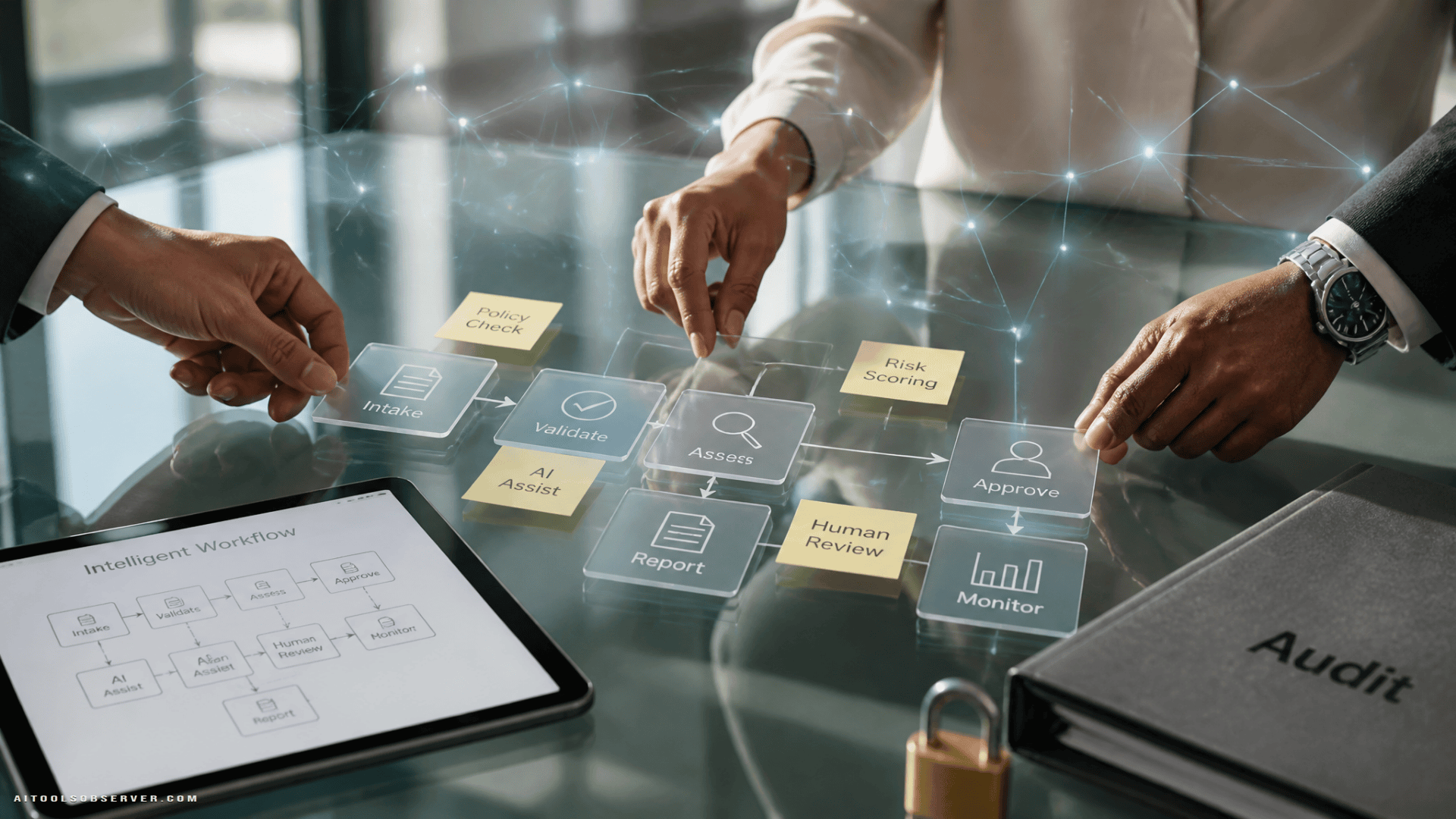
Based on the available description, its job is to bring process knowledge closer to actual execution: the workflows, systems, automations, and AI-driven experiences that carry work forward. In plain English, it tries to reduce the gap between the process diagram and the thing people and software actually do.
That matters because a lot of enterprise automation still breaks in the handoff. The process is documented in one place, the workflow lives somewhere else, and the AI layer shows up later wearing a confidence badge.
Why this launch matters now
This is less about adding “AI” to a product page and more about a familiar enterprise problem getting sharper.
As organizations move beyond single-task automation, work starts spreading across:
- people
- departments
- business systems
- rules-based workflows
- AI-driven actions
Once that happens, the hard part is not automating one step. It is seeing the whole chain, understanding who owns what, and proving that the system did what it was supposed to do.
That is why governance is doing so much heavy lifting in this launch. AI may be the flashy part, but control, visibility, and auditability are the reasons buyers show up.
The bigger platform play
Nintex Processes appears to extend a broader platform strategy rather than stand alone as a disconnected add-on.
Nintex has already been bringing together products such as Workflows, Apps, and Forms with newer pieces like Orchestration, Agent Designer, and Solutions ALM. The logic is clear: if enterprises want AI and automation to operate inside real business processes, they do not want five separate control rooms.
This makes Nintex Processes feel like connective tissue. Not glamorous, but useful. Like good plumbing, only with more governance language.
What problem it is trying to solve
The description points to organizations with complex operating models, especially where work crosses teams and software environments. Think less “auto-send email” and more “coordinate a regulated, multi-step process across people, systems, and approvals without creating compliance theater.”
The product is positioned around a few practical needs:
- stronger visibility into how work gets done
- clearer links between documented processes and live execution
- more control as AI becomes part of operational workflows
- better auditability for high-consequence work
That last point matters. AI in enterprise settings is not just a productivity toy. In many cases, it touches decisions, records, approvals, and customer or public-facing outcomes. If no one can explain the workflow around it, adoption tends to hit a wall.
Who this is really for
This launch looks best suited to larger organizations dealing with complicated workflows and tighter governance requirements.
The context mentions sectors like manufacturing, public sector, and financial services, which makes sense. These are the kinds of environments where process sprawl is expensive and “we’ll figure it out later” is not considered a governance framework.
More broadly, Nintex Processes should be relevant for:
- IT teams managing workflow architecture
- operations leaders trying to standardize execution
- transformation teams scaling automation beyond pilots
- compliance-minded organizations that need oversight built in
If your company is still at the stage of automating a few repetitive tasks, this may feel like a lot. If your company already has workflows, bots, forms, approvals, and AI experiments scattered around the estate, it starts to look more practical.
The real trend underneath: process is moving closer to orchestration
One of the more interesting signals here is not the feature set. It is the category shift.
Process mapping and workflow execution used to live in noticeably separate buckets. One documented intent. The other ran the work. AI is blurring that separation fast.
As organizations experiment with AI agents and intelligent automation, the old model starts to creak. You need process context to guide execution, and you need execution data to keep process models honest. Otherwise, “process management” becomes a museum of outdated swimlanes.
Nintex is betting that process governance needs to sit much closer to orchestration. That is a sensible read of where enterprise software is heading.
Tradeoffs to watch
The value proposition is strong, but buyers should read it with clear eyes.
A unified platform can simplify governance, reduce fragmentation, and make automation easier to manage. It can also concentrate more responsibility inside one vendor’s ecosystem. For some teams, that is efficiency. For others, it is a strategic decision with long-term consequences.
There is also a practical challenge: connecting process knowledge to live workflows sounds great, but it only works if teams actually maintain the process layer. Governance software is helpful. Governance theater is still theater.
So the question is not just whether Nintex can connect AI, workflows, and process control. It is whether customers can operationalize that connection across messy, real-world teams.
Why CIOs and operations teams will care
For IT and operations leaders, this launch speaks to a familiar boardroom tension: move faster with AI, but do not create a control problem.
That is why the emphasis on visibility, accountability, and oversight matters more than the AI label. Enterprises are increasingly looking for a practical path between experimentation and operational discipline.
Nintex appears to be positioning itself for that middle ground:
build with AI, orchestrate across systems, and keep enough governance in place that nobody has to explain a mystery workflow to audit six months later.
Takeaway
Nintex Processes is less about flashy automation and more about making enterprise AI behave like part of an operating model.
If your organization is trying to scale AI and workflow automation without losing ownership, traceability, or common sense, this is the kind of launch worth watching. The smart question is not “Does it do AI?” It is “Does it help us run complex work with fewer blind spots?”












Comments (0) No comments yet
Want to join this discussion? Login or Register.
No comments yet. Be the first to share your thoughts!