



What changed
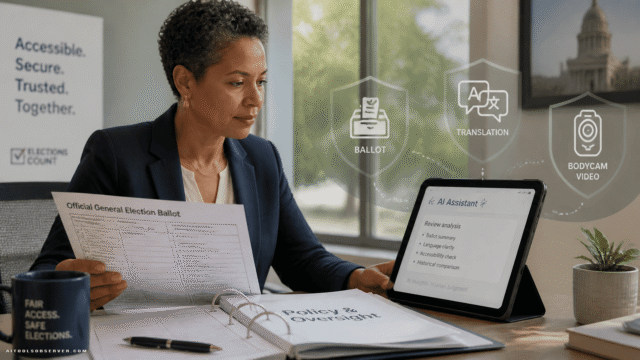
Based on the available reporting, the FBI considered using artificial intelligence to assess signatures on a large batch of mail-in ballot envelopes from Fulton County, Georgia.
The initiative appears to have been discussed recently, though its current status is unclear. At the same time, the broader Fulton County election probe reportedly involved a significant internal redirection of FBI analytical resources.
That combination matters. This is not a small pilot in a lab setting. It appears connected to a politically charged federal review of ballots tied to claims of fraud that have already been heavily disputed.
Why this is getting scrutiny
Signature matching has always been contested, even before AI entered the picture.
Election workers and investigators may use signature comparison as one signal, but experts have long argued that handwriting and signature analysis is inherently messy. Signatures can vary because of age, stress, illness, speed, writing surface, pen type, or simple inconsistency.
That means the core challenge is not just software quality. It’s that the underlying task itself is noisy.
If an agency applies AI to a weak signal, scale does not automatically improve accuracy. It can just scale uncertainty faster.
The technical problem with ballot signature matching
On paper, signature verification sounds straightforward: compare the signature on a ballot envelope to a prior signature on file.
In practice, it is much less clean.
Common limitations include:
- signatures changing over time
- limited reference samples
- poor image quality
- rushed or awkwardly written ballot-envelope signatures
- inconsistent review thresholds
- subjective decisions about what counts as a mismatch
One especially important detail in the reporting is that the review may rely on a narrow comparison set, such as a voter registration signature against a ballot-envelope signature. Experts generally view that kind of limited sample as a weak basis for confident conclusions.
In other words, the model is only one part of the system. The dataset, process design, and threshold-setting can matter just as much.
Why AI does not remove subjectivity
A common misunderstanding is that once AI is involved, human bias disappears. That is not how these systems work.
Someone still has to decide:
- which signatures are used for training or comparison
- how much variation is acceptable
- what confidence score counts as suspicious
- when a human reviewer steps in
- how findings are interpreted in an investigative context
One reported comment captures the issue well: the outcome can depend on the threshold chosen for evidence of fraud. That’s not a minor setting. It can shape how many false positives a system generates.
If the threshold is too strict, legitimate ballots may be flagged. If it’s too loose, the system may miss actual irregularities. In a politically charged investigation, that tradeoff becomes even more sensitive.
The election context makes this riskier
This story is not just about document analysis software. It sits inside a broader fight over the legitimacy of the 2020 election.
That matters because public trust in election systems depends not only on accuracy, but on independence. If investigators are perceived as using novel AI methods to validate a predetermined narrative, the technology itself becomes part of the controversy.
Even a technically competent system could face intense skepticism if:
- its methods are opaque
- its training data is unclear
- its review process is inconsistent
- its findings are released selectively
- its use appears politically motivated
That is why election-tech scrutiny is different from ordinary enterprise AI scrutiny. In a marketing workflow, a false positive is annoying. In an election probe, it can affect public confidence in democratic institutions and broader election integrity.
Signature matching already has a difficult history
The broader debate over signature verification did not start with this probe.
During and after the 2020 election, signature checks became a flashpoint in disputes over mail-in voting. Critics argued the process was subjective and error-prone. Research and legal testimony have also raised concerns that signature-based rejection can disproportionately affect certain groups of voters, including older voters, younger voters, disabled voters, and voters of color.
That backdrop is critical. AI is being considered for a process that was already controversial when handled by humans.
So the question is not, “Can AI do signature matching?” The better question is, “Can AI make a disputed and error-prone process trustworthy enough for election enforcement?” Based on the available context, that answer appears far from settled.
What experts appear to agree on
There are disagreements about how capable modern signature-matching systems are, but a few themes stand out.
1. Signatures are unusually difficult evidence
Unlike fingerprints or DNA, signatures naturally vary. That makes them a weak candidate for clean automated judgments, especially when records are limited.
2. General-purpose AI is not the same as specialized forensic tooling
The reporting suggests officials discussed commercial AI options alongside broader image-comparison approaches. Experts generally distinguish between specialized systems designed for signature analysis and nonspecialized AI tools that are not built for this exact use case.
That distinction matters because “AI” is too broad a label. Not every model that can analyze images or documents is suitable for forensic election review.
3. Human oversight is still required
Even defenders of automated signature technology tend to argue that trained reviewers should check a meaningful share of cases. That undercuts the idea that AI can serve as a neutral, final answer on its own.
What this means for AI in elections
This Fulton County story highlights a larger pattern in government AI adoption.
Agencies are increasingly tempted to use AI in areas where there are huge backlogs, large datasets, and pressure to produce answers quickly. Elections check all three boxes. But speed and scale are exactly what can make a flawed review process more dangerous.
For election-related AI systems, the real evaluation criteria should include:
- accuracy under real-world conditions
- transparency around methodology
- clear appeal or review mechanisms
- representative data sources
- safeguards against political misuse
- independent validation
Without those guardrails, AI can turn a disputed manual process into a disputed automated one.
Why founders and AI buyers should pay attention
Even if you do not work in civic tech, this case is a useful lens for evaluating AI products.
When vendors claim an AI system can classify, verify, detect fraud, or assess authenticity, ask:
- What is the ground truth?
- How noisy is the underlying data?
- How many examples are available per subject?
- What happens when the model is uncertain?
- Who sets the threshold?
- What is the cost of a false positive?
These are not just election questions. They apply to finance, insurance, HR, compliance, and identity verification too.
The lesson is simple: AI can make judgment calls look objective, even when the underlying evidence is unstable.
The practical takeaway
If you’re evaluating AI tools, treat “automated verification” claims with caution, especially in high-stakes settings. The Fulton County probe is a reminder that when the source data is messy and the incentives are political, AI does not solve the trust problem by itself.
A smarter approach is to look past the model label and inspect the process around it: data quality, thresholds, human review, auditability, and failure costs. That’s usually where the real story is.











Comments (0) No comments yet
Want to join this discussion? Login or Register.
No comments yet. Be the first to share your thoughts!