


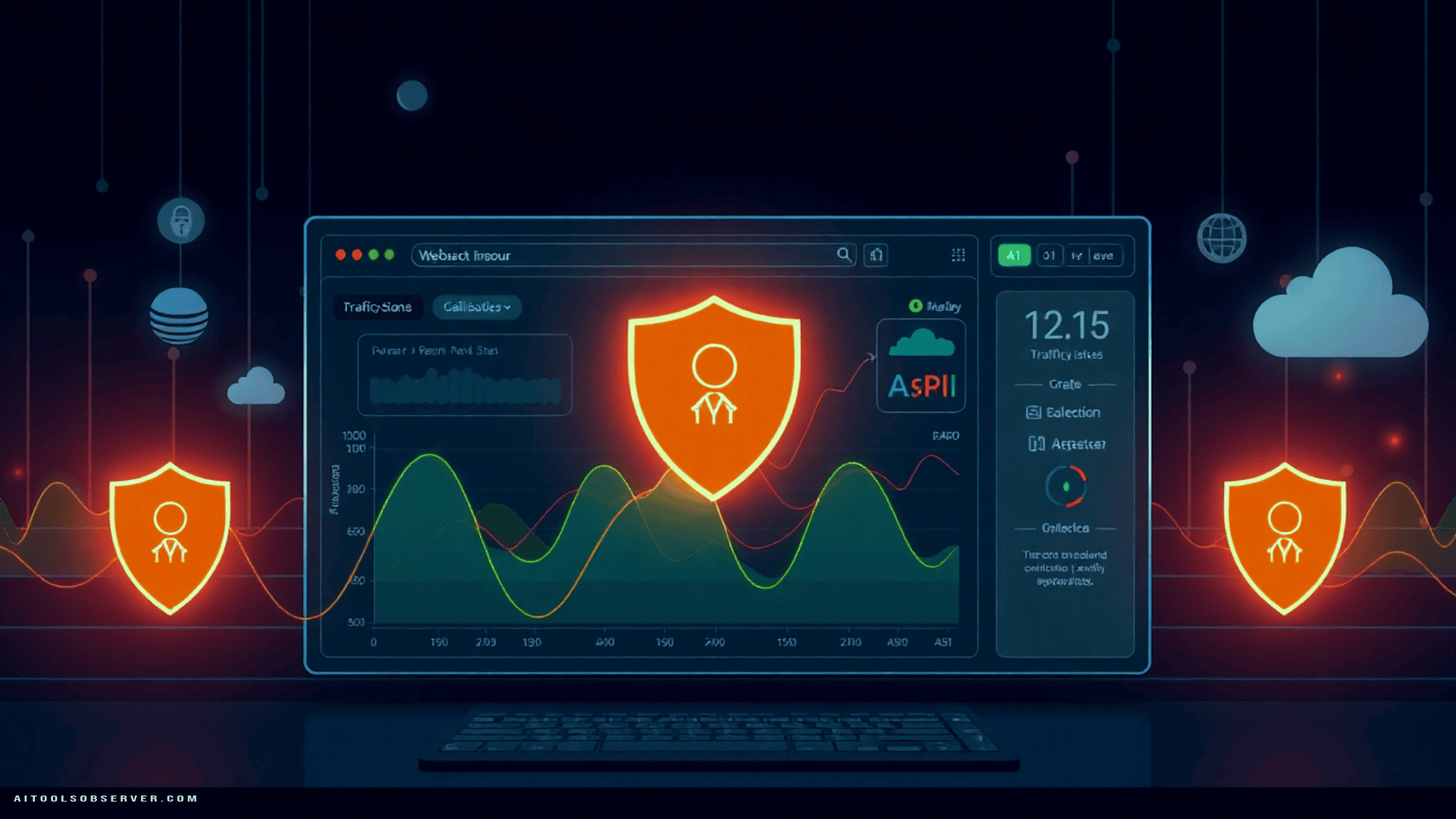
What Changed (And Why It Matters Now)

The old DDoS playbook was simple: throw enough traffic at a target until it buckles. Defenders learned to recognize the patterns. Blocklists, rate limits, firewalls — the usual toolkit held up reasonably well.
AI broke that equilibrium.
Modern AI-assisted attacks don’t just flood your front door. They probe your APIs, map your cloud architecture, sniff out misconfigured endpoints, and adapt in real time when defenses push back. What used to take a human attacker weeks of reconnaissance now takes minutes — sometimes seconds.
This isn’t a marginal upgrade. It’s a category shift.
The 12-Hour Problem

Here’s the number that should keep your security team awake: 12 hours.
That’s the window security experts now cite as the outer limit for patching exploitable flaws before AI-assisted attacks find and weaponize them. Not 72 hours. Not a sprint cycle. 12 hours.
Traditional patch management wasn’t built for this cadence. Most organizations still operate on weekly or monthly cycles, with change-approval processes that add friction by design. That friction, once a feature, is now a liability.
The implication is uncomfortable but clear: if you can’t move faster than the attack surface expands, you’re perpetually behind.
The AI Trap Most Companies Fall Into
There’s a specific mistake that keeps surfacing in cloud security audits, and it’s counterintuitive enough to be worth naming directly.
Companies add AI-powered security tooling — threat detection, anomaly scoring, automated response — and assume the coverage is comprehensive. It often isn’t. The gaps tend to live in the seams: between cloud providers, between legacy infrastructure and new deployments, between what the tool monitors and what it doesn’t.
AI attackers are exceptionally good at finding seams.
The trap isn’t using AI for defense. The trap is assuming that deploying AI tools equals having AI-level visibility. Those are very different things.
How AI-Driven DDoS Attacks Actually Work

Understanding the mechanics helps you defend against them. Here’s the condensed version.
Reconnaissance at Machine Speed

Before a single packet hits your server, AI tools are already mapping your attack surface — open ports, API endpoints, third-party dependencies, CDN configurations. This phase used to take human hackers days. Automated tools compress it to minutes.
Adaptive Traffic Patterns

Classic DDoS traffic has recognizable signatures. AI-generated attack traffic doesn’t. It mimics legitimate user behavior, varies request patterns dynamically, and adjusts when it detects filtering rules kicking in. Signature-based detection struggles here.
Botnet Coordination

AI doesn’t just make individual attacks smarter — it makes botnets smarter. Distributed attack nodes can now coordinate in real time, shifting targets, rotating IPs, and timing surges to overwhelm mitigation systems that rely on threshold-based triggers.
API Targeting

APIs are the new front line. They’re often less hardened than primary web surfaces, more directly connected to backend systems, and increasingly exposed as businesses expand integrations. AI attackers know this. Your API security posture matters more than it ever has.
The Defense Stack Worth Building

Good news: AI works both ways. The same capabilities that make attacks smarter can make defenses smarter — if you build the stack deliberately.
Continuous Attack Surface Monitoring

You can’t defend what you can’t see. Tools that continuously map your exposed surface — not just at deployment, but in real time as configurations drift — give you the situational awareness that static audits miss. MazeBolt’s approach, for instance, focuses on non-disruptive continuous testing against live environments rather than point-in-time assessments.
Behavioral Anomaly Detection

Move beyond signature matching. AI-powered behavioral analysis establishes baselines for normal traffic patterns and flags deviations — even when those deviations don’t match any known attack signature. This is how you catch adaptive attacks that deliberately avoid looking like attacks.
Automated Mitigation Triggers

Speed is the variable that matters most now. Human-in-the-loop response processes add latency that AI attackers exploit. Automated mitigation — traffic rerouting, rate limiting, challenge-response activation — needs to engage before a human has finished reading the alert.
API Gateway Hardening

Rate limiting at the API layer, authentication enforcement, payload inspection, and anomaly scoring per endpoint. These aren’t exotic measures. They’re table stakes in 2026, and a surprising number of organizations still haven’t fully implemented them.
What Your Team Should Do This Week

Practical beats theoretical. Here’s a short list that doesn’t require a six-month roadmap.
Audit your API exposure. List every external-facing API endpoint. Check authentication requirements. Identify which ones touch sensitive backend systems. Prioritize hardening from there.
Review your patch cadence. If your current process can’t move in under 24 hours for critical vulnerabilities, find the bottleneck and fix it. The 12-hour window is real.
Test your DDoS mitigation. Not in a staging environment — against your live infrastructure, non-disruptively. You need to know what actually holds up, not what theoretically should.
Map your cloud seams. Where does your AI security tooling have blind spots? Between providers? At legacy integration points? Find the gaps before attackers do.
Brief your team on adaptive attack patterns. The people watching your dashboards need to know what AI-assisted attacks look like. Behavioral anomalies, not just volume spikes.
The Bigger Picture

DDoS attacks used to be a brute-force problem. Throw enough bandwidth at the attacker’s traffic, absorb the hit, wait it out. That model is obsolete.
AI-driven attacks are precision problems. They find the specific weakness in your specific configuration and exploit it at machine speed. The defense has to match that precision — continuous visibility, behavioral intelligence, automated response, and a team that understands the new threat model.
The organizations that treat this as a checkbox exercise will find out the hard way that checkboxes don’t stop adaptive systems.
The ones that build genuinely intelligent defenses — layered, tested, and fast — will be the ones still online when everyone else is filing incident reports.
Observe the threat clearly. Then choose smarter tools to meet it.












Comments (0) No comments yet
Want to join this discussion? Login or Register.
No comments yet. Be the first to share your thoughts!