


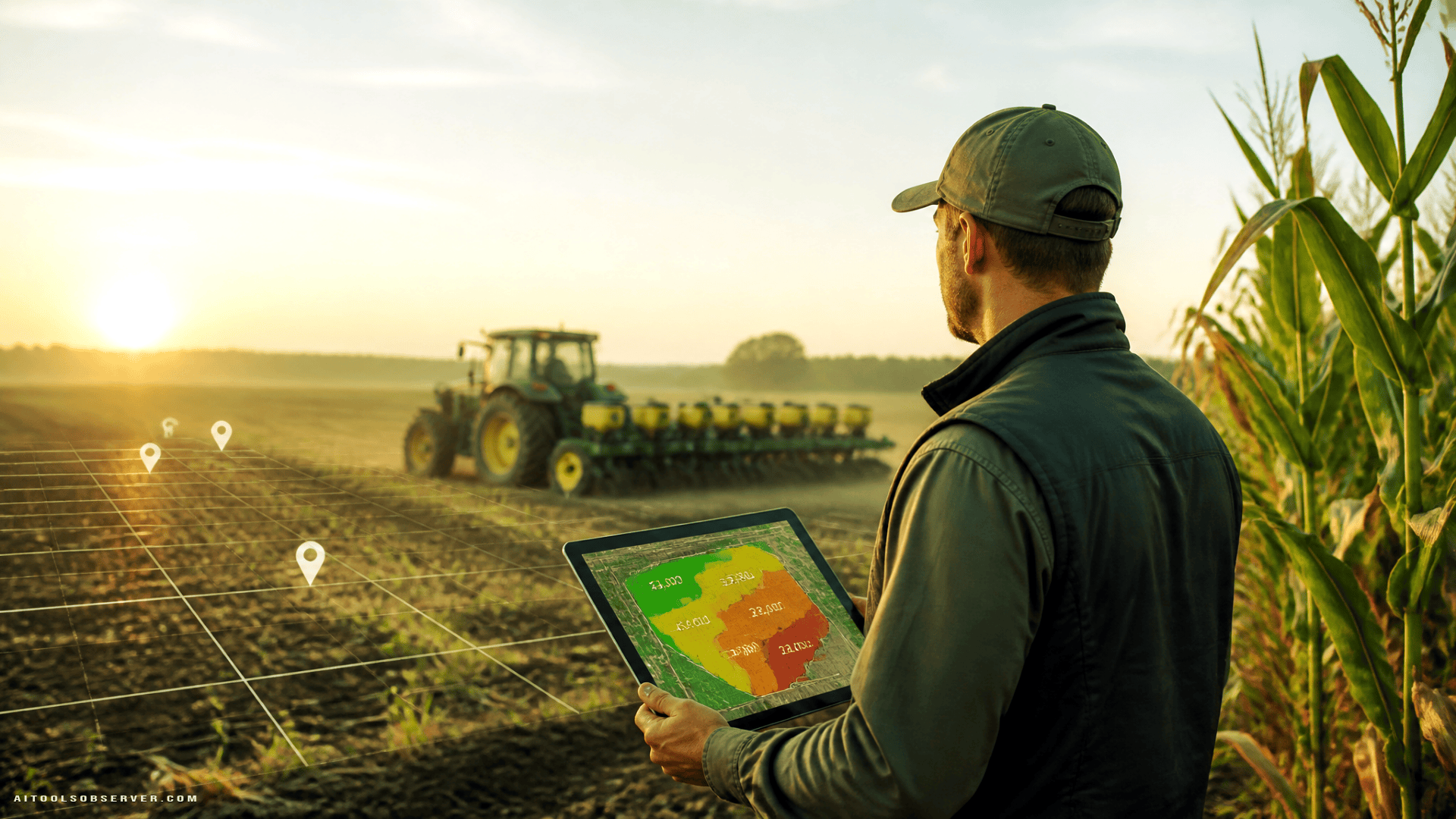
The workflow problem: one field, many micro-environments
Farm management often has to balance speed, cost, and uncertainty. Planting decisions are made under pressure, and standardization has clear operational benefits. But fields are not uniform systems.
Some areas can support higher seeding populations because they hold moisture better or have stronger yield potential. Other areas may be more vulnerable to nutrient loss, poor drainage, or erosion. Treating both zones identically can reduce economic efficiency.
This creates three linked problems:
- Seeds may be overapplied where returns are weak
- Yield potential may be missed where conditions are stronger
- Fertilizer and crop protection decisions may be less targeted than they could be
Variable-rate seeding addresses this by adjusting seed density by zone rather than by field. The challenge is determining those zones and rates with enough confidence to be useful in real planting operations. This is where machine learning becomes practical.
How AI fits into variable-rate seeding
The University of Missouri researchers used an AI model trained on common field data, including soil samples, elevation, and years of yield records from two Ohio farms. The aim was not just to predict yield, but to identify agronomic and economic optima for seeding decisions.
In plain terms, the model asks a more useful question than “What is the average yield?” It asks:
- Where does planting more seed actually pay off?
- Where does it add cost without enough return?
- How should seeding rates vary across a field based on local conditions?
That distinction matters. In farming, the highest biological output is not always the best decision if the input costs rise faster than the gain.
Machine learning is well suited to this task because field performance depends on interacting variables rather than one obvious cause. Soil characteristics, topography, historical productivity, and weather-related conditions all influence how a crop responds. A model can detect patterns across those variables and turn them into location-specific recommendations.
What the system is actually optimizing
This use case is about more than planting density. It sits inside a broader precision agriculture workflow.
According to the research description, the AI-supported approach can help farmers:
- Adjust seeding rates by field zone
- Better align fertilizer use with local yield potential
- Use crop protection inputs more selectively
- Reduce unnecessary applications
- Lower the risk of runoff and related environmental impacts
That makes variable-rate seeding a decision layer, not a standalone tactic. Once a field is segmented more intelligently, other input decisions can become more targeted as well.
This is one of the stronger patterns in applied AI: the first gain often comes from improving classification and segmentation. In this case, the field is no longer treated as one unit. It becomes a map of distinct management zones.
Why corn looked more promising than soybeans
One of the most useful parts of the Mizzou research is that it did not flatten the results into a simple “AI works” conclusion. Corn and soybeans behaved differently.
Corn: clearer response, stronger near-term fit
Corn showed more consistent and predictable results in the study. The model was able to identify areas where higher planting rates made sense and areas where they did not.
That makes corn a more immediate candidate for AI-driven variable-rate seeding. If crop response is more stable, then model recommendations are easier to trust and easier to operationalize.
For growers, this matters because predictability is part of adoption. A recommendation does not need to be perfect to be useful, but it does need to be reliable enough to justify changing a standard practice.
Soybeans: more adaptive, harder to model cleanly
Soybeans were more complicated. The research suggests soybeans can adapt during the season based on environmental conditions, which makes the relationship between seeding rate and final yield less direct.
In many cases, rainfall and temperature appeared to influence outcomes more strongly than planting decisions alone. That means a machine learning model may have a harder time producing consistent soybean recommendations across seasons and conditions.
This is an important reminder for AI buyers and adopters in any industry: a good workflow for one category does not automatically transfer to another. Similar-looking use cases can have very different model reliability depending on how stable the underlying system is.
The data inputs that make this possible
A practical strength of this use case is that it relies on field data many precision agriculture programs already work with or can reasonably collect.
The research used:
- Soil samples
- Elevation data
- Historical yield records
- Geospatial analysis
This is a common pattern in effective AI deployments. The value does not come only from the model. It comes from combining existing operational data in a better decision framework.
For farms, that means the barrier is not necessarily “adopt AI” in the abstract. It is more concrete:
- Are field records clean enough?
- Is yield history available at sufficient resolution?
- Are zones mapped accurately?
- Can planting equipment execute variable-rate prescriptions in real time?
If the answer to those questions is yes, the path to practical experimentation becomes much clearer, especially when teams already work with structured sources such as Open Datasets.
What this changes for farm economics
The most immediate business case is input optimization.
Planting more seeds does not automatically increase returns. In weaker field zones, a higher seeding rate may simply add cost. In stronger zones, under-seeding may leave yield on the table. The goal is not maximum seeding or minimum seeding. It is better-fit seeding.
That has several economic implications:
- Seed spend can be allocated more efficiently
- Fertilizer and crop protection can be better matched to local potential
- Management can move from average-field assumptions to zone-level decisions
- Profitability can improve even without increasing total field output dramatically
This is especially relevant in agriculture because margins depend on many small decisions. AI is useful here not because it removes uncertainty, but because it helps reduce avoidable inefficiency.
The environmental side is not separate from the business case
The research also points to a second benefit: reducing unnecessary nutrient and chemical applications.
When farmers have a better understanding of which parts of a field are likely to respond productively, they can avoid applying inputs where the return is low and the environmental risk may be higher. That can help limit runoff and reduce pressure on nearby soil and water systems.
This matters because sustainability in agriculture often succeeds when it aligns with operational logic. Precision input management is easier to adopt when it supports both cost control and resource efficiency.
In that sense, AI-assisted variable-rate seeding is not just an agronomy tool. It is also part of a broader land stewardship workflow.
Where this use case is strong and where caution is needed
This research offers a credible picture of where AI can help on the farm, but it also shows where caution is warranted.
Strong fit
- Spatially variable fields
- Crops with more predictable response patterns, such as corn in this study
- Farms with several years of usable field data
- Equipment capable of executing variable-rate planting plans
More difficult fit
- Crops with highly adaptive in-season behavior, as seen with soybeans
- Environments where weather dominates management effects
- Operations with weak historical data quality
- Teams expecting a model to replace field knowledge rather than support it
The broader lesson is straightforward: AI performs best when it sharpens decisions in systems that are already being measured well.
A practical way to think about tool selection
For readers evaluating AI tools in agriculture, this use case suggests a simple checklist.
Ask whether a platform can do three things well:
- Ingest and organize agronomic and geospatial data
- Produce zone-specific recommendations tied to economics, not just yield
- Fit naturally into existing farm equipment and planning workflows
A tool that predicts yield but does not translate that into operational seeding prescriptions may be interesting, but less useful. A tool that generates prescriptions without transparent data logic may be difficult to trust. The best systems usually sit between those extremes.
This is also why university-led research matters. It helps clarify what should be measured, what can be predicted, and where claims need restraint.
Readers comparing implementation options may also look at broader Machine Learning Frameworks used to support model development.
Why this example matters beyond agriculture
Variable-rate seeding is a farm-specific use case, but the AI pattern is widely relevant.
The pattern is:
- Start with a process currently managed by averages
- Map meaningful variation inside that process
- Train models on historical and contextual data
- Shift from uniform treatment to targeted decisions
- Measure both performance and cost impact
That framework applies far beyond crop management. It is the same logic behind lead scoring, dynamic pricing, preventive maintenance, and personalized recommendations. The domain changes. The operational idea does not.
In agriculture, however, the stakes are unusually tangible. Every recommendation affects real land, real inputs, and a season that cannot be rerun.
The useful takeaway
AI-driven variable-rate seeding is not about making planting more complicated. It is about stopping the field from being treated as if every acre behaves the same.
The University of Missouri research suggests this approach is already more actionable for corn than for soybeans, with machine learning helping identify where seeding intensity can improve returns and where it only adds cost. For farms with the right data foundation, that makes AI less of a headline and more of a management tool.
The practical takeaway is simple: if a decision is still being made at field average, and the field itself is not average, that is exactly where AI should be tested first.










Comments (0) No comments yet
Want to join this discussion? Login or Register.
No comments yet. Be the first to share your thoughts!