


The Old Way Was Slow by Design
Traditional car development ran in sequence. Design finishes, then engineering starts. Engineering finishes, then testing starts. Each handoff added months. Each revision sent teams back to the beginning.
The problem wasn’t talent or ambition. It was architecture — a product pipeline built for a slower world.
GM’s New Operating System
GM’s chief product officer Sterling Anderson — who joined from autonomous trucking company Aurora in 2025 — describes what GM has built as “a new operating system for product development.”
The core shift: concurrent workflows instead of sequential ones.
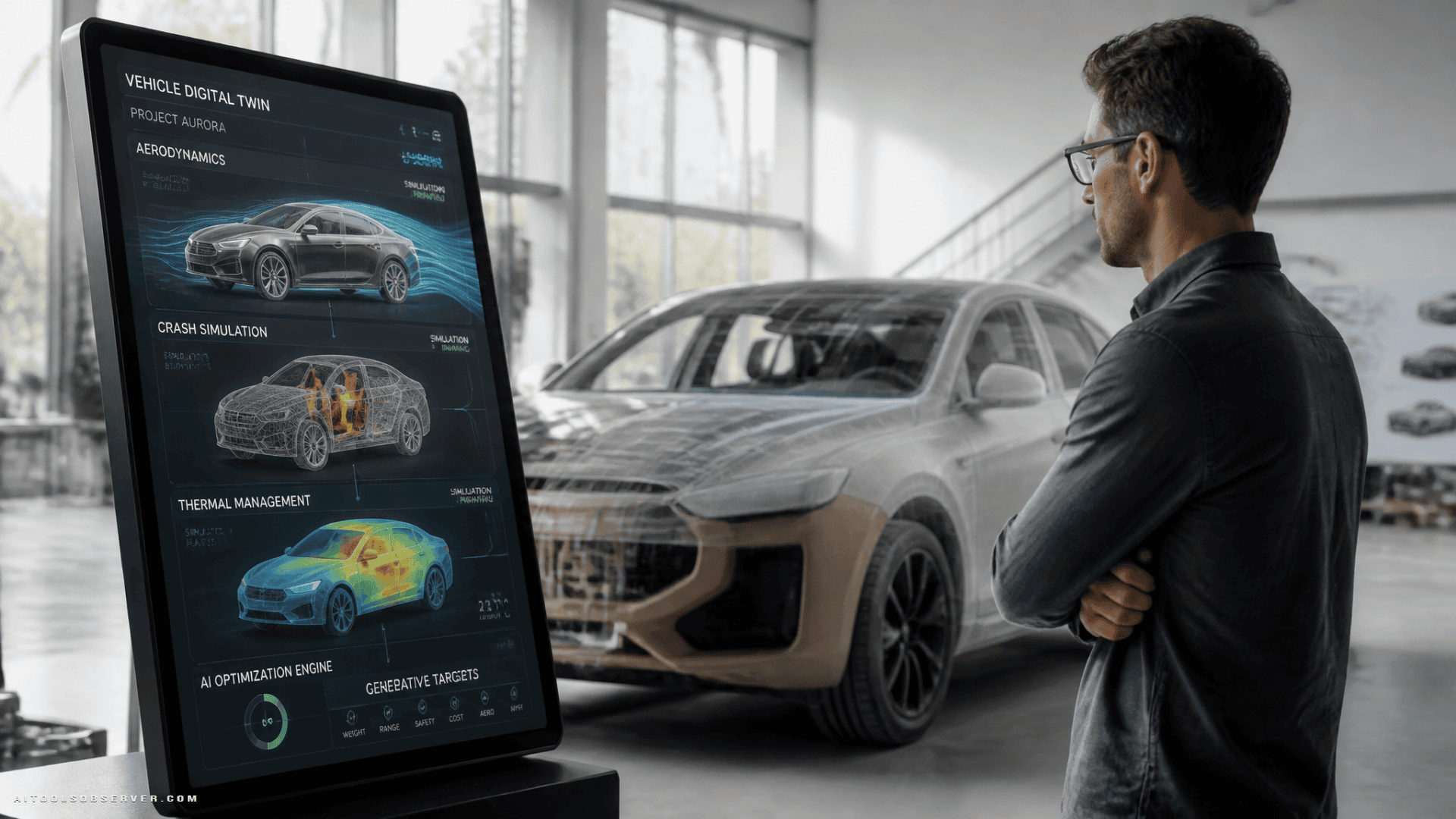
Rather than waiting for a body design to be finalized before touching the structure, teams now work in parallel on a unified digital model. A change to the aerodynamics updates the relevant data across chassis, crash safety, and interior systems — simultaneously.
That’s not just faster. It’s a fundamentally different way to build a car.
What AI Is Actually Doing Here
The acceleration comes from embedding AI, generative design, and advanced simulation across every stage of development:
- Virtual wind tunnels run alongside exterior design, not after it
- Co-simulations balance energy use and cabin cooling at the same time
- Virtual crash tests inform chassis decisions before a physical prototype exists
- Generative design tools explore structural options faster than any human team could iterate
None of these tools are new in isolation. What’s new is weaving them into a single, connected pipeline where outputs from one discipline immediately feed into others.
Why This Matters Beyond GM
A two-year development cycle changes competitive dynamics significantly. Faster iteration means faster response to market shifts, regulatory changes, or new technology — like battery chemistry improvements or new driver-assist capabilities.
For a company with $185 billion in revenue, shaving two to three years off each vehicle program isn’t just an engineering win. It’s a strategic one.
The Practical Takeaway
GM’s approach is a useful model for any complex product organization, not just automakers. The real insight isn’t “use more AI.” It’s replace sequential handoffs with concurrent, connected workflows — and let AI handle the coordination overhead that makes parallelism hard.
The tools are increasingly available. The bottleneck is usually the process architecture around them.











Comments (0) No comments yet
Want to join this discussion? Login or Register.
No comments yet. Be the first to share your thoughts!