


Who Is Tilly Norwood and Why Does She Matter
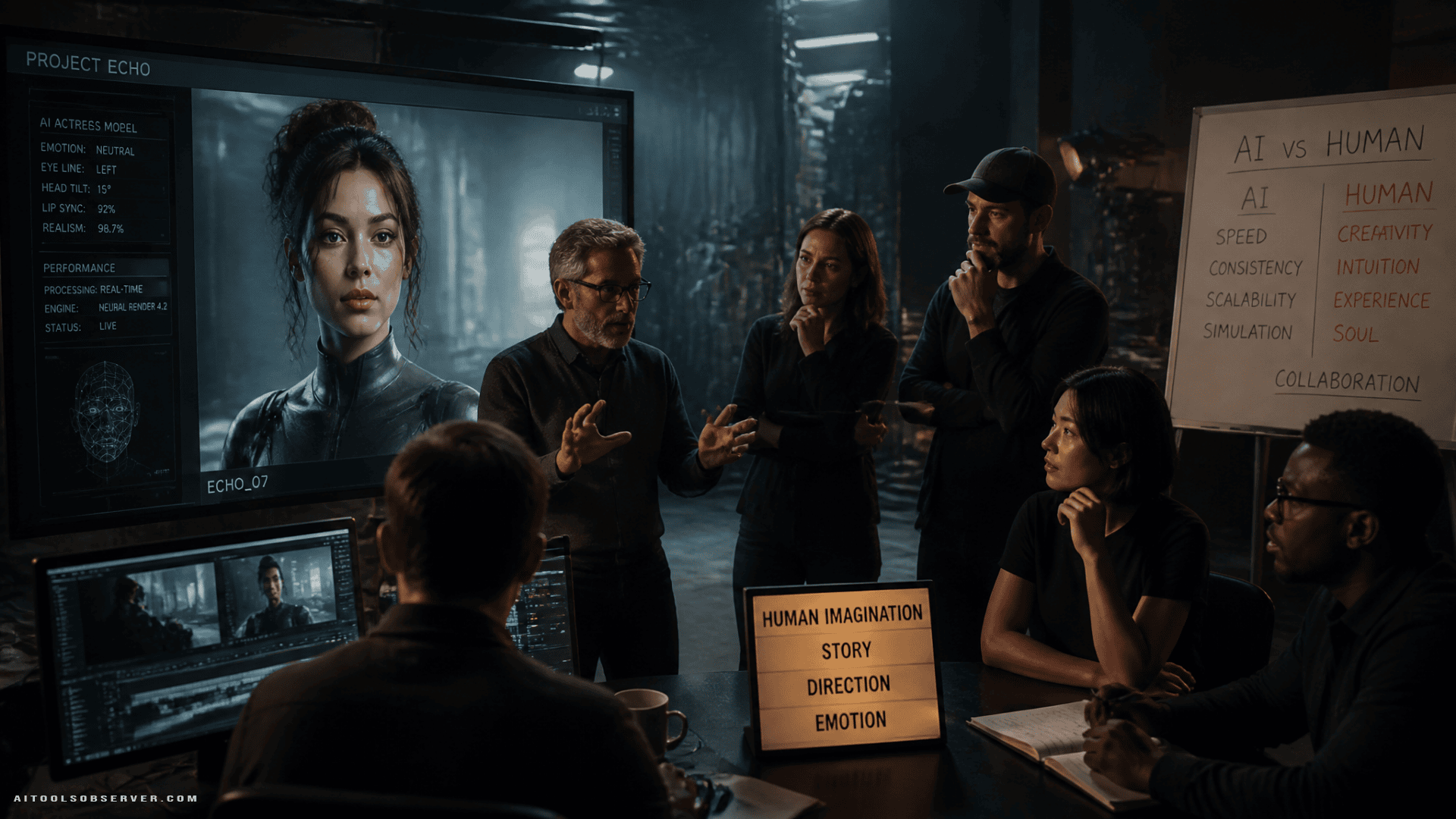
Tilly Norwood is a synthetic performer — fully AI-generated, not a human actor using a stage name. Particle6 created her specifically to demonstrate what AI can do in narrative filmmaking.
The studio’s director, Van der Velden, framed the project deliberately. The film will be “funny, chaotic and self-aware,” she said, but with something deeper underneath — exploring identity, performance, and the very human fears that AI triggers. That’s a self-aware creative choice, not just a tech demo.
Van der Velden was also direct about the production model: traditional film professionals — directors, writers, editors — working alongside AI specialists. The message was clear: this isn’t AI replacing humans. It’s AI embedded within a human-led process.
But the industry didn’t receive it that way.
The Backlash Was Fast and Specific
SAG-AFTRA, the entertainment industry union representing actors and media professionals, responded quickly. The union stated it does not consider Norwood an actor, and that “creativity is, and should remain, human-centered.”
That’s not a vague philosophical objection. It’s a boundary drawn in labor terms.
The concern isn’t really about one AI character in one film. It’s about precedent. If a studio can introduce a synthetic performer, market her like a real actor, and build a film around her, what stops the next studio from doing the same — but without the human crew, the ethical framing, or the transparency?
That’s the slippery slope the industry is trying to block before it becomes standard practice.
Why 2023 Still Matters Here
The Tilly Norwood situation didn’t emerge in a vacuum. It lands directly on top of unresolved tension from the 2023 SAG-AFTRA strikes — the first time industry professionals walked out in 15 years.
AI guardrails were a central sticking point in those negotiations. Actors wanted guarantees that studios wouldn’t use AI to replace human performances, scan likenesses without consent, or generate synthetic versions of real performers. The final labor agreement placed limits on how AI can be used in production.
Particle6’s introduction of a fully synthetic actor — even a fictional one with no real human counterpart — tests the spirit of those agreements. It raises a question the contracts may not have fully anticipated: what happens when the AI performer was never human to begin with?
What Particle6 Is Actually Arguing
It’s worth separating the studio’s stated position from the controversy around it.
Van der Velden’s argument is nuanced: AI can support premium narrative filmmaking, but only with “substantial amounts of human craft, skill, judgment and time.” She framed that not as a limitation of the technology, but as the point.
That’s a meaningful distinction. It pushes back against the idea that AI tools are plug-and-play replacements for human creative work. It positions AI as infrastructure — powerful, but dependent on skilled humans to produce anything worth watching.
Whether you find that reassuring or insufficient depends on where you sit in the industry. For a writer or director, it might sound reasonable. For an actor whose livelihood depends on being cast, it still represents a category of competition that didn’t exist before.
The Broader Pattern for AI Tools in Creative Industries
What’s happening in film is a compressed version of what’s playing out across every creative sector — writing, design, music, voice work.
A few patterns are worth tracking:
- Transparency is becoming a differentiator. Particle6 was upfront about Norwood being AI-generated. Studios that obscure this will face harder backlash when it surfaces.
- Labor agreements are the new regulatory layer. In the absence of government regulation, unions are setting the guardrails. That’s already shaping what AI tools studios can legally deploy.
- The “AI plus humans” framing is everywhere — but execution varies. Saying AI supports human creativity is easy. Proving it in a production context is harder and more expensive than most tools vendors admit.
- Synthetic performers are a new tool category. Whether they expand or collapse depends heavily on how early adopters like Particle6 handle the cultural and legal friction.
What This Means for AI Tool Builders and Adopters
If you’re building AI tools for creative workflows, the Tilly Norwood situation is a case study in deployment risk. The technology worked. The controversy wasn’t about capability — it was about context, consent, and category.
For teams evaluating AI tools in media, entertainment, or content production, a few questions are now non-negotiable:
- Does the tool have a clear policy on synthetic performers or generated likenesses?
- How does it interact with existing labor agreements or platform terms?
- Is the human creative role genuinely preserved, or just described that way in the marketing?
The guardrails being built in Hollywood right now will eventually influence how AI tools are evaluated, licensed, and deployed across the broader creative economy.
The Takeaway
Tilly Norwood isn’t the last AI-generated performer you’ll hear about. She’s the first one that forced a public reckoning.
The real story isn’t whether AI can play a role in film — it clearly can. The story is whether the industry can build frameworks fast enough to govern how it does. SAG-AFTRA is drawing lines. Studios are testing them. And the tools enabling all of this are evolving faster than the agreements meant to contain them.
For anyone in the AI tools space: watch how this resolves. The precedents being set in entertainment will shape what responsible AI deployment looks like in every creative field that follows.





Comments (0) No comments yet
Want to join this discussion? Login or Register.
No comments yet. Be the first to share your thoughts!