


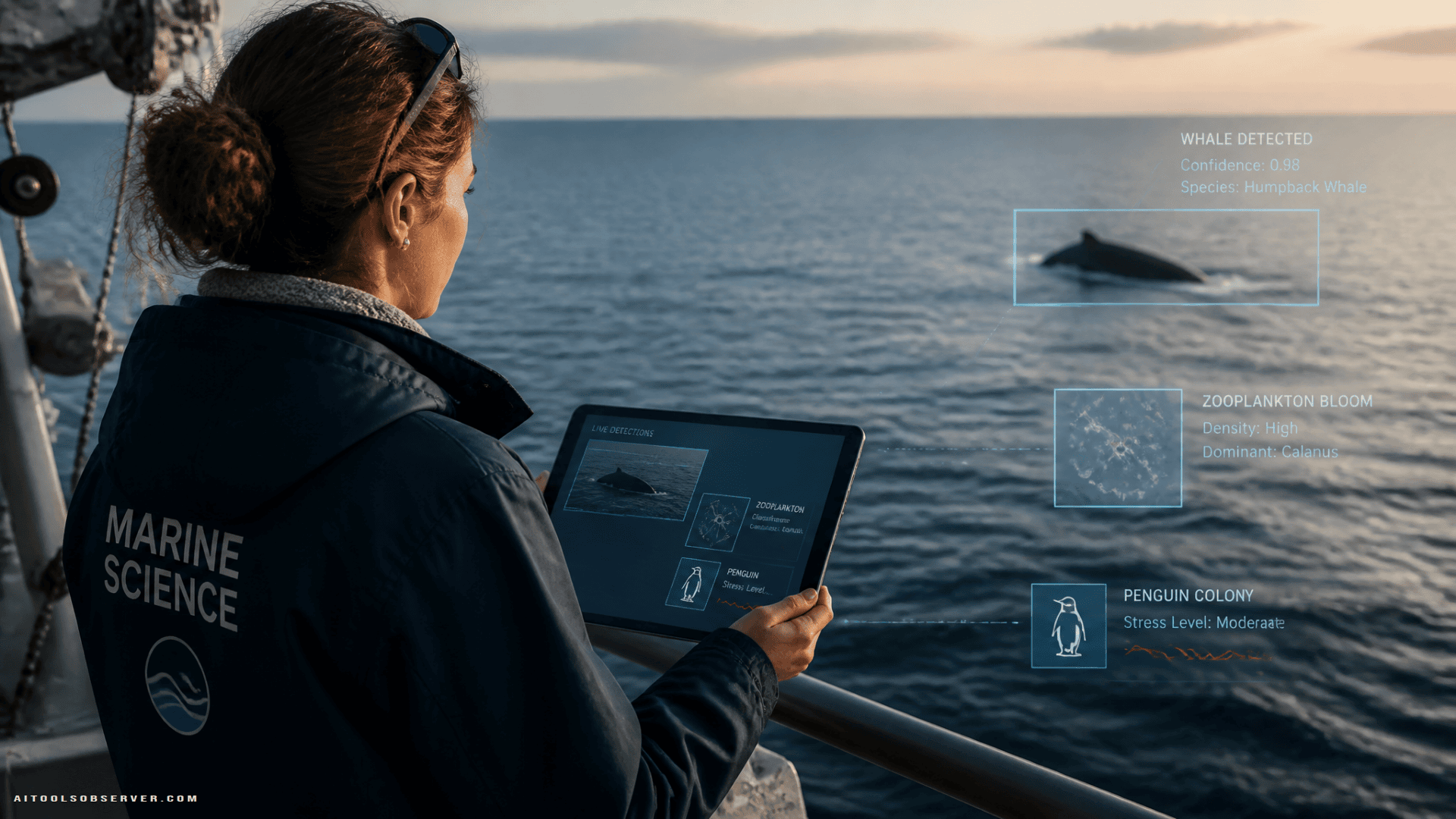
A Robot That Reads Penguin Moods
In Antarctica, a small yellow robot called ECHO moves at roughly one centimeter per second across the ice. Its job: monitor emperor penguin colonies without spooking them.
AI recognition tools help ECHO read the penguins’ stress levels in real time. A green bounding box means the penguin is calm. A red box means it’s stressed — and ECHO slows down or stops. The system was developed by Daniel Zitterbart, associate scientist at WHOI, who leads the project.
The penguins aren’t just a curiosity. The Southern Ocean absorbs a significant portion of global CO2 and plays a major role in regulating the planet’s temperature. Penguin colony health serves as a proxy for the broader ecosystem. If the penguins are doing well, the ocean likely is too.
“There is no AI that can help me go out in the field and catch a penguin,” Zitterbart said. “To learn about the natural world, you still need to go into the natural world.”
300 Million Plankton Images — and Counting
Heidi Sosik, a senior scientist in WHOI’s biology department, has used AI to monitor plankton in the North Atlantic for over 20 years. She started by repurposing fingerprint-recognition software to identify microscopic marine species — one of the earliest practical applications of image recognition in ocean science.
When she began, she was processing around 300,000 images. Today, that number is 300 million.
Plankton sit at the base of the ocean food web. Tracking their populations and diversity gives scientists an early signal of ecosystem health and the effects of climate change. Without AI-assisted image classification, analyzing data at this scale simply wouldn’t be possible with available research staff.
WhaleSpotter: AI That Helps Boats Avoid Whales
Vessel strikes are one of the leading causes of marine mammal death. For the critically endangered North Atlantic right whale — with fewer than 400 individuals remaining — a single collision can be catastrophic. Vessel strikes account for more than a third of right whale deaths, according to WHOI.
WhaleSpotter, another Zitterbart project, uses AI to detect nearby whales in real time, giving boat captains enough warning to change course. The system can identify multiple whale species, including the North Atlantic right whale.
Critically, the AI flags potential sightings — but a human scientist reviews and verifies the data after the fact. The tool accelerates response time; it doesn’t replace expert judgment.
Surveying Fish Stocks on the Ocean Floor
SMAST’s HabCam survey has been filming the ocean floor since the 1990s, using drop cameras to monitor scallop populations on Georges Bank and track Atlantic cod recovery in the Gulf of Maine. The result is thousands of hours of underwater video that someone has to watch.
Historically, that task fell to graduate students. Now, SMAST Dean Kevin Stokesbury says his team uses AI “as much as possible” to automate species identification in the footage.
But it’s not a solved problem. Tracking whether the fish in one frame is the same individual in the next frame — and correctly identifying the species — remains a genuinely hard computer vision challenge. The AI helps, but it requires careful validation.
The Human-in-the-Loop Principle
Across all of these applications, one principle holds firm: no AI makes a final decision without human review.
Sosik put it plainly: “It’s a tool like any other. It’s only as good as its user.”
Zitterbart goes further. He’s skeptical of most AI products being released today and doesn’t plan to incorporate newer tools into his research for many more years. The systems he trusts were built gradually, tested rigorously, and validated against real-world data over decades.
This isn’t technophobia. It’s scientific discipline. In research contexts where bad data can distort policy decisions — fisheries management, endangered species protection, climate modeling — the cost of an unchecked AI error is high.
The Environmental Tradeoff Worth Acknowledging
There’s an uncomfortable irony in using energy-intensive AI to study climate-vulnerable ecosystems. Data centers that power large AI models consume significant amounts of electricity and water. As demand for AI infrastructure grows, so does pressure on energy grids.
Massachusetts has not yet seen data center proposals, but state energy officials expect that to change. For researchers using AI to track the effects of climate change, this tension is real — and worth naming honestly.
The tools being used in marine research are generally narrower and less resource-intensive than large language models. But the broader AI industry’s environmental footprint is a legitimate concern that the field is still working through.
The Funding Pressure Reshaping Research Choices
Federal funding cuts are pushing some researchers toward private grants from companies like Google and Amazon, which offer between $500,000 and $1 million per grant — less than what’s available through the National Science Foundation, but increasingly necessary to fill gaps.
Kris Lewis, an assistant professor at the University of Rhode Island Graduate School of Oceanography, is evaluating these options. Her concern isn’t the money itself — it’s transparency. With NSF and NOAA, she knows who reviews applications. With private tech companies, that process is less clear.
At WHOI, researchers are more cautious about private funding, partly because private partnerships often involve intellectual property agreements that limit academic freedom. Zitterbart avoids them entirely for that reason.
The funding landscape matters because it shapes what research gets done, who controls the findings, and whether scientists can publish freely. That’s not an abstract concern — it directly affects the quality and independence of the science.
What This Means for AI Tool Adopters
If you’re evaluating AI tools for data-intensive research or monitoring workflows, the marine science field offers a useful model:
- Start narrow. The most effective tools here solve one specific problem — species identification, stress detection, vessel collision avoidance — rather than trying to do everything.
- Build in human review. Automation accelerates data processing; expert judgment validates it. These aren’t competing priorities.
- Expect a long validation runway. The tools Sosik and Zitterbart trust took years to develop and test. Fast-moving AI products may not meet that bar yet.
- Watch the funding strings. Whether in research or business, who funds your AI adoption can shape what you’re allowed to do with the results.
The most useful takeaway from ocean science AI isn’t about the technology itself. It’s about the discipline required to use it well — knowing what it can handle, where it fails, and why a human still needs to be in the room.










Comments (0) No comments yet
Want to join this discussion? Login or Register.
No comments yet. Be the first to share your thoughts!