


The Core Problem: AI Is Amplifying Existing Billing Incentives
Medical billing and coding professionals translate diagnoses and procedures into standardized codes. Those codes determine what insurers pay and what patients owe. The system has always had financial pressure baked into it. AI appears to be turning up the heat.
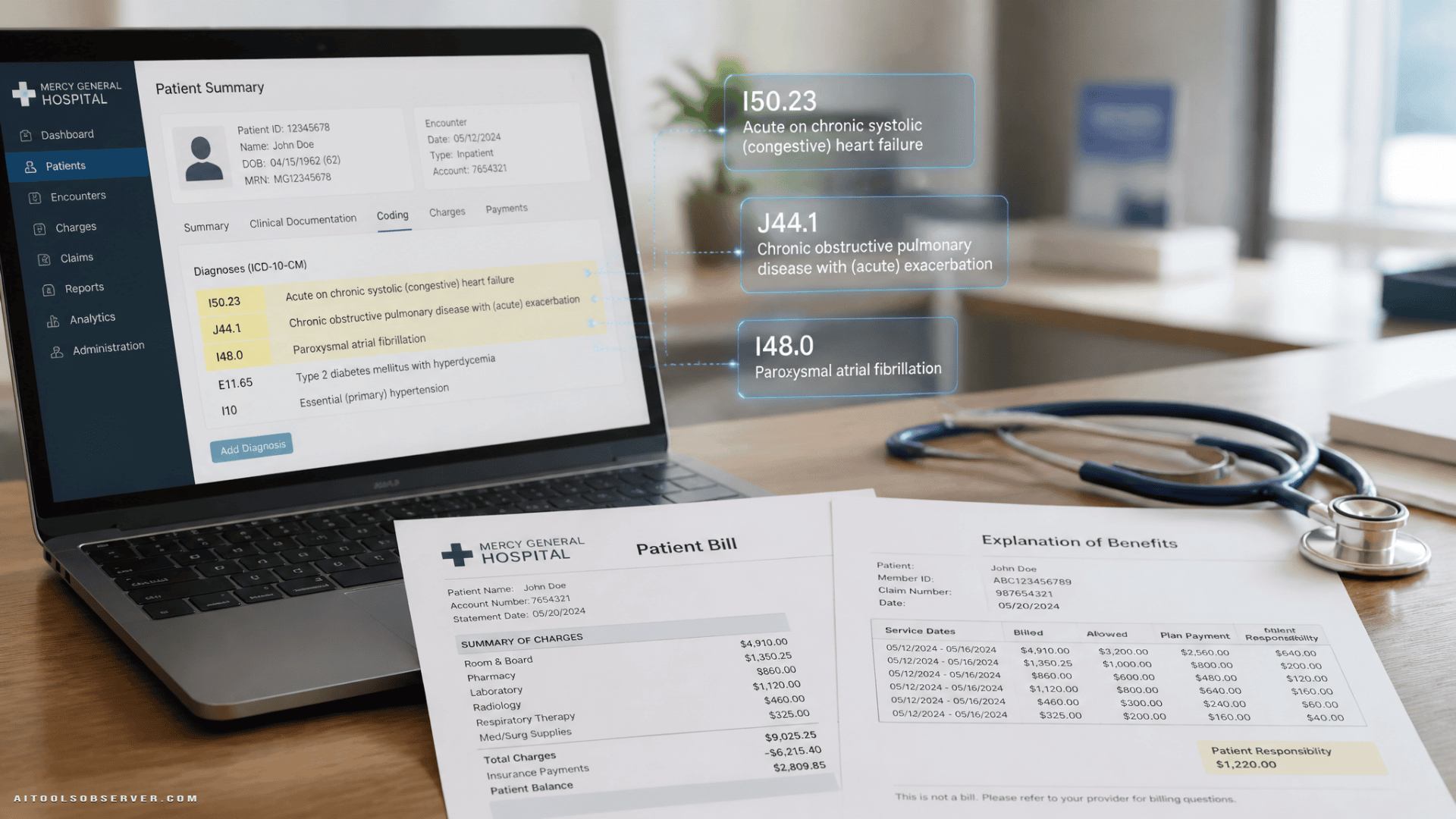
Blue Cross Blue Shield Association estimated that hospitals’ use of AI-assisted medical coding contributed to close to $1 billion in additional costs for its health plans between 2023 and 2025. Much of that increase came from secondary diagnoses that moved patients into higher-paying reimbursement categories—diagnoses that, in many cases, were not accompanied by any change in care.
Roughly 70% of that billing increase, or $653 million, was tied to additional diagnoses that didn’t result in different treatment.
Health economist Christopher Whaley at Brown University put it plainly: AI appears to be “accelerating, and in some sense making it easier to capture, the existing and underlying billing incentives that are in the system.”
That’s not the same as fraud. Many of the additional diagnoses are legitimate and were simply undercaptured before. But some conditions “clinically just don’t really matter and don’t influence the patient’s care,” while still allowing another billing code—and a higher payment.
What This Means for Patients
The financial impact doesn’t stay inside the hospital-insurer relationship. It flows downstream.
Luke Chalker, BCBSA’s senior vice president of product and data science, said consumers have reason to be concerned. More complex coding can lead to higher reimbursement without more care. “Those costs can eventually show up in the form of higher premiums and out-of-pocket costs,” he said.
Benefits consulting firm Marsh has forecast that the cost per employee for health coverage is expected to rise 8.2% on average in 2027—which would mark the highest increase since 2003. AI-driven coding intensity is one factor in a larger picture, but it’s a factor worth watching.
The Hospital Side of the Argument
The American Hospital Association pushed back on BCBSA’s analysis, arguing that patients today are older and more clinically complex, and that AI tools are helping providers “appropriately capture their patients’ conditions to aid in care planning.”
The AHA also pointed out the tension in insurers raising concerns about provider coding while simultaneously using automated tools to downcode claims and issue denials—practices that add administrative burden and cost on the provider side.
That’s a fair point. This isn’t a clean story of one side gaming the system.
Marisa Greenwald, a partner at Oliver Wiver Wyman’s Health and Life Sciences practice, noted that AI is already producing real benefits. Physicians spend less time on documentation after hours. More accurate coding can capture diagnoses that were genuinely missed. There are legitimate efficiency gains here.
But she also acknowledged the difficulty: “It’s hard to disentangle how much of it is better accuracy. There’s always going to be misuse and user error and overcoding.”
An Administrative Arms Race Nobody Wins
Here’s where the trend gets structurally concerning.
Hospitals are using AI to code more aggressively. Insurers are using AI to scrutinize and deny claims. Providers are then using AI to appeal those denials at scale. Each side is investing in increasingly sophisticated tools—tools that have nothing to do with delivering care.
Whaley called it an “administrative arms race.” Greenwald was more vivid: if both sides keep escalating, healthcare could end up with “robots talking to robots and just fighting with each other.”
Those tool costs don’t disappear. They flow through the system to consumers.
Where AI Is Operating in the Billing Cycle Right Now
- Clinical documentation: AI captures diagnoses and procedures during or after patient encounters
- Coding: AI translates documentation into billing codes, often surfacing secondary diagnoses
- Claims review: Insurers use AI to flag, downcode, or deny claims
- Appeals: Providers use AI to generate and submit denial appeals at scale
AI is now present at every stage of the same billing dispute.
For a related view of how AI affects operational workflows beyond billing, see AI for Patient Access, Referrals, and Care Coordination.
The Human-in-the-Loop Question
Vanessa Moldovan, author of The Healthcare Revenue Cycle AI Playbook and head of RCM strategy at Magical, made a point worth anchoring to: the tensions around medical coding existed long before AI. You could line up ten human coders reviewing the same chart and get ten different results.
But she draws a firm line at unsupported diagnoses. “If the patient didn’t have those conditions, they didn’t have those conditions.” That’s why she opposes fully autonomous coding. “There should always be a human in the loop.”
Chalker agreed, saying AI should “support decision-making, not replace human judgment.”
There’s also a patient safety dimension that often gets overlooked. AI-generated diagnoses can become part of a patient’s permanent medical record. Moldovan flagged the risk of over-trusting AI outputs simply because they come from a machine. “I think we’re in danger of trusting it too much because we’re like, ‘Oh cool, it’s AI, it must be smarter.’”
The Right Test for AI in Healthcare Billing
Whaley offered a useful frame for evaluating whether AI investment in billing is actually worthwhile.
If AI increases spending but improves access or quality of care, that could still be a net positive. The problem is when AI is used purely to “shuffle the cards a little bit more and make sure you come out on top” without doing anything meaningful for patients.
That’s the question healthcare systems, insurers, regulators, and patients should be asking: Is this AI improving care, or is it just improving someone’s position in a billing dispute?
What to Watch
For anyone tracking the AI tools ecosystem in healthcare, a few dynamics are worth following closely:
- Regulatory scrutiny of AI-assisted upcoding is likely to increase as the cost data becomes harder to ignore
- Audit requirements for AI-generated coding are an emerging best practice—similar to how human coders have always been audited
- Insurer AI tools for claims review are becoming more sophisticated, which will pressure providers to invest more in their own AI defenses
- Transparency standards around which AI tools are being used, and how, remain largely absent from the current landscape
The AI tools entering healthcare billing aren’t inherently problematic. Some are genuinely reducing administrative burden and helping providers get paid for care they actually delivered. But the same capabilities that improve documentation accuracy can also intensify financial incentives that were already misaligned with patient outcomes.
The smarter question isn’t whether to use AI in revenue cycle management. It’s whether the humans overseeing it are asking the right questions about what it’s actually optimizing for.
Related reading: AI Tools for Managed Care Authorizations and How Cigna Uses AI to Cut Costs and Improve Care.
















Comments (0) No comments yet
Want to join this discussion? Login or Register.
No comments yet. Be the first to share your thoughts!