


The Problem With Most Diet Tools
Most nutrition apps have the same fatal flaw: they ask too much, too fast.
Replace your entire breakfast. Cut out this food group. Follow this 28-day plan. The result? People disengage, revert, or just feel guilty about their pasta.
The UC Davis team took a different approach. Instead of redesigning meals from scratch, their AI works within existing meal patterns — the foods people already eat, already enjoy, already know how to cook.
The insight is almost embarrassingly simple: if the meal stays familiar, people actually follow through.
How the Model Works

The researchers trained a generative AI model on data from 135,491 meals logged by 55,228 adults in the “What We Eat in America” study. That’s a serious dataset — covering real breakfast, lunch, and dinner patterns across a wide population.
The model learned what meals actually look like in practice, not what nutritionists wish they looked like. Then it got to work finding the weakest link in each meal — the one ingredient doing the most nutritional damage — and suggesting a smarter alternative.
The substitutions are clustered around similar options, so the meal stays recognizable. You’re not being told to eat something alien. You’re being told to eat a slightly better version of what you already wanted.
The Numbers Are Surprisingly Good

Here’s where it gets interesting for anyone who cares about outcomes:
- ~10% improvement in overall nutritional quality
- 47% closer to USDA Dietary Guidelines
- 22–34% reduction in modeled meal costs
That last one tends to surprise people. Healthier eating has a reputation for being expensive. But when you’re swapping processed meat for legumes or refined grains for whole grains, you’re often moving down the price ladder, not up.
Lead author Ilias Tagkopoulos, director of the AI Institute for Next-Generation Food Systems, puts it plainly: the biggest gains came from replacing refined grains with whole grains, or swapping a processed meat component for a lean protein or legume. Better fiber, better protein quality, better micronutrient density — and a lower grocery bill.
The Sandwich Test

Tagkopoulos offers a clean example worth quoting directly:
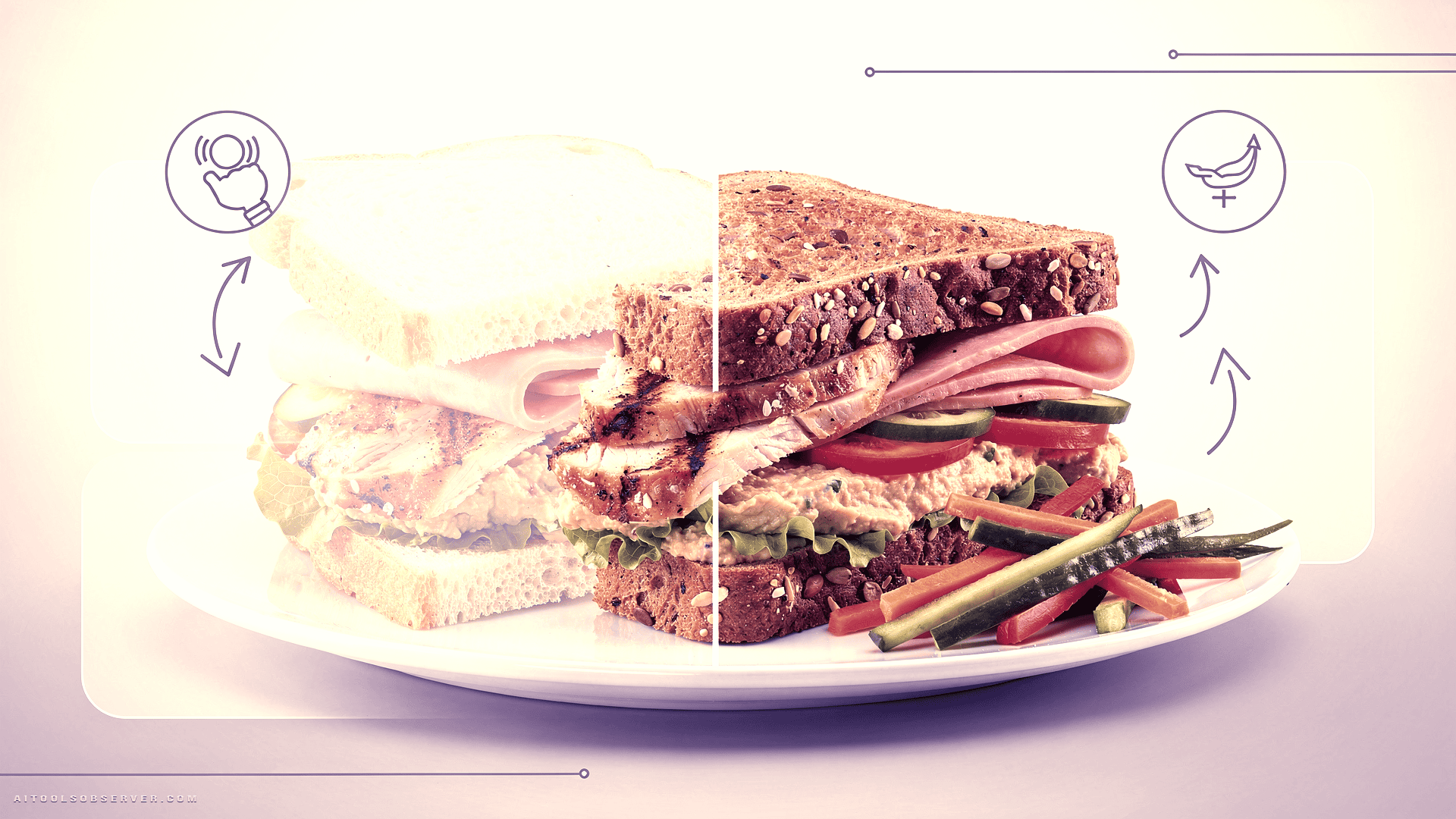
“In a typical sandwich, replacing white bread with whole-grain bread, processed meat with grilled chicken or hummus, and adding greens or tomato can increase fiber and micronutrients while reducing sodium and saturated fat. The meal is still a sandwich, but nutritionally it is much closer to dietary guidance.”
That’s the whole thesis in three swaps. The meal doesn’t change its identity. It just gets better at its job.
This is also what separates the model from a general-purpose LLM. When tested against GPT-4o, the specialized model produced meals significantly closer to the 2025–2030 USDA Dietary Guidelines. Domain-specific training matters — especially when the goal is precision, not creativity.
Cultural Identity Isn’t an Afterthought

One of the more thoughtful design choices here is how the model handles cultural context.
The researchers explicitly built the system to preserve meal familiarity — not just for convenience, but because food is identity. Telling someone to stop eating rice bowls or lentil dishes isn’t a nutrition strategy. It’s a fast track to being ignored.
The model was trained on US data, but Tagkopoulos sees a clear path to localization. European food consumption databases, Japan’s National Health and Nutrition Survey, Korea’s NHANES equivalent — the architecture is adaptable. The key is rebuilding with local data, local meal archetypes, and local price signals.
A mezze plate can be optimized. So can a noodle bowl. The logic scales; the data just needs to follow.
Where This Goes Next

The team is currently working with some heavyweight collaborators: the American Heart Association, the Rockefeller Foundation, the Periodic Table of Food Initiative, chefs, and school districts across the US. The $2 million Bezos Earth Fund award backing the project signals this isn’t just an academic exercise.
But Tagkopoulos is candid about what still needs to happen before this lands in a consumer app or public health program.
Personalization is the hard part. Allergies, medical conditions, cooking skill, local food availability, cultural preferences, budget constraints — a useful system has to hold all of that simultaneously. And it has to earn trust. Users need to understand why a swap is recommended, not just receive an algorithmic nudge they can’t interrogate.
Real-world validation studies are still needed. The current evaluation is entirely computational.
What This Means for AI Tool Builders
If you’re building in the health, food, or wellness space, this research is a useful design signal.
The winning move isn’t to maximize recommendations — it’s to minimize friction. One to three swaps beats a 30-item meal plan every time. Familiarity is a feature, not a compromise. And cost-awareness isn’t a nice-to-have; it’s a core part of whether anyone actually adopts your suggestions.
The generative AI layer here isn’t doing anything flashy. It’s doing something harder: being genuinely useful within the constraints of real human behavior.
The Takeaway
The best diet tool isn’t the one with the most features. It’s the one that changes the least while improving the most.
Swap the bread. Keep the sandwich. That’s not a compromise — that’s good design.

















Comments (0) No comments yet
Want to join this discussion? Login or Register.
No comments yet. Be the first to share your thoughts!