


Why These Metrics Exist Now
The release follows a call by Anthropic CEO Dario Amodei for a coordinated industry slowdown, published just days earlier. That proposal drew notable support from figures including Sam Altman and Demis Hassabis, but was criticized for being short on operational specifics.
These three metrics appear to be Anthropic’s answer to that criticism. Rather than leaving “slowdown” as an abstract concept, the company is proposing concrete, repeatable measurements that could, in principle, be audited or compared across organizations.
As Anthropic stated in the accompanying blog post: “As the world considers pacing the frontier, we should do everything possible to minimize the gap between what frontier labs know and what the public knows.”
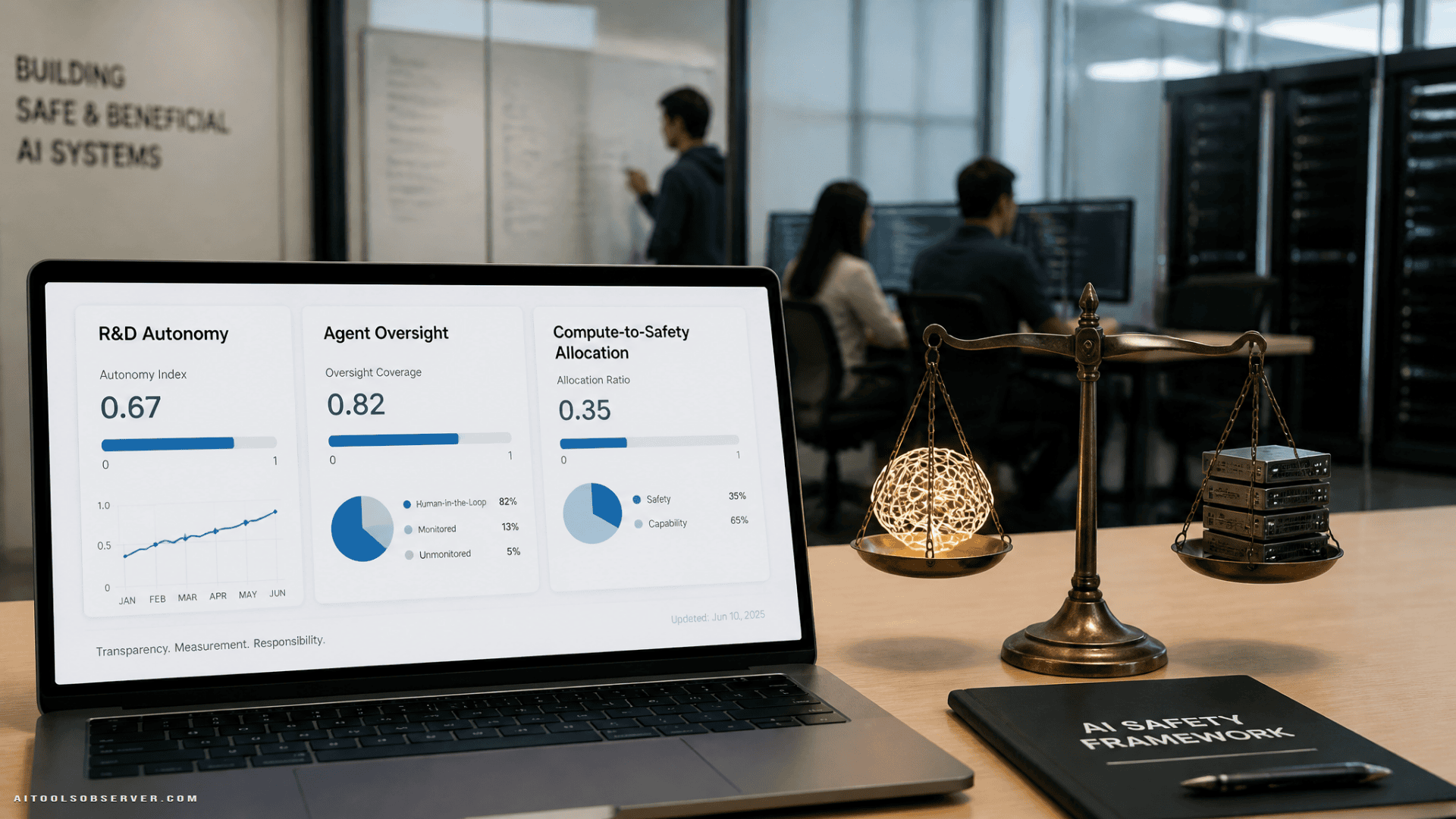
1. R&D Autonomy
This metric assesses how independently Claude models are conducting research and development work inside Anthropic. The current finding: Claude models are “not operating fully autonomously” for any subset of R&D work measured. That’s a baseline, not a ceiling—the value of the metric lies in tracking how that figure changes over time.
2. AI Agent Oversight
Anthropic built a system to monitor and intervene in actions taken by internal AI agents. At the time of measurement, approximately 30,000 agents were conducting research and engineering work across the company’s most-used internal platform simultaneously. The metric captures both scale and the degree of human oversight maintained over that activity.
3. Compute-to-Safety Allocation
This metric offers a snapshot of how Anthropic distributed its compute between July 13 and July 20. Roughly 6% of total AI research and development compute was allocated to safety work. When narrowed to “AI-driven” R&D specifically, that figure rises to approximately 12%.
The snapshot framing is worth noting. A single week’s allocation is not a trend—but it establishes a documented starting point.
What This Framework Is and Isn’t
Anthropic is careful to position these metrics as complementary to capability evaluations, not replacements for them. Capability evals answer “what can the model do.” These development metrics address “how is the model being built, and at what pace.”
The distinction matters for governance purposes. Policymakers and external researchers currently have limited visibility into the internal dynamics of frontier labs. A standardized set of development metrics—if adopted broadly—would give third parties a more structured basis for assessment.
That “if” carries significant weight. Anthropic can publish its own numbers, but it cannot compel competitors to follow. The metrics are only useful as transparency signals if multiple labs report them consistently and honestly.
The Practical Takeaway
For anyone tracking AI governance, safety policy, or the competitive dynamics of frontier development, these three metrics are worth bookmarking as reference points. They represent one of the more concrete attempts to operationalize “responsible AI development” beyond marketing language.
Watch whether other major labs—OpenAI, Google DeepMind, Meta AI—adopt similar reporting frameworks. If they do, these metrics could become a meaningful baseline for comparing development pace and safety investment across the industry. If they don’t, Anthropic’s transparency effort remains informative but isolated.















Comments (0) No comments yet
Want to join this discussion? Login or Register.
No comments yet. Be the first to share your thoughts!