


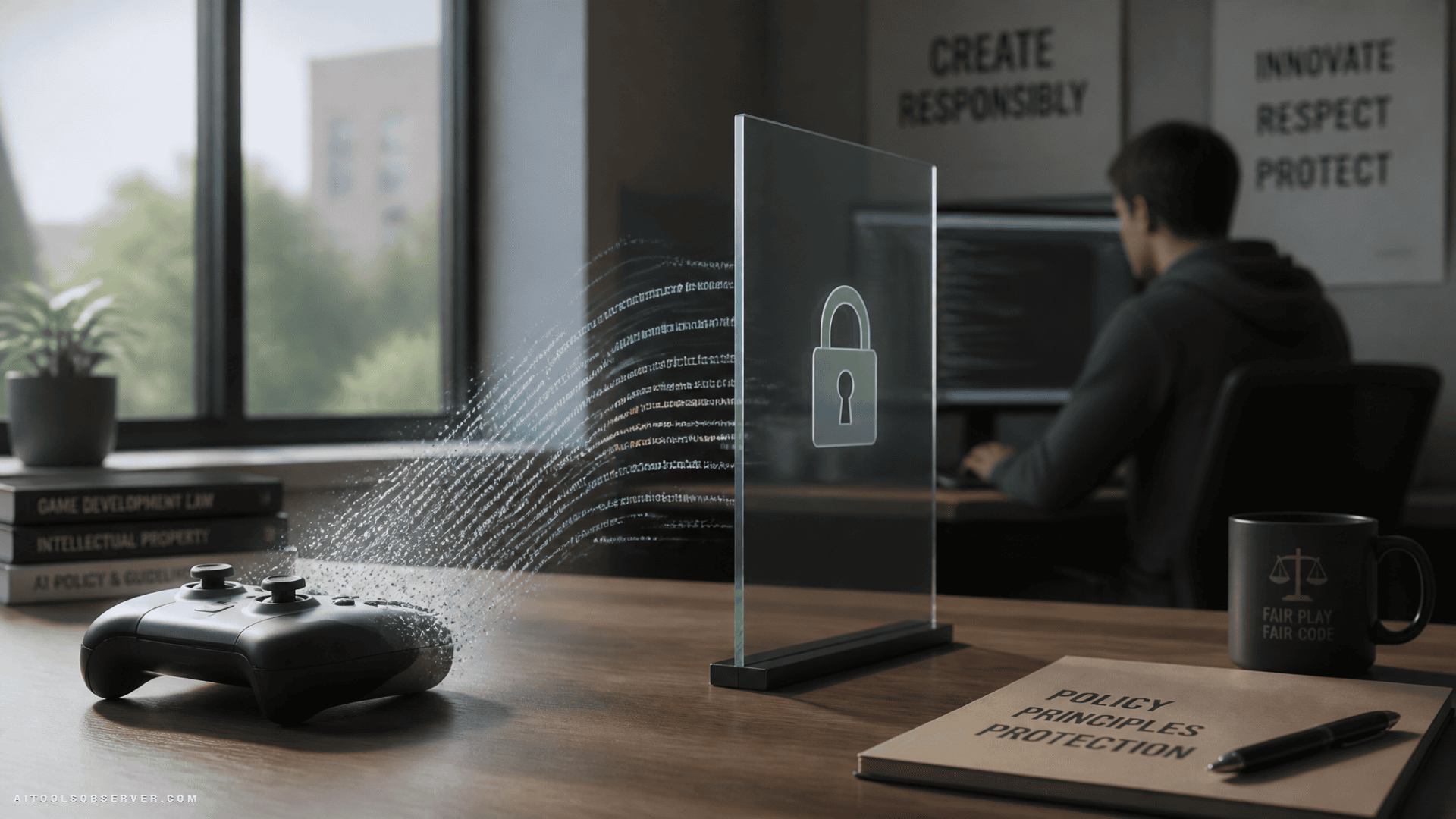
What reportedly changed in Claude
Based on recent reports, Claude now appears more likely to refuse requests tied to recreating existing games, modifying commercial titles, or helping with reverse engineering-style tasks. The reported changes seem especially focused on preventing AI-assisted cloning of existing video games.
That matters because game cloning is not a niche concern. Smaller studios and indie teams often feel the impact first, since they have fewer legal and financial resources to defend original concepts, mechanics, or assets when copycat projects flood the market.
The broader issue is straightforward: if an AI assistant can help deconstruct a game and reproduce key parts of it, the tool may increase legal and ethical risk for both users and providers.
Why Anthropic would want tighter limits
Even without an official announcement, the logic behind this kind of restriction is easy to understand. Reverse engineering and cloning can intersect with copyright, platform rules, and intellectual property disputes.
For an AI company, allowing a model to actively assist with those workflows creates obvious exposure. It also raises harder questions about how much responsibility a model provider has when its system is used to imitate or rebuild someone else’s product.
This is especially sensitive in gaming, where disputes around ports, modding, console workarounds, and cloned titles already create friction. AI adds speed and scale to activities that were already controversial before large language models became common developer tools.
Why some developers may welcome this
There is a strong case for stricter guardrails.
If these reported restrictions reduce the ease of cloning existing games, they could help protect:
- Indie studios with limited legal protection
- Original game concepts from fast copycat releases
- Players from low-quality cloned titles
- AI vendors from being pulled into IP disputes
This is the practical side of AI policy that often gets overlooked. Safety rules are not just about abstract ethics. Sometimes they are about limiting obvious commercial misuse before it becomes standard practice.
For developers who build original games, tighter restrictions may feel less like censorship and more like overdue friction.
The downside: legitimate work may get blocked too
The bigger problem is overblocking.
Reports suggest that some developers are now hitting refusals even when they are trying to do routine, legitimate work. If Claude becomes too cautious, it may reject basic game development tasks simply because they resemble reverse engineering or modification requests.
That creates a familiar AI tooling problem: a safeguard designed to stop abuse can also make the product less useful for honest users.
In game development, that could affect tasks like:
- Understanding old project structures
- Debugging systems inspired by common genre conventions
- Refactoring code in legacy game projects
- Discussing compatibility, mechanics, or implementation patterns in general terms
The challenge is not whether guardrails should exist. It is whether the tool can distinguish between harmful imitation and normal development support.
Where the legal risk really sits
Developers sometimes assume the risk begins only when assets are copied directly. In reality, the danger can start much earlier.
Using AI to help recreate a game’s structure, systems, logic, or technical implementation may raise questions even when the output is not a literal one-to-one copy. If the workflow depends on decompilation, extraction, or close imitation of protected material, legal exposure can increase quickly.
That is why AI providers are likely to become more conservative here. From their perspective, blocking suspicious requests is easier than trying to judge intent perfectly on every prompt.
This also explains why broader restrictions across AI coding tools would not be surprising. As more developers use these systems for software and content workflows, policy teams will likely keep tightening rules around high-risk use cases.
What this means for AI policy in game development
This looks like part of a larger shift, not an isolated moderation tweak.
AI companies are under pressure to prove their tools can support creativity without enabling obvious misuse. In gaming, that means policy decisions will increasingly shape what assistants can do around:
- Decompilation
- Reverse engineering
- Asset reproduction
- System imitation
- Clone-style prototyping based on existing games
That has a direct product impact. The more legal and reputational risk AI vendors see in a category, the more restrictive those tools may become.
For studios, this means AI coding tools capability is no longer the only question. Tool reliability now includes policy reliability. A model that is technically strong but frequently refuses valid development tasks may become harder to use in production.
How developers should adapt
If you use AI tools in game development, this is a good moment to tighten your workflow assumptions.
A few practical adjustments can reduce friction:
1. Avoid prompts tied to existing commercial games
Do not ask an AI model to recreate, decompile, or rebuild a named game. Even if your goal is educational or exploratory, that wording is more likely to trigger refusal and may create unnecessary risk.
2. Ask for original implementations instead
Frame requests around mechanics, systems, or design patterns in generic terms. Ask for an original inventory system, dialogue manager, or platformer controller rather than a recreation of a specific title’s implementation.
3. Separate inspiration from imitation
Genre conventions are normal. Close reproduction is where things get risky. If your prompt reads like a shortcut to someone else’s shipped product, expect stricter tools to push back.
4. Keep human review in the loop
AI-generated code or design help should not be treated as a legal filter. Teams still need internal review around IP, licensing, and platform compliance.
5. Expect more policy changes across tools
Even if one model is still permissive today, that may not last. Build workflows that can survive stricter moderation tomorrow.
What to watch next
The key question is whether AI companies can build more precise guardrails instead of broader refusals. Developers do not just need safer tools. They need tools that can tell the difference between infringement risk and ordinary professional work.
If that balance is not solved, two things may happen at once: cloning gets harder, but legitimate development with AI gets more frustrating.
For teams choosing AI tools, this is the takeaway: do not evaluate a model only on coding quality. Look at how it handles sensitive requests, where it refuses, and whether its policy boundaries fit your real workflow. In game development, those limits are starting to matter as much as the model itself.













Comments (0) No comments yet
Want to join this discussion? Login or Register.
No comments yet. Be the first to share your thoughts!