


What changed
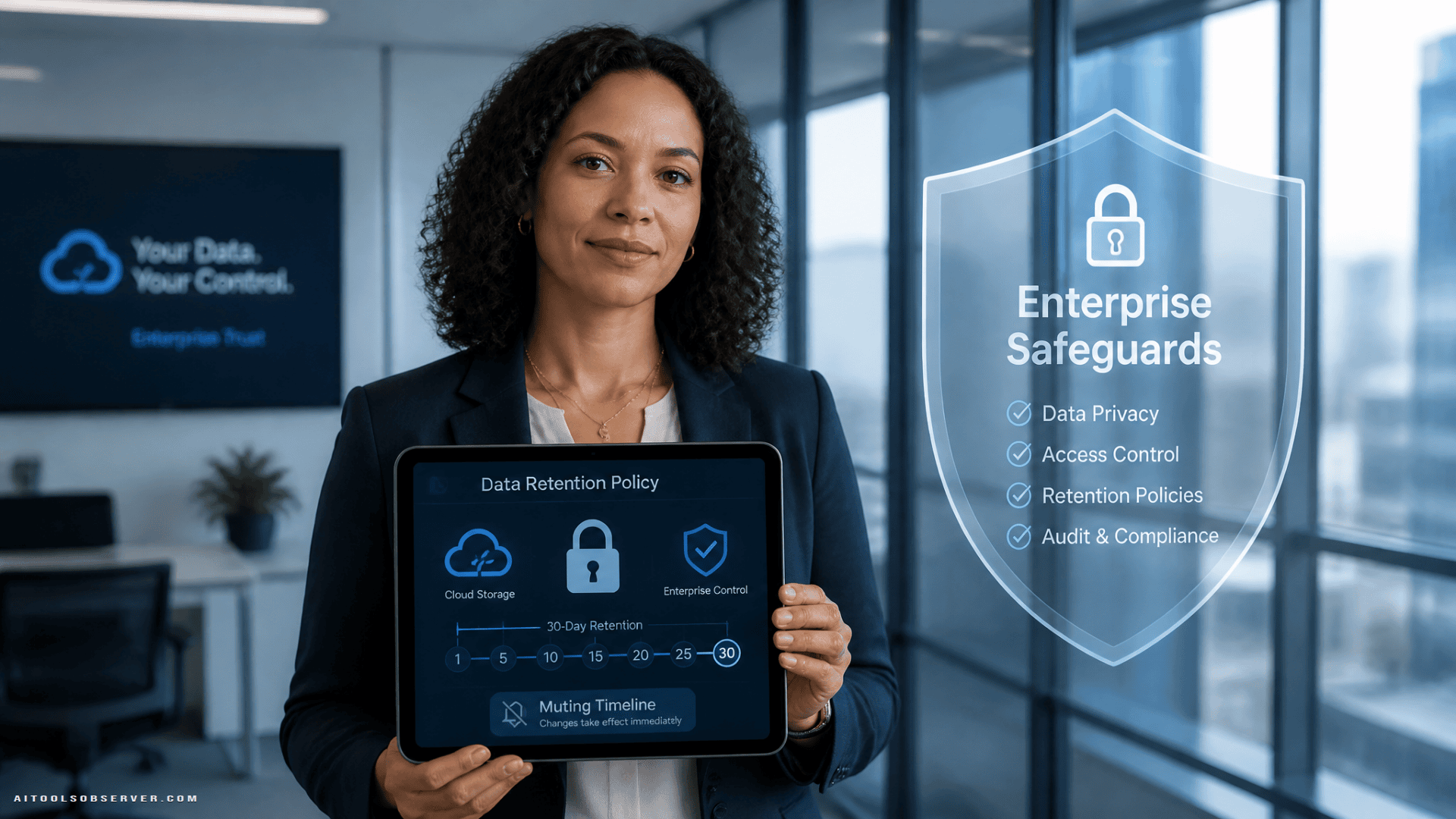
Back in June, Anthropic tied a 30-day retention requirement to traffic on its more advanced models, framing it as a safety measure against misuse and more complex cyber threats.
That may have made sense from a risk-management angle. It landed less smoothly with enterprise teams that have strict rules around data handling, compliance, and internal security posture.
The update appears to be Anthropic’s answer to that tension: keep the safety checks, but let businesses keep tighter control over where review and storage happen.
What Enterprise Frontier Safeguards is supposed to do
Based on the available details, the new setup is designed to give enterprise customers more control in three areas:
- how their data is reviewed
- how their data is stored
- how safety monitoring is managed
The practical shift is this: businesses can use automated safety monitoring without requiring Anthropic human review. That matters because many enterprise objections were never about safety itself. They were about who touches the data, where it lives, and what policies that triggers internally.
Anthropic also says these controls will apply whether customers use its models directly or through a cloud provider. That removes one common procurement headache: one policy for direct access, another for hosted access.
Why enterprises pushed back
For a consumer tool, a retention window can feel like boilerplate. For enterprises, it can block deployment outright.
Sensitive workloads often involve customer records, legal material, internal strategy documents, regulated data, or code. Even if a vendor promises not to use retained data for training, security and compliance teams still ask the same annoying-but-correct questions:
- Who can review it?
- Where is it stored?
- How long does it exist?
- Can we audit the process?
- Does this fit our own data governance rules?
That is the real story here. Enterprise AI adoption is increasingly less about model quality alone and more about operational trust.
Anthropic’s balancing act
Anthropic is trying to solve a familiar AI platform problem: safety teams want visibility, while enterprise customers want containment.
Enterprise Frontier Safeguards looks like an attempt to split the difference. Anthropic still gets the scanning it says it needs for misuse prevention, while customers get a setup that better matches stricter privacy requirements.
That is a much more enterprise-friendly pitch than “trust us, we’ll keep it for 30 days.”
The competitive angle
This is not happening in a vacuum. Enterprise AI vendors are converging on the same battleground: data control.
If two model providers are roughly comparable for a business use case, the winner is often not the one with the flashiest demo. It is the one that gives legal, security, and IT fewer reasons to say no.
Anthropic also faces pressure from rivals moving on similar retention and privacy concerns. In that context, this policy shift looks less like a side note and more like table stakes for serious enterprise deals.
What it means for Claude buyers
If you are evaluating Claude for enterprise use, this update changes the checklist.
Instead of treating retention policy as a fixed constraint, teams can now look more closely at:
- whether automated monitoring meets internal governance needs
- whether human review can be avoided for sensitive workloads
- how direct and cloud-based access compare under the new controls
- whether the safeguards are available for the models and use cases you actually need
The main caveat: rollout is phased, with broader availability expected later. So for buyers, “available in principle” is not the same as “ready for production next week.”
What about non-enterprise users?
Anthropic says the June retention policy still applies to non-enterprise subscribers using its Mythos-class models.
That split is worth noticing. Enterprise customers are getting more tailored controls because they demand them, and because they tend to drive the biggest contracts. Smaller users may not get the same flexibility.
In other words, privacy posture is becoming a premium feature of AI infrastructure.
Why this matters beyond Anthropic
This is one of the clearer signs that the AI market is maturing. Vendors can no longer treat safety, privacy, and governance as separate conversations.
For businesses, model access now comes bundled with policy design. The best tool is not just the one that performs well. It is the one your security team won’t turn into a six-week email chain.
Useful takeaway
If you are comparing enterprise AI platforms, don’t stop at model benchmarks. Ask how safety monitoring works, who can review data, where retention happens, and whether those controls hold up across direct and cloud deployments.
Anthropic’s update is a reminder that in enterprise AI, “can it do the task?” is only half the question. The other half is “can we use it without breaking our own rules?”






Comments (0) No comments yet
Want to join this discussion? Login or Register.
No comments yet. Be the first to share your thoughts!