


What ServiceNow actually launched
The update adds four main pieces to EmployeeWorks:
- Productivity Assistants
- Productivity Routines
- ToolSmith
- Conversations API
Taken together, they look less like a chatbot refresh and more like an attempt to turn internal operations into something employees can actually shape themselves.
That matters because enterprise AI agents often dies in one of two places: the pilot, or the handoff to IT.
The practical angle: less “AI assistant,” more “work assistant”
The most useful detail here is that ServiceNow is not framing these agents as generic helpers. They’re positioned around actual roles and repeatable work.
Productivity Assistants
These are specialized assistants built for persona-based tasks. According to the description, they can handle long-running work and actions across systems.
ServiceNow says pre-built assistants are available for HR Service Delivery use cases, including:
- Talent Insights Assistant
- HR Business Partner Assistant
- Manager Assistant
It also includes a:
- Research Assistant
- Calendaring Assistant
That mix says a lot. This is not just about answering questions in a chat window. It’s about handling internal tasks that usually bounce between portals, forms, approvals, and “who owns this?”
Productivity Routines may be the sleeper feature
If Productivity Assistants are the face of the release, Productivity Routines may be the feature operations teams care about most.
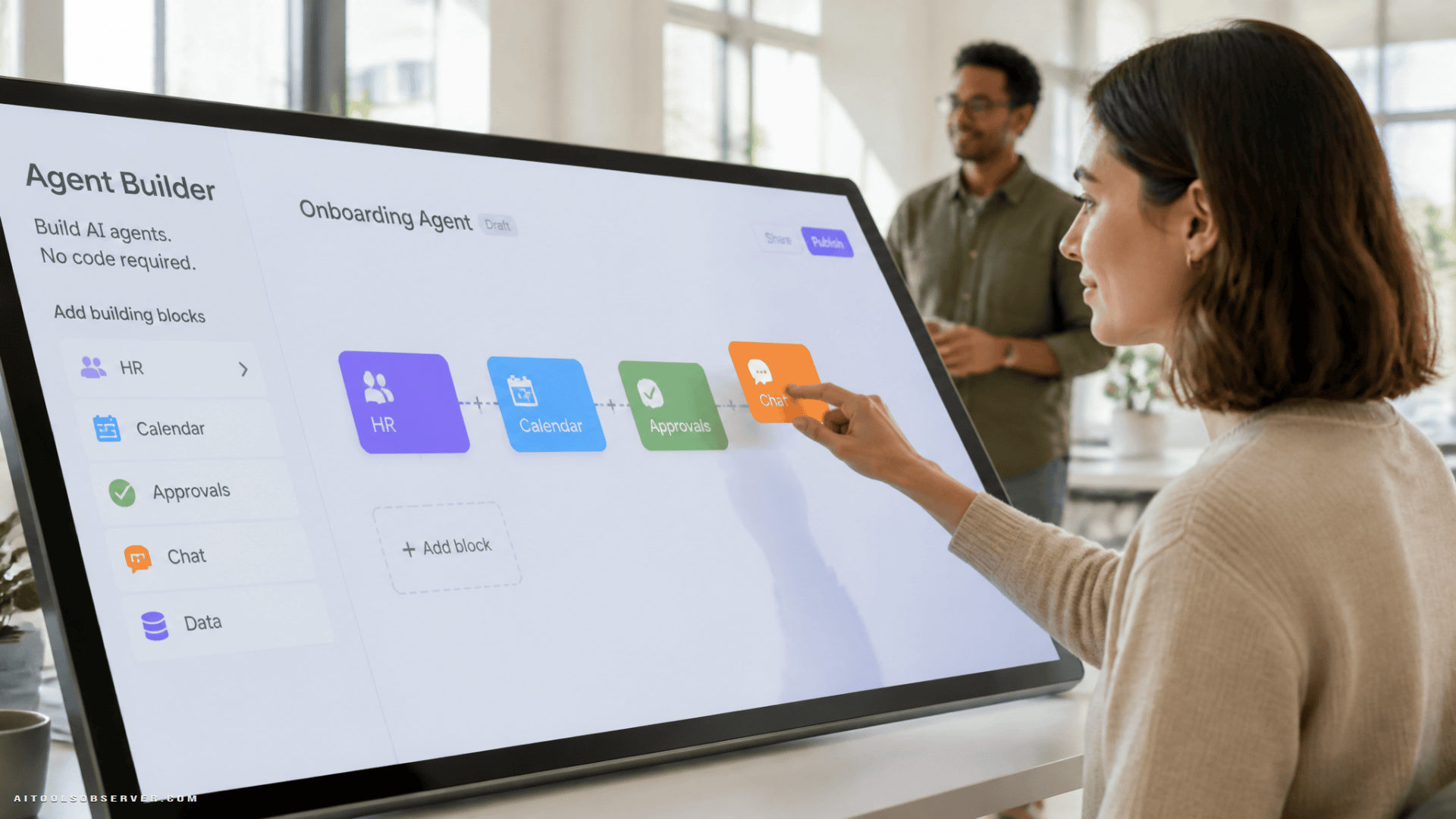
These routines let employees build agents that automate repetitive background tasks without needing to know backend systems or API integrations. In plain English: fewer manual clicks, less waiting on technical teams, and less “I have to do this every Friday and I hate it.”
That makes EmployeeWorks sound less like an AI layer and more like a no-code operations surface.
For HR and internal service teams, that could mean things like:
- recurring employee support workflows
- routine request handling
- process follow-ups that usually depend on someone remembering to do them
Not glamorous. Very useful.
ToolSmith is where ServiceNow tries to bridge no-code and dev-grade automation
ToolSmith is the most developer-facing part of the update, but it still follows the same simplification theme.
ServiceNow describes it as a developer environment trained on more than 75,000 APIs, where developers can describe automation goals in natural language. The company says this can reduce build times from weeks to minutes.
That claim should be read as directional, not universal. Enterprise workflows have a talent for becoming weird the second you touch them.
Still, the idea is clear: instead of manually wiring every step, developers can start with intent and let the platform handle more of the setup. For teams already living in ServiceNow, that could lower the cost of building internal automations that previously felt too annoying to prioritize.
The Conversations API is the enterprise-friendly move
A lot of AI products want you to come to them. Enterprises usually want the opposite.
The Conversations API appears designed for that reality. It allows organizations to integrate EmployeeWorks capabilities into existing internal apps and tools without rearchitecting systems.
That may be the least flashy part of the release and the most important. If the agents only work inside one polished demo environment, adoption gets weird fast. If they can show up inside the systems employees already use, the odds improve.
In enterprise software, “no rearchitecture required” is basically poetry.
Who this looks built for
This update appears especially relevant for teams dealing with internal operations at scale:
- HR service delivery teams
- internal operations teams
- employee experience teams
- enterprise IT and workflow owners
- developers supporting business automation
It is also clearly aimed at organizations that want AI agents without turning every request into a custom engineering project.
If your company already uses ServiceNow heavily, this will make more immediate sense than if you’re looking for a standalone AI agent platform from scratch.
What stands out from the early customer examples
ServiceNow shared two customer examples from earlier deployments.
The Salvation Army Australia said its AI assistant resolved nine out of ten questions without escalation and returned more than 5,000 hours to staff. INRY, a Cprime Company, reported a 60% reduction in internal request submission times and a 97% completion rate after deploying EmployeeWorks.
As always, vendor-provided case studies are best read as signals, not guarantees. Still, they point to the use cases ServiceNow wants to own: internal support, request handling, and employee workflows where speed and completion matter more than dazzling conversation.
The bigger product signal
This launch fits a broader pattern in enterprise AI: the winners may not be the loudest chatbots. They may be the platforms that quietly remove friction from repetitive internal work.
ServiceNow seems to be betting that companies do not just want AI to answer questions. They want AI to complete tasks, move work across systems, and live inside existing operations without a rebuild.
That is a more boring pitch than “autonomous enterprise intelligence.” It is also much easier to buy.
Availability and what to watch
Productivity Assistants, Productivity Routines, ToolSmith, and the Conversations API are currently in controlled availability.
The key thing to watch is not whether the feature list sounds impressive. It’s whether non-technical teams can actually create reliable automations without producing a new category of internal mess.
If ServiceNow gets that balance right, EmployeeWorks becomes more than an HR helper. It becomes a practical agent layer for the kind of work nobody brags about, but everyone still has to do.










Comments (0) No comments yet
Want to join this discussion? Login or Register.
No comments yet. Be the first to share your thoughts!