


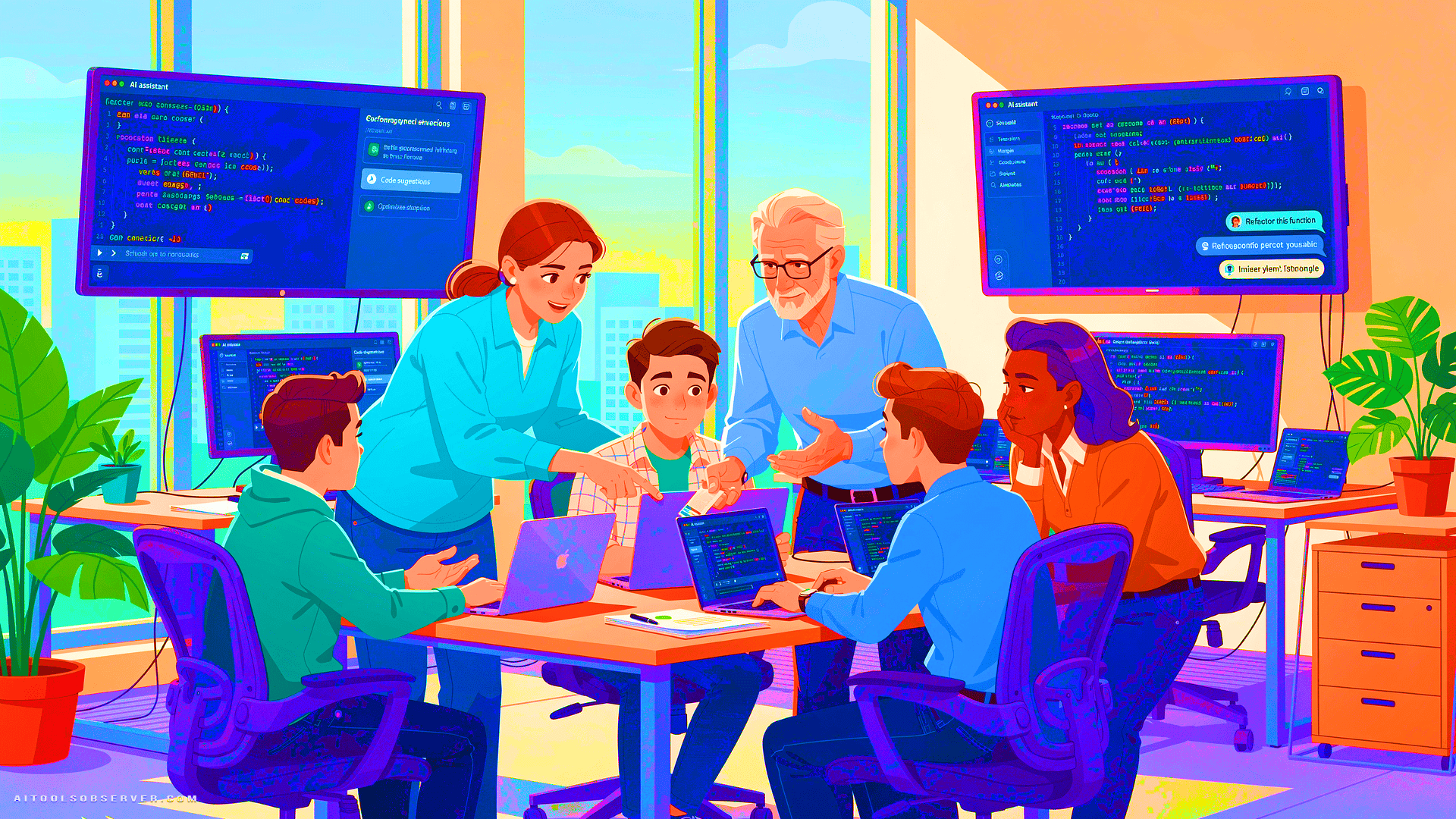
The Quote That Started It
Last year, Garman called replacing junior software developers with AI “one of the dumbest things I’ve ever heard.” In a recent interview with Wired, he doubled down — framing the move not just as shortsighted, but as structurally self-defeating.
“At some point that whole thing explodes on itself,” he said. “If you have no talent pipeline that you’re building and no junior people that you’re mentoring and bringing up through the company, we often find that that’s where we get some of the best ideas.”
That’s not sentiment. That’s a systems argument.
Why the Math Doesn’t Favor Cutting Junior Roles

Entry-level workers are, almost by definition, the cheapest people on your payroll. Replacing them first — in favor of retaining expensive senior talent — isn’t a cost-cutting strategy. It’s the opposite.
There’s also a generational edge being thrown away. Recent graduates arrive already fluent in AI tools, carrying fresh energy and zero legacy habits. They’re not resistant to the new stack. They are the new stack.
Eliminating that cohort to save short-term headcount costs is like canceling R&D to hit a quarterly number. It works once.
Amazon Is Hiring, Not Retreating

Actions matter more than quotes. Amazon plans to bring on 11,000 interns and recent graduates in 2026. The company employs more software developers today than it did two years ago — despite significant advances in AI coding tools.
That’s a deliberate signal, not an accident.
It also complicates the dominant narrative that AI adoption inevitably means fewer humans. At Amazon’s scale, the opposite appears to be true — at least for now, and at least for certain roles.
The Layoff Asterisk
To be fair, Amazon isn’t without contradictions here.
The company announced roughly 14,000 layoffs last fall, targeting mostly middle management. Earlier cuts hit AWS, Wondery, and consumer devices. CEO Andy Jassy framed these as culture and efficiency moves, not AI-driven decisions — though internal memos tell a more nuanced story, citing AI-driven workflow improvements and a stated goal to automate up to 75% of certain work.
So the picture is messy. Junior talent gets protected in Garman’s framework. Middle layers, apparently, do not.
‘Wipe Out’ vs. ‘Change’ — A Distinction Worth Keeping
Garman isn’t dismissing AI’s disruptive potential. He’s just refusing to catastrophize it.
His analogy is instructive: Microsoft Excel didn’t eliminate finance jobs. It eliminated the manual calculation part of finance jobs — and created demand for people who could use the new tool well. The work transformed. It didn’t disappear.
“I do think that half of white-collar jobs may change,” he said, “but wipe out and change are different.”
That distinction is doing a lot of heavy lifting right now, and most public discourse is collapsing it entirely.
What the Data Actually Shows
The picture on AI’s labor impact is genuinely murky. A Stanford study found AI is having a “significant and disproportionate impact” on entry-level workers, particularly 22–25-year-old software engineers and customer service agents.
But here’s the catch: the unemployment gap between recent graduates and the broader workforce opened six months before ChatGPT launched. Economists like Apollo’s Torsten Slok point to broader economic factors, not AI, as the primary driver.
Correlation is doing a lot of work in the AI-kills-jobs narrative. The evidence is real but not yet conclusive.
The Smarter Takeaway for Builders
If you’re running a team — or advising one — Garman’s argument translates into something practical:
Automating junior roles to cut costs is a short-term optimization with long-term structural damage. You lose the pipeline. You lose the fresh perspective. You lose the people who will eventually become your senior talent.
AI should be making your junior people faster, not making them unnecessary.
The companies that figure out that distinction early will have a compounding advantage. The ones that don’t will, as Garman put it, eventually explode on themselves.
Conclusion
The real question isn’t whether AI changes work. It will. The question is whether your organization is building for the next decade or just optimizing for the next quarter. Those are very different strategies — and right now, they’re easy to confuse.













Comments (0) No comments yet
Want to join this discussion? Login or Register.
No comments yet. Be the first to share your thoughts!