


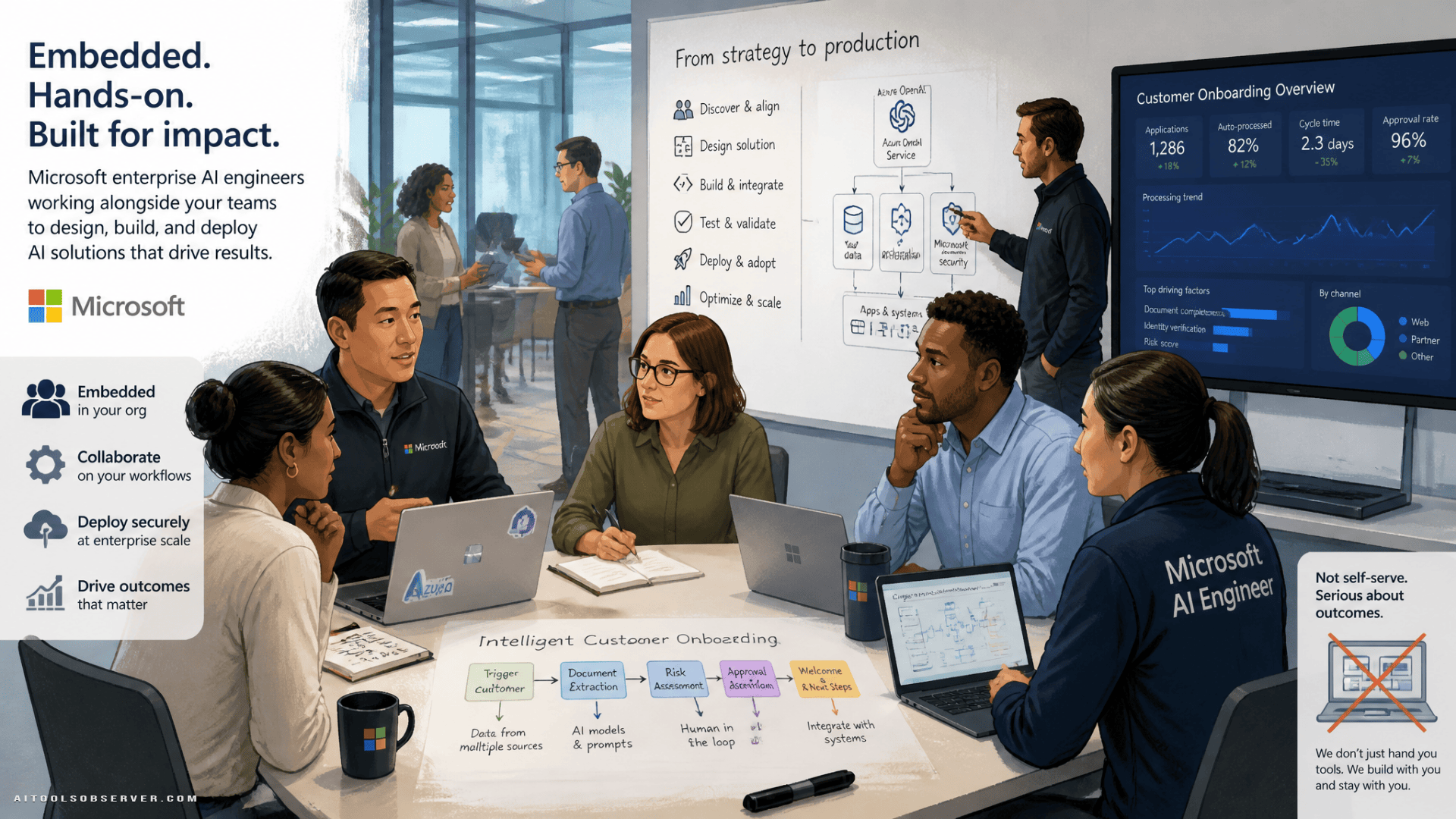
What Is Microsoft Frontier Company?
Microsoft Frontier Company is a $2.5 billion initiative embedding 6,000 industry and engineering experts directly inside customer organizations. The pitch: co-design, co-innovate, deploy, and continuously improve AI systems based on measurable business outcomes.
In plain English, Microsoft is sending its people into your company to make AI systems actually work there. Less “here’s your API key, good luck,” more “we’ll move in and fix it ourselves.”
Microsoft commercial chief Judson Althoff calls it “the largest, most capable, outcome-driven engineering organization in the industry.” Whether that’s true or aspirational is, charitably, unclear.
Why This Exists
Here’s the uncomfortable truth the industry is slowly admitting: selling LLM subscriptions at scale hasn’t worked the way anyone hoped.
Companies signed up, spent heavily on token allotments, and largely got non-productive work in return. 404 Media reported that firms from Amazon to Citi Bank have started throttling internal AI usage after runaway token costs produced little measurable value. The “just subscribe and transform” model is quietly failing.
Microsoft isn’t alone in pivoting. Amazon, Anthropic, and OpenAI have all launched similar forward-deployed programs recently. The logic is the same across all of them: get closer to the customer, get hands-on, and build things that actually justify the invoice.
The Layoffs Sitting Right Next to the Announcement
Timing is everything, and Microsoft’s timing here is… something.
Days before the Frontier Company announcement, reports surfaced that Microsoft plans to cut roughly 5,500 employees—about 2.5% of its workforce. Up to 1,000 of those cuts could hit the Xbox gaming division. Microsoft insists it’s not reducing its gaming investment overall, just reallocating it. Cold comfort if you’re one of the 1,000.
The juxtaposition is hard to ignore: $2.5 billion going into enterprise AI engineering, while thousands of employees are shown the door. “Human capital and token capital compound” lands differently when the human capital in question is being let go.
The Palantir Cameo You Didn’t Ask For
Palantir CEO Alex Karp had a notable meltdown on CNBC this week, blaming tech companies for overpromising on LLMs and veering into a rant about billionaire taxes and AI backlash. His stock dipped in real time during the segment.
It’s worth noting that the “Forward Deployed Engineering” language Microsoft borrowed for this initiative originated with Palantir—a company whose core business is surveillance and military operations. The terminology comes from war. That context doesn’t make the enterprise AI pitch more reassuring.
What the Numbers Actually Say
Microsoft’s stock is down roughly 20% from a year ago—the last time Xbox faced mass layoffs. The company was also pouring billions into AI infrastructure then. The pattern is consistent: big AI investment, workforce reduction, stock pressure.
The one concrete change? An Xbox Series X now costs $150 more than it did last summer.
What This Means for Enterprise AI Buyers
The shift from “subscribe to an LLM“ to “embed engineers inside your org” is a meaningful signal. It suggests the easy part of AI adoption—signing up—was never the hard part. Implementation, change management, and measurable ROI are where the real work lives.
If you’re evaluating AI tools for your business right now, this trend matters. The vendors winning enterprise deals aren’t just selling access anymore. They’re selling outcomes, with people attached.
That raises the bar—and the price—for everyone. Choose accordingly.











Comments (0) No comments yet
Want to join this discussion? Login or Register.
No comments yet. Be the first to share your thoughts!