



TL;DR
- HubSpot is the best AI CRM for most SMBs in 2026—free plan for 2 users, 500 AI credits/month on the $20 Starter plan.
- Salesforce fits large businesses, but Pro Suite plus Agentforce for Sales runs around $54,000/year for a 20-person team.
- Zoho CRM Professional is the cheapest plan on this list that includes AI agents, at $23/user/month.
- HubSpot and Attio already connect to ChatGPT and Claude; Salesforce’s Claude integration is in beta.
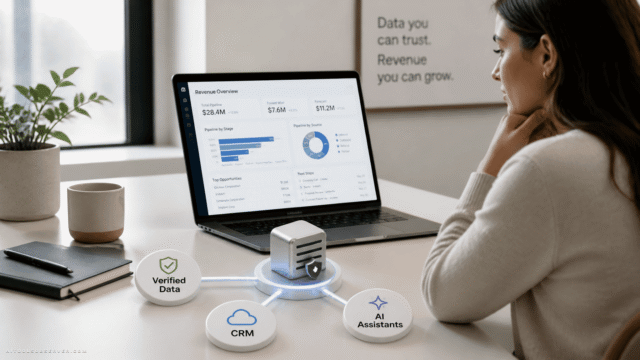
- Clean your CRM data before paying for AI. An AI CRM is only as good as the data inside it.
For more context on how AI sales assistants are showing up in daily workflows, compare these CRM features against the broader shift in sales tooling.
What Makes a CRM an “AI CRM”?
The label gets applied loosely. Here’s a practical way to think about it.
Entry level: AI summarizes emails or drafts messages. Useful, but not transformative.
Mid level: AI reads emails, joins calls, reviews transaction history, scores leads, and suggests next steps. This is where most mid-market tools sit in 2026.
High level: AI agents find leads, send emails from a script, and update the CRM automatically—without a human triggering each step.
Before evaluating any tool, answer two questions:
- What data sources can the AI actually read?
- Can it do the work itself, or does it only make suggestions?
The gap between those two answers is where most CRM AI disappointments happen.
Fix Your CRM Data Before You Pay for AI
This is the most overlooked step in the whole process.
If emails, calendars, and call notes aren’t in the system, AI will score leads and forecast revenue based on incomplete data. The output will be confidently wrong.
Before upgrading to any AI plan, do three things:
- Connect your inbox, calendar, and meeting notes to the CRM.
- Merge duplicate contact and company records.
- Fill in missing fields on your top 20% of active deals.
This is usually much cheaper than upgrading your plan—and it dramatically improves AI accuracy regardless of which tool you use. Related CRM Automation & Enhancement tools can help support that cleanup work.
Quick Comparison: Best AI CRM Software
Prices referenced 17 November 2026, annual billing unless noted.
| Tool | Starting Price | Free Plan | AI Included |
|---|---|---|---|
| HubSpot | ~$20/user/month (Starter) | Yes, 2 users | 500 credits/month on Starter |
| Salesforce | $25/user/month (Starter Suite) | Free trial | Agentforce add-on from $125/user/month |
| Attio | $40/month (Plus, 1 user) | Yes, 3 users | Ask Attio on free plan |
| Pipedrive | $14/user/month (Lite) | 14-day trial | Varies by plan |
| Zoho CRM | $14/user/month (Standard) | Free trial | AI agents from Professional ($23/user/month) |
| Dynamics 365 Sales | $65/user/month (Professional) | No | Copilot from Enterprise tier |
1. HubSpot — Best for Most SMBs
HubSpot is a full customer platform: sales, marketing, and support in one system. For small businesses, the entry point is genuinely low—a free plan for up to two users with no credit card required.
The Starter plan runs approximately $20/user/month and includes 500 HubSpot Credits per month. Professional starts at $90/user/month (annual) and includes 3,000 credits, but adds a one-time $1,500 setup fee. Enterprise adds a $3,500 onboarding fee on top of that.
What the AI actually does: HubSpot’s Breeze Assistant handles everyday tasks without consuming credits for standard use. The Prospecting Agent—which automates outreach sequences—charges credits based on usage. In September 2026, HubSpot introduced multi-agent coordination and Smart CRM, which can automatically sync emails, calls, and meetings to reduce manual data entry.
HubSpot and Attio are currently among the few CRMs with confirmed integrations to both ChatGPT and Claude.
Pros:
- Free CRM for up to 2 users, no credit card required
- Marketing, sales, and support on one platform
- Breeze Assistant available from basic plans
- Prospecting Agent automates outreach
Cons:
- Costs jump significantly at Professional
- Setup fees at Professional ($1,500) and Enterprise ($3,500) add to year-one costs
- Unused AI credits expire monthly
Best for: Small businesses that want to manage the full customer journey in one place and want a real free tier before committing.
2. Salesforce (with Agentforce) — Best for Large Teams
Salesforce is built for businesses managing complex, multi-department sales processes with deep customization needs. Agentforce is the AI layer that adds agents capable of handling leads, basic customer care, and opportunity tracking autonomously.
Pricing breakdown:
- Starter Suite: $25/user/month
- Pro Suite: $100/user/month (annual)
- Agentforce for Sales add-on: from $125/user/month
For a 20-person team on Pro Suite plus Agentforce, the annual cost approaches $54,000—before implementation costs or Flex Credit overages.
Salesforce’s Claude integration is currently in beta, which means AI model flexibility is coming but isn’t fully available yet.
Pros:
- Agentforce agents perform work, not just suggestions
- Deep customization for complex sales processes
- Starter Suite covers core sales, service, and marketing functions
Cons:
- Agentforce adds significant cost per user
- Flex Credits and agent usage limits vary by edition; overages add up
- Advanced configuration typically requires an admin or implementation partner
Best for: Large organizations that need enterprise-grade customization, permissions, and integration depth—and have the budget and internal resources to support it.
3. Attio — Best for Startups and Flexible Data Models
Attio takes a different approach. Instead of a fixed set of fields and objects, you build your own data structure—custom object groups, relationships, and processes that match how your team actually works.
Pricing:
- Free plan: up to 3 users, includes Ask Attio
- Plus: $40/month for 1 user, $35/month per additional user (annual)
- Pro: $100/month for first user, $79/month per additional user (annual)
Attio gives each user individual credits for Ask Attio, plus a shared credit pool for workspace AI features and workflows. Like HubSpot, Attio has confirmed integrations with both ChatGPT and Claude.
Pros:
- Free plan for 3 users with AI assistant included
- Fully customizable data structure
- Shared workspace credit pool is practical for small teams
Cons:
- Call analysis only available on Pro—competitors include it at lower price points
- Pro seats at $79/month add up quickly for growing teams
- Initial data structure setup requires upfront time investment
Best for: Startups, investment funds, or teams managing non-traditional relationships who want AI built in from the start and full control over how data is organized.
4. Pipedrive — Best for Pipeline-Focused Sales Teams
Pipedrive is built around one core idea: help salespeople track every deal from first contact to close. The drag-and-drop pipeline interface makes it fast to see deal stage and next steps without digging through menus.
Pricing (annual billing):
- Lite: $14/user/month
- Growth: $39/user/month
- Premium: $59/user/month
- Ultimate: $79/user/month
A 14-day free trial is available. AI features—including report generation from prompts and email assistance—vary by plan, with more capable AI tools appearing at higher tiers.
Pros:
- Lowest entry price on this list at $14/user/month
- Clean, visual pipeline interface that salespeople actually use
- AI reporting and email tools available on mid-tier plans
Cons:
- AI capabilities are more limited compared to HubSpot or Salesforce at equivalent price points
- No free plan—only a trial
- Teams that need marketing or support tools will need additional software
Best for: Sales-focused teams that want a clean, affordable pipeline tool and don’t need a full customer platform.
5. Zoho CRM — Best Budget Option with AI Agents
Zoho CRM includes AI in every plan—no separate credit system to manage. That’s a meaningful differentiator at the lower end of the market.
Pricing (annual billing):
- Standard: $14/user/month
- Professional: $23/user/month (AI agents start here)
- Enterprise: Full Zia AI assistant
At $23/user/month, Zoho CRM Professional is the cheapest plan on this list that includes AI agents. Zia, Zoho’s AI assistant, handles lead scoring, anomaly detection, and workflow suggestions. Full Zia capabilities require the Enterprise tier.
Pros:
- AI included in every plan, no credit limits
- Cheapest AI agent plan on this list
- Strong automation features across tiers
Cons:
- Full AI capabilities require Enterprise tier
- Interface feels less modern compared to Attio or HubSpot
- Ecosystem depth can make setup complex for small teams
Best for: Budget-conscious SMBs that want AI agents without paying per-credit fees, especially if they’re already in the Zoho ecosystem.
6. Microsoft Dynamics 365 Sales — Best for Microsoft-Heavy Organizations
Dynamics 365 Sales is the natural choice for organizations already running Microsoft 365, Teams, and Azure. The integration depth with the Microsoft stack is hard to match.
Pricing:
- Professional: $65/user/month (annual)
- Copilot AI: Available from Enterprise tier
The Professional plan covers core sales management. Microsoft Copilot for Sales—the AI layer—requires the Enterprise tier, which increases the per-user cost meaningfully.
Pros:
- Deep integration with Microsoft 365, Teams, and Azure
- Copilot for Sales is well-integrated with Outlook and Teams workflows
- Strong compliance and data residency options for regulated industries
Cons:
- Copilot requires Enterprise tier—not available on the entry plan
- Steeper learning curve for teams not already in the Microsoft ecosystem
- Less flexible for non-Microsoft tool stacks
Best for: Mid-to-large organizations already committed to the Microsoft ecosystem who want AI that works natively inside Outlook and Teams.
7. Freshsales — Best for Support-Sales Hybrid Teams
Freshsales is part of the Freshworks suite, which means it connects naturally with Freshdesk for support and Freshmarketer for marketing. For teams where sales and support overlap, this integration reduces the need for separate tools.
Freddy AI, Freshworks’ AI layer, handles lead scoring, deal insights, and conversation summaries. AI features are available on mid-tier plans, though the depth of automation scales with plan level.
Pros:
- Native integration with Freshdesk and Freshmarketer
- Freddy AI available on mid-tier plans
- Clean interface with a relatively short learning curve
Cons:
- AI depth doesn’t match HubSpot or Salesforce at comparable price points
- Less customizable than Attio or Salesforce for complex data models
- Smaller partner and integration ecosystem than the top-tier tools
Best for: Growing teams that handle both sales and customer support and want one vendor for both functions.
8. Close — Best for High-Volume Outbound Sales
Close is built specifically for inside sales teams doing high-volume outbound. Built-in calling, SMS, and email sequences are core features, not add-ons. The interface is designed to minimize clicks between activities.
AI features in Close focus on call transcription, summary, and follow-up suggestions—practical tools for teams making a high volume of calls daily.
Pros:
- Built-in calling and SMS without third-party integrations
- AI call summaries and follow-up suggestions
- Designed for speed and volume, not complexity
Cons:
- Not a full customer platform—limited marketing and support features
- Less suitable for complex B2B sales with long cycles
- Pricing can be high relative to features for teams that don’t do outbound calling
Best for: Inside sales teams running high-volume outbound who want calling, sequencing, and AI summaries in one tool.
How to Choose the Right AI CRM for Your Team
The right answer depends on three things: team size, sales complexity, and how much of the customer journey you need to manage in one place.
If you’re a small business or early-stage startup: Start with HubSpot’s free plan or Attio’s free plan. Both include real AI features without a credit card. Upgrade when you hit the limits.
If you’re a sales-focused team under 20 people: Pipedrive or Zoho CRM Professional gives you AI agents at a price that doesn’t require a board approval.
If you’re scaling past 50 people with complex processes: Salesforce or Dynamics 365 are worth the cost—but calculate the full number including Agentforce, Flex Credits, and implementation before signing.
If you’re in a Microsoft-first organization: Dynamics 365 is the path of least resistance. Copilot works where your team already works.
If you do high-volume outbound: Close is purpose-built for that motion in a way that general-purpose CRMs aren’t.
Teams evaluating CRM choices alongside broader sales automation needs should compare where automation lives: in the CRM itself, in add-ons, or in adjacent workflow tools.
The Real Cost Question
The advertised price is rarely the final price. Before committing to any AI CRM, calculate:
- Seat cost × number of users × 12
- AI add-on cost (Agentforce, Copilot, etc.) if not included
- Onboarding or setup fees (HubSpot Professional: $1,500; Enterprise: $3,500)
- Credit overages if your team uses AI features heavily
- Integration costs for tools not natively supported
For a 20-person team, the difference between the cheapest and most expensive option on this list can exceed $40,000 per year. That gap is worth a spreadsheet before you sign.
Final Takeaway
The best AI CRM for most growing teams in 2026 is HubSpot—the free plan is real, the AI is genuinely useful from Starter, and the platform grows with you. Attio is the strongest alternative for startups that want flexibility over structure.
But the tool matters less than the data inside it. A well-maintained HubSpot account will outperform a poorly maintained Salesforce instance every time. Before you upgrade your plan, upgrade your data.
For readers comparing CRM choices against other AI tools for business, the same rule applies: useful automation starts with clean systems and realistic pricing.










Comments (0) No comments yet
Want to join this discussion? Login or Register.
No comments yet. Be the first to share your thoughts!