


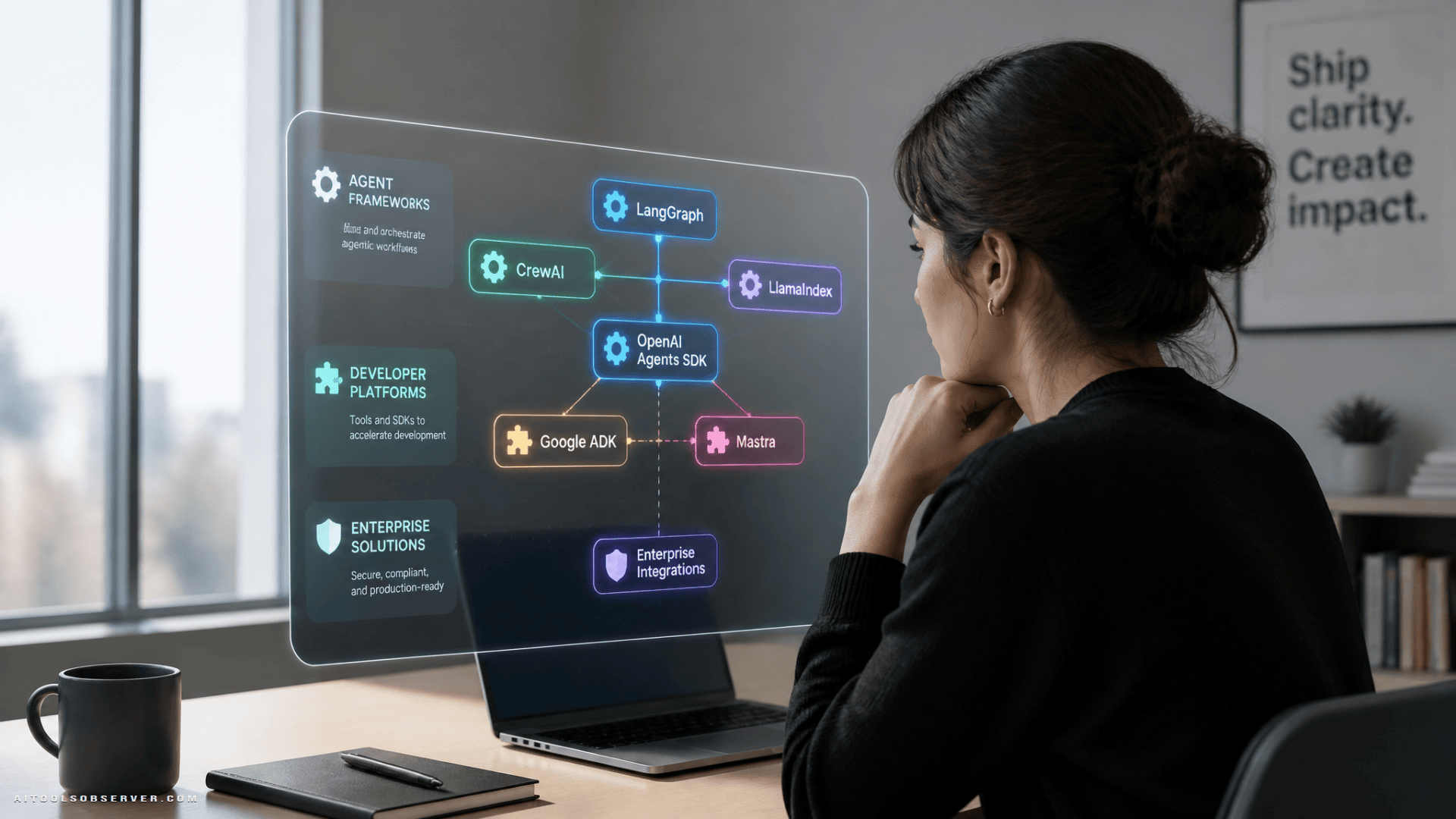
What Actually Qualifies as an Agent
Before comparing tools, it’s worth being precise about what an agent is. The bar matters because “agent washing” — rebranding existing automation as agentic AI — is widespread in 2026.
A genuine AI agent:
- Receives a goal, not a step-by-step script
- Plans how to achieve that goal autonomously
- Selects and invokes tools to execute each step
- Handles failures by adapting its approach
- Produces an outcome without human instruction at each intermediate stage
A chatbot that answers questions from a knowledge base is not an agent. A workflow that triggers when an email arrives and sends a pre-defined response is not an agent. Applying this bar eliminates a large share of tools currently marketed as agentic.
The Market Context in 2026
The scale of adoption is no longer speculative. Salesforce Agentforce has reached significant annual revenue growing at triple-digit rates year over year. Claude Code crossed $2.5 billion in annualized revenue approximately one year from launch. Microsoft reports that 160,000 organizations built more than 400,000 custom agents on Copilot Studio within its first 90 days of availability.
Gartner projects that by the end of 2026, 40 percent of business applications will embed AI agents capable of specific autonomous tasks — up from less than 5 percent in 2025.
These are production deployment numbers, not research project numbers.
How to Use This Guide
The agentic AI market segments more sharply than almost any software category. The technical skill required ranges from Python graph programming to natural language template configuration. The deployment context ranges from a command-line terminal to a Salesforce CRM interface to an enterprise contact center. The buyer ranges from a solo ML engineer to a CIO deploying across a Fortune 500 service desk.
A single ranked list produces a recommendation appropriate for none of these buyers. The tools are not competing with each other in any meaningful sense. This guide is organized by category and use case so you can navigate directly to what’s relevant.
A note on scope: Manus is excluded because its corporate ownership remains legally unresolved following regulatory action in April 2026. Recommending a platform with unresolved ownership would not serve readers planning production deployments. Zapier Agents, Make AI, and Relay.app are covered in a separate no-code automation guide.
Category 1: Developer Frameworks and Orchestration
These are tools for engineering teams building custom agents in code. They require programming knowledge — typically Python or TypeScript — and give you architectural control that higher-level platforms intentionally abstract away.
Developer Frameworks and Orchestration is the core category for teams evaluating these options.
LangGraph
LangGraph is the production engineering standard for building stateful, complex multi-agent systems. It models workflows as directed graphs with explicit state management, conditional edge routing, and built-in checkpointing for pause-and-resume execution.
Its defining characteristic is control. You decide which nodes run, in what order, under what conditions, and with what state carried between them. That level of precision is what separates LangGraph from higher-level frameworks — and it’s also what makes it harder to learn.
The LangSmith companion provides the observability layer that production agent systems require: tracing every step, logging every tool call, and enabling replay of failed runs without re-running the entire workflow. Version 0.4, released April 2026, brought improved state persistence and enhanced human-in-the-loop checkpoints that allow an agent to pause at any graph node and await human approval before continuing.
Key features:
- Directed graph execution with conditional edge routing for complex branching and looping
- Built-in state checkpointing for pause-and-resume across long-running tasks
- Human-in-the-loop interrupt primitives at any graph node
- LangSmith observability with step tracing, tool call logging, and run replay
- 110,000+ GitHub stars across the LangChain ecosystem
- MIT licensed; LangSmith free for individuals, $500/month for teams
Best for: Engineering teams building production agent systems with complex conditional logic, multi-agent coordination, error recovery requirements, and human-in-the-loop approval gates — where the architectural control of a graph execution model is necessary and simpler frameworks have reached their ceiling.
CrewAI
CrewAI is the most accessible multi-agent orchestration framework for development teams new to agentic AI. It organizes agents into role-based crews where each agent has a defined persona, backstory, goal, and set of tools — and the crew executes a structured process where agents collaborate, delegate, and pass work between each other.
The result reads like a team workflow description rather than a graph algorithm. A developer can define a working multi-agent research-and-write crew in approximately 20 lines of Python. A new developer can be onboarded to the codebase in an afternoon.
CrewAI reached 30,000+ GitHub stars in 18 months — the fastest community adoption of any agent framework in the category. It shipped enterprise-grade observability and scheduling for multi-agent coordination in April 2026.
The tradeoff versus LangGraph is straightforward: CrewAI wins on readability and speed of development; LangGraph wins when the workflow requires conditional branching, error recovery, or state management that the crew model cannot express cleanly.
Key features:
- Role-based crew orchestration with agent personas, backstories, goals, and tools
- A working multi-agent system definable in ~20 lines of Python
- 30,000+ GitHub stars in 18 months
- Enterprise-grade observability and scheduling shipped April 2026
- 82% benchmark task success rate with 1.8-second average latency — fastest in category
- Model-agnostic: OpenAI, Anthropic, local models, and others
- MIT open-source license; CrewAI Enterprise for production governance
Best for: Development teams new to multi-agent systems, and organizations building agents whose workflows can be expressed as structured team collaboration between specialized roles.
AutoGen
AutoGen is Microsoft’s asynchronous event-driven multi-agent framework, reaching version 1.0 general availability in April 2026 with a fully rearchitected v2 API. Its conversational GroupChat model — where multiple agents participate in structured conversations and delegate to specialized sub-agents — excels at complex layered decision-making tasks including multi-step research, code-executing analysis agents, and systems where agents need to discuss, refine, and validate outputs through conversation before acting.
The Microsoft backing gives AutoGen natural integration depth with Azure OpenAI, Azure AI Foundry, and the broader Microsoft enterprise AI stack. AutoGen Studio provides a visual interface for prototyping and debugging agent conversations without writing code.
Version 1.0 GA brought major architectural improvements: better state management, improved async execution, enhanced debugging tools, and a new plugin system for extending agent capabilities.
Key features:
- Asynchronous event-driven multi-agent conversations with GroupChat coordination
- Version 1.0 GA released April 2026 with rearchitected v2 API
- AutoGen Studio visual companion for prototyping and debugging
- Native integration with Azure OpenAI, Azure AI Foundry, and Microsoft enterprise stack
- Code execution capability for agents that write and run code within the workflow
- Model-agnostic with support for OpenAI, Anthropic, and local models
- MIT open-source license
Best for: Teams in the Microsoft and Azure ecosystem building research agents, analysis pipelines, and multi-step reasoning systems where agent-to-agent conversational dialogue is the primary coordination mechanism.
OpenAI Agents SDK
The OpenAI Agents SDK is the production-grade agent SDK released by OpenAI in March 2025 and reaching production maturity in 2026. Its core abstraction is the handoff — agents explicitly transfer control and conversation context to each other in a structured way that is easier to trace and debug than the implicit delegation of competing frameworks.
Despite the name, it’s provider-agnostic and compatible with 100+ LLMs. With 26,900+ GitHub stars and 10 million+ monthly downloads, it has the broadest developer adoption of any agent SDK in the category. Built-in tracing, guardrails, input and output validation, and structured tool calling are included as first-class features rather than external add-ons.
If your primary goal is the fastest path to a working multi-agent system with the strongest developer experience, this SDK consistently wins on time-to-first-working-agent over more configurable alternatives.
Key features:
- Explicit handoff model for structured control transfer with full conversation context preservation
- 26,900+ GitHub stars and 10 million+ monthly downloads
- Provider-agnostic compatibility with 100+ LLMs
- Built-in tracing, guardrails, and input/output validation as first-class features
- Production maturity with deeper OpenAI Platform integration reached in 2026
- MIT open-source license
Best for: Development teams that want the fastest path to a working production multi-agent system, particularly those already building on OpenAI models where native platform integration reduces friction.
Google ADK
Google ADK is Google’s official Agent Development Kit, released in April 2026. It uses a hierarchical agent tree model where a root orchestrator delegates to specialized sub-agents, with inter-agent communication governed by Google’s Agent-to-Agent (A2A) protocol.
The A2A protocol is the most strategically interesting aspect of ADK. It enables interoperability between agents built with different frameworks — meaning a Google ADK agent can discover and invoke an agent built with LangGraph or CrewAI through a standardized task interface. This positions ADK as a framework for heterogeneous multi-framework agent ecosystems rather than a single-vendor stack.
ADK is optimized for Gemini models and integrates natively with Vertex AI Agent Engine, but supports other models and cloud environments. As an April 2026 release, its community and production reference base are still growing relative to LangGraph, CrewAI, and AutoGen.
Key features:
- Hierarchical agent tree model with root orchestrator delegating to specialized sub-agents
- Agent-to-Agent (A2A) protocol enabling interoperability with LangGraph, CrewAI, and other frameworks
- Optimized for Gemini models with native Google Cloud and Vertex AI infrastructure integration
- Google Search grounding for agents requiring real-time web information
- Google Workspace integration for agents operating on enterprise Google data
- April 2026 release with a growing community and production reference base
Best for: Development teams standardized on Google Cloud and Gemini that want native Google Search grounding, Vertex AI managed infrastructure, and Google Workspace integration — and organizations building heterogeneous multi-framework agent systems where A2A protocol interoperability matters.
LlamaIndex
LlamaIndex is the framework for building agents that retrieve, reason over, and act on enterprise data. Where LangGraph and CrewAI are general-purpose orchestration frameworks that include retrieval as one tool among many, LlamaIndex treats retrieval as the primary architectural concern and builds agent orchestration on top of it.
This distinction matters enormously for knowledge-intensive applications. If your agent’s value is proportional to the quality of its data retrieval — internal knowledge bases, document corpora, structured data sources — LlamaIndex’s retrieval-first architecture provides structural advantages that general-purpose frameworks require significant additional configuration to replicate.
LlamaCloud, its managed service, provides a hosted data pipeline for production RAG applications without self-managed vector infrastructure.
Key features:
- Retrieval-first architecture combining document ingestion, chunking, embedding, retrieval, and agent reasoning
- The strongest enterprise data retrieval foundations of any agent framework in this guide
- LlamaCloud managed service for production RAG data pipelines
- Multi-step reasoning, tool use, and structured outputs built on top of retrieval
- Multi-agent coordination with retrieval-aware context passing
- Support for documents, databases, APIs, and structured data sources
- MIT open-source license
Best for: Enterprise teams building knowledge-intensive agents — internal knowledge assistants, document analysis agents, research synthesizers — where retrieval quality is the primary determinant of agent value.
Mastra
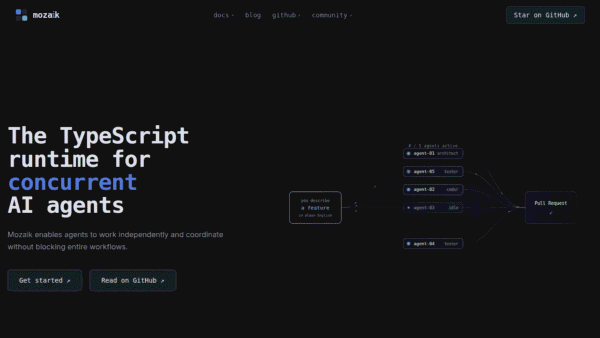
Mastra is the TypeScript-first agent framework for Node.js and Next.js developers who want to build production AI agents without leaving the JavaScript ecosystem. It provides native tool calling, persistent memory management, workflow orchestration, RAG pipelines, and built-in observability in a single TypeScript SDK.
The positioning is distinct from every other framework in this section. LangGraph, CrewAI, AutoGen, and the OpenAI Agents SDK are Python-first. Mastra treats TypeScript as a first-class language — the type definitions, documentation, examples, and community patterns are built around TypeScript idioms rather than translated from Python.
For teams building AI-native web applications in Next.js, Remix, or Node.js backends where Python is not part of the stack, Mastra eliminates the language boundary that forces a choice between learning Python for agent development or accepting suboptimal TypeScript support in Python-first frameworks.
Key features:
- TypeScript-first agent development with native type definitions and documentation designed for JavaScript developers
- Native tool calling, persistent memory management, and RAG pipelines in a single TypeScript SDK
- Workflow primitives covering sequential steps, branching, parallelism, and human-in-the-loop approvals
- Built-in observability for tracing agent execution and debugging production issues
- Node.js and Next.js native integration for full-stack web application development
- Compatibility with OpenAI, Anthropic, Google, and major model providers
Best for: Frontend-adjacent and full-stack JavaScript and TypeScript development teams building AI-native web applications, where Mastra’s TypeScript-first design eliminates the language boundary that forces teams into Python for agent development.
How the Developer Frameworks Compare
Choosing between these frameworks comes down to three variables: your team’s language preference, the complexity of your workflow logic, and your infrastructure context.
| Framework | Language | Best Workflow Type | Infrastructure Fit |
|---|---|---|---|
| LangGraph | Python | Complex conditional, stateful | Any |
| CrewAI | Python | Role-based team collaboration | Any |
| AutoGen | Python | Conversational multi-agent | Microsoft/Azure |
| OpenAI Agents SDK | Python | Fast multi-agent shipping | OpenAI-first |
| Google ADK | Python | Hierarchical, multi-framework | Google Cloud |
| LlamaIndex | Python | Knowledge retrieval-intensive | Any |
| Mastra | TypeScript | Full-stack web applications | Node.js/Next.js |
The most common mistake teams make is choosing a framework based on benchmark scores or GitHub stars rather than workflow fit. A 5-percentage-point difference in benchmark task success rate matters far less than whether the framework’s execution model matches how your agent actually needs to work.
What Comes Next in This Guide
The full 33-tool review continues across three additional categories:
Visual and No-Code Agent Builders — platforms like Lindy, Relevance AI, and others that let operations and business teams build and deploy agents through natural language configuration and visual interfaces, without writing code.
Enterprise Agent Platforms — Salesforce Agentforce, Microsoft Copilot Studio, ServiceNow AI Agents, Glean, and others built for organizations deploying agents within existing enterprise infrastructure, CRM systems, and service management platforms.
Specialized and Purpose-Built Agents — Claude Code and other agents built for specific high-value domains including software engineering, sales, customer service, and knowledge work, where purpose-built beats general-purpose.
The Practical Takeaway for Right Now
If you’re an engineering team evaluating developer frameworks, the decision tree is simpler than the market noise suggests:
- Complex stateful workflows with conditional logic → LangGraph
- Team collaboration workflows, fastest onboarding → CrewAI
- Microsoft/Azure ecosystem, conversational agents → AutoGen
- Fastest path to working multi-agent system → OpenAI Agents SDK
- Google Cloud ecosystem → Google ADK
- Knowledge retrieval is the core value → LlamaIndex
- TypeScript/Node.js stack → Mastra
The tools in this category are genuinely good. The risk isn’t picking the wrong framework — it’s spending three months building on a framework that was the right choice for someone else’s problem. Match the execution model to your workflow first, then evaluate everything else.









Comments (0) No comments yet
Want to join this discussion? Login or Register.
No comments yet. Be the first to share your thoughts!