


The Last Piece of a Four-Platform Strategy

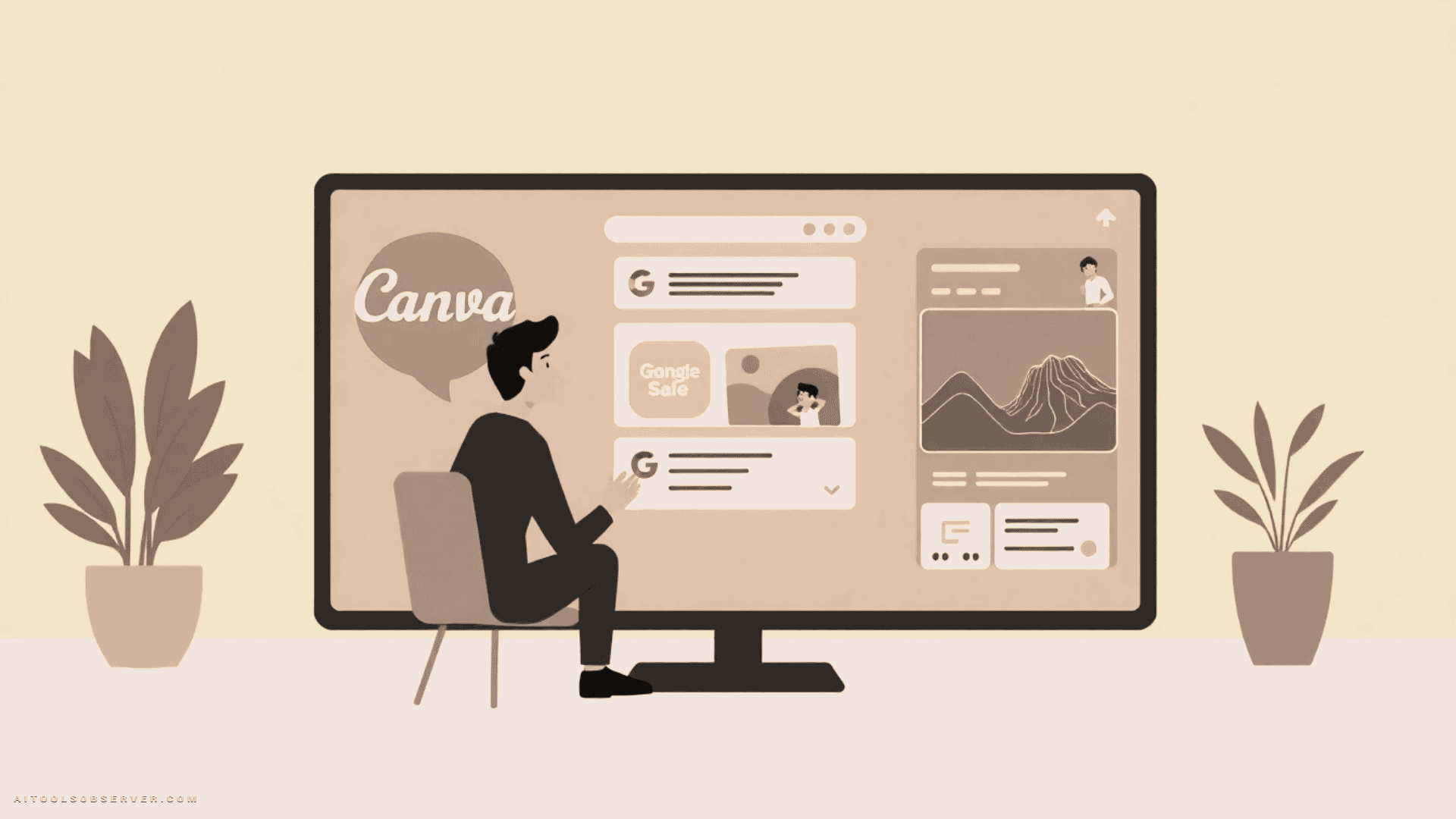
The Gemini integration is not an isolated product move. It closes a loop. Canva’s API now connects every major AI assistant on the market — Claude, ChatGPT, Microsoft Copilot, and Gemini — to its design engine, brand kit data, and template library.
That is a meaningful structural position. Wherever a user happens to work, Canva can surface inside the conversation rather than competing for attention as a standalone destination.
The announcement was made at Google I/O, signaling that both companies see strategic value in the partnership at a platform level.
What the Integration Actually Does

The technical details here matter more than the headline.
When a Gemini user requests a design, the tool does not return a flat image. It returns a live Canva file — one that remains fully editable after generation. That distinction separates this from most AI image outputs, which produce finished pixels with no clean path to iteration.
For users with a Brand Kit configured in Canva, the generated design automatically pulls in saved logos, typefaces, and color schemes. No additional prompting is required. The brand layer applies at the point of generation.
There is a second workflow worth noting: users generating images through Google’s native image tools can pipe those outputs directly into Canva’s Magic Layers feature, which decomposes a finished AI image into individually editable components. Raw AI output becomes a structured, modifiable asset.
Closing the Gap Between Output and Publish
Anwar Haneef, Canva’s general manager and head of ecosystem, framed the problem precisely.
“The biggest friction in AI-powered creative work for companies has always been the gap between AI output and brand-ready asset. Bringing the Canva Design Engine and Canva Brand Kits into AI tools removes that step.”
This is the core enterprise proposition. AI-generated visuals are fast, but they are rarely publication-ready without manual brand alignment. Canva’s integration compresses that correction step — or eliminates it entirely when a Brand Kit is in place.
For marketing teams operating at scale, that reduction in friction is not cosmetic. It directly affects how quickly AI-generated content can move from prompt to approved asset.
Context: Canva AI 2.0 and the Broader Platform Shift

The Gemini launch sits inside a larger strategic reorientation. Earlier this year, Canva relaunched its platform as Canva AI 2.0, replacing its template-first model with AI agents that build and iterate designs from conversational prompts.
The platform now connects to external services including Gmail, Slack, Zoom, Google Drive, and HubSpot. A persistent memory feature tracks individual working patterns over time, allowing the system to adapt to how specific users operate rather than starting from a blank context on each session.
Canva reported $4 billion in revenue for 2025 and counts 220 million users globally. The company is not optimizing for a niche — it is building infrastructure for mainstream creative workflows at enterprise scale.
The Competitive Pressure Arriving from Google Itself

The timing carries an edge worth acknowledging. At the same Google I/O event where the Canva-Gemini integration was announced, Google introduced Pics — a text-to-graphic tool embedded directly into Google Workspace.
That puts Google in direct competition with Canva on its own core territory, even as the two companies deepen their integration on another front. It is a familiar dynamic in platform ecosystems: partner and competitor, simultaneously.
Canva’s response, whether intentional or not, is to become harder to displace by embedding itself inside the tools users already rely on. If Canva is accessible from within Gemini, Copilot, ChatGPT, and Claude, the switching cost rises — not through lock-in, but through presence.
What This Means for AI Tool Decision-Makers
For teams evaluating AI-assisted design workflows, the Gemini integration shifts the calculus in a specific direction. The question is no longer whether to use an AI assistant or a design tool — it is whether the design tool can operate inside the AI assistant already in use.
Canva’s cross-platform API strategy answers that question directly. Teams standardized on Google Workspace and Gemini can now access Canva’s full design and brand infrastructure without leaving their primary environment.
The Brand Kit automation is particularly relevant for enterprise buyers. Consistent brand application across AI-generated assets has been a genuine operational problem. Canva is positioning itself as the layer that solves it — quietly, at the point of generation, before the asset ever reaches a reviewer.
Conclusion
The integration of AI assistants with professional design infrastructure is still early. But Canva’s move to cover all four major platforms simultaneously suggests the company understands where creative workflows are heading — and intends to be embedded in them before the market fully arrives.










Comments (0) No comments yet
Want to join this discussion? Login or Register.
No comments yet. Be the first to share your thoughts!