


The On-Ramp Has Closed for Most Workplace Users
A year ago, the dominant narrative was about getting people to try generative AI. That chapter is largely over for workplace users. The majority have already crossed the threshold. They’ve moved past the “let me test this” phase and into something more deliberate.
Personal use still has more room to grow. About 15% of personal gen AI users are newcomers, compared to 12% in the workplace. From September 2025 through May 2026, personal-only use became the largest active segment, reaching roughly 37% of consumers by May. The growth engine has shifted from workplace adoption to personal and dual-use expansion.
The practical implication: if you’re building or marketing AI tools, your workplace audience is mostly experienced. Your personal-use audience still has a meaningful newcomer segment worth shaping.
Time Turns Casual Users Into Power Users
Here’s the data point that reframes the whole conversation: 75% of power users have at least one year of gen AI experience. That drops to 50% for mainstream users and 42% for light users.
Heavy use doesn’t happen overnight. It develops through repeated exposure, accumulated context, and growing confidence in the tool’s outputs. The benchmark uses a scoring system that weights tasks by complexity—drafting an email earns one point, investment advice earns three—and power users consistently score higher because they’ve learned to push the technology into harder territory.
This has a direct implication for product strategy. You can’t manufacture power users through onboarding alone. You have to build tools that reward continued use and get better as users get more experienced.
Experienced Users Do More, Rely on AI More, and Choose Differently
The task volume gap is striking. Personal newcomers average 6.6 gen AI tasks. Users with at least one year of experience average 11 tasks—a 68% increase. That’s not just more of the same tasks. It’s a fundamentally different relationship with the technology.
The task mix also changes. Writing stays dominant, rising from 47% among newcomers to 59% among experienced users. But the bigger story is in the categories that start low and climb fast: finances jump from 23% to 39%, health and wellness from a lower base to 49%, and travel from 26% to 46%.
Experienced users aren’t just doing more. They’re doing harder things.
When AI Becomes Essential, Not Just Useful
The benchmark distinguishes between using AI for a task and calling it essential—meaning you couldn’t complete the task without it, or it would be significantly harder. That gap between usage and essentiality is where the real competitive insight lives.
Among users with at least one year of experience, 31% say gen AI is essential for managing finances and banking. Among newcomers, that figure is 13%. That’s a 129% difference. For learning, it’s 35% versus 26%. For health and wellness, 32% versus 23%.
These aren’t marginal gains. They represent a fundamental shift in how users perceive the technology’s role in high-stakes decisions.
The Tool Stack Gets Wider With Experience
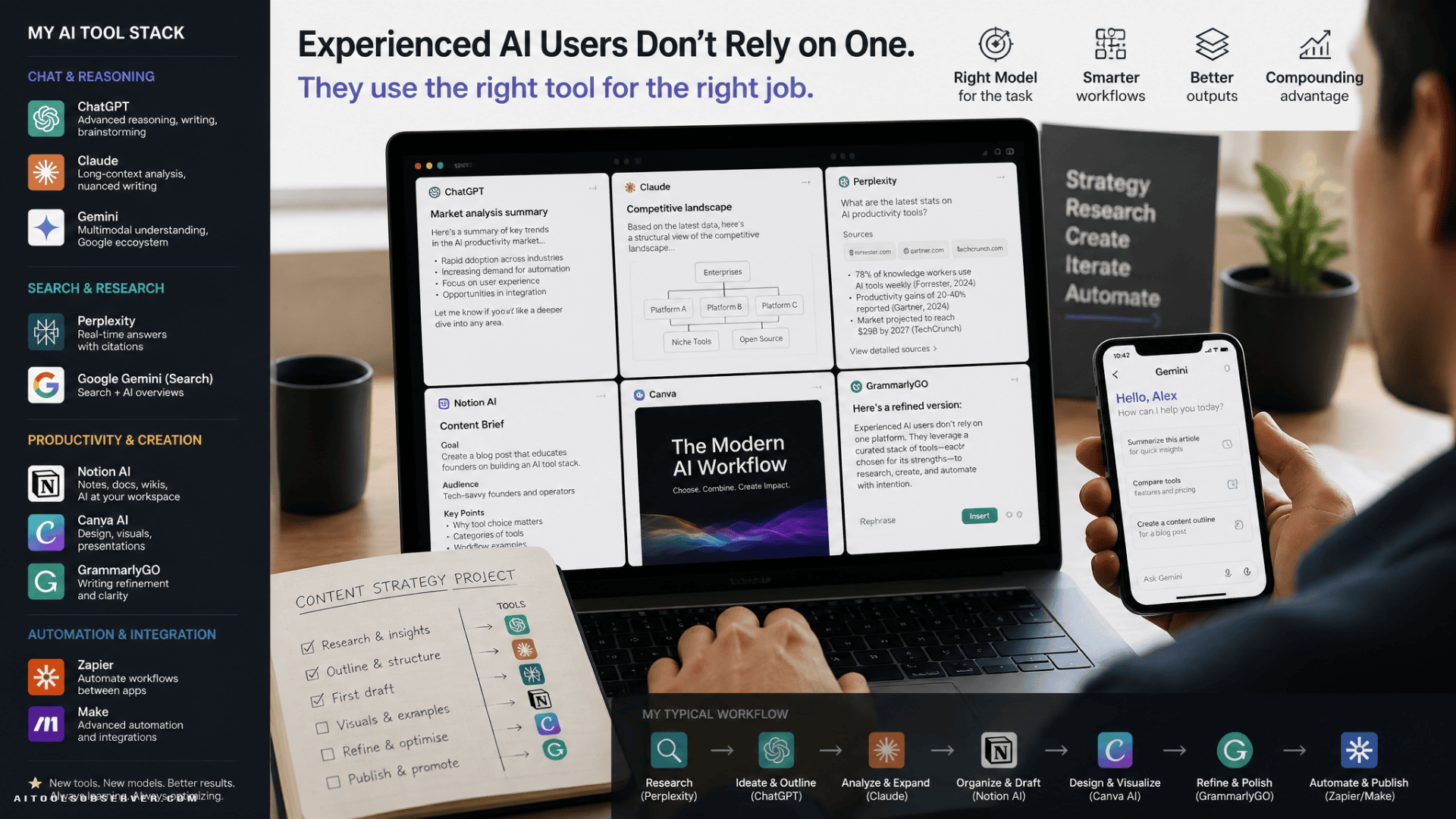
New users tend to rely on whatever AI is closest—a phone assistant, a search summary, a built-in feature. Experienced users make deliberate choices.
Among personal newcomers, 22% name a dedicated AI platform as their most helpful tool. Among users with at least a year of experience, that rises to 35%. Reliance on mobile phone assistants drops from 20% to 11% over the same tenure range.
The platform mix also broadens significantly. ChatGPT remains dominant at 74% among experienced personal users. But the second and third tools tell the real story:
- Gemini: 52% among experienced users vs. 45% among newcomers
- Microsoft Copilot: 28% vs. 18%
- Claude: 16% vs. 6%
- Grok: 12% vs. 4%
Experienced users are 158% more likely than newcomers to use Claude. Power users average 2.9 platforms, more than double the 1.4 used by light users. The multi-tool stack isn’t a sign of indecision—it’s a sign of sophistication.
Search Is Losing Ground Faster Than Anyone Else
The substitution effect on search engines is accelerating with tenure. Among personal newcomers, 26% say they use search engines less because of gen AI. Among users with at least a year of experience, that rises to 38%—a 47% increase. Pullbacks from specialized sites and shopping platforms are smaller, and social media use is nearly flat across tenure groups.
Search is the clearest casualty of AI maturity. That has implications for SEO strategy, content distribution, and where brands invest in visibility.
The Product Discovery Problem Nobody Is Solving Well
Here’s an anomaly worth paying attention to. Experienced users are more likely to use gen AI for product discovery—52% versus 39% among newcomers. But only 20% of experienced users call it essential for that task, compared to 28% of newcomers.
Usage goes up. Perceived necessity goes down. That’s a performance gap.
The benchmark’s interpretation is direct: seasoned users keep trying AI for shopping, but the experience isn’t strong enough to depend on. Comparison quality is weak. Product data is inconsistent. The handoff from recommendation to purchase is clunky. Merchants and commerce platforms have a real product problem here, not a marketing problem.
What This Means for AI Tool Providers and Buyers
The benchmark’s implications break down cleanly by audience.
For AI platform providers, the competition is no longer about acquisition. It’s about depth. Most workplace users are already experienced. Growth comes from helping them complete more tasks, use the tool more often, and bring it into higher-value workflows. The “most helpful” position is the strategic prize—not total usage share.
For financial services and FinTech, the data is a clear signal. Reliance on gen AI for finances rises sharply with tenure. Users who’ve been around for a year are far more likely to call it essential for banking and financial management. That creates real demand for trustworthy outputs, explainable reasoning, and clean escalation paths to human advisors.
For marketers and brands, personal use is still the younger frontier. Its larger newcomer share gives you an opening to shape habits early—through strong onboarding, practical templates, and demonstrations of value that go beyond novelty.
For anyone building AI workflows, the multi-tool stack is the norm among experienced users, not the exception. Designing for interoperability and complementary use cases matters more than trying to be the only tool someone opens.
The Takeaway
The 2026 Consumer AI Benchmark makes one thing clear: experience is the variable that changes everything. It changes which tools users choose, how many they use, which tasks they tackle, and how much they trust AI with decisions that actually matter.
The platforms that win the next phase won’t just be the ones with the best models. They’ll be the ones that help users get better over time—tools that remember context, reward skill development, and fit naturally into real workflows. The casual AI user is fading. The experienced, multi-platform, workflow-driven user is the market now.
Build for that person.












Comments (0) No comments yet
Want to join this discussion? Login or Register.
No comments yet. Be the first to share your thoughts!