


The Real Reason Most Side Hustles Stall
It’s not effort. It’s architecture.
Most solopreneurs are still running a 2024 workflow in 2026. They layer new tools onto a business that was built for one person doing everything manually — and then wonder why growth plateaus. According to Zoom’s 2026 State of Solopreneurship report, 64% of solo business owners say their business would not have grown at all in the past year without AI. That’s not a small number. That’s a structural shift.
The problem isn’t that you need more tools. It’s that the tools you have aren’t talking to each other. Research doesn’t feed content. Content doesn’t feed your chatbot. Your chatbot doesn’t feed your sales loop. Everything runs in parallel and nothing compounds.
The fix isn’t addition. It’s reconstruction.
Tool 1: NoteGPT + Perplexity AI — Content Research That Actually Finds Gaps
Most content research looks like this: Google a topic, skim a few articles, write something that sounds like everything else in your niche. That’s why most content performs like everything else in your niche.
NoteGPT and Perplexity AI change the input. You feed them the top-performing videos and content in your niche and ask them to surface the angles your competitors are missing — not just what’s working, but what’s being left on the table. The output isn’t a summary. It’s a content brief built around actual gaps in the market.
This is where the stack starts. Research feeds content. If this step is weak, everything downstream is weaker.
Tool 2: Lyro AI — A Chatbot That Converts While You Sleep
Most solopreneurs lose leads between 9pm and 9am. A prospect lands on your site, has a question, gets silence, and moves on. Lyro AI handles up to 70% of prospect conversations around the clock — and every single conversation becomes data.
That last part is what most people miss. It’s not just about answering questions. It’s about learning what questions your prospects are actually asking, which tells you exactly where your offer messaging is breaking down. You wake up with a sharper pitch and a warmer pipeline.
Tool 3: Instantly — Cold Outreach That Scores Itself
Cold outreach has a reputation problem because most people run it like a spray-and-pray campaign. Instantly changes the model. It turns cold outreach into a warm-lead machine by scoring engagement across inboxes and flagging exactly who to follow up with — and when.
Instead of guessing which leads are worth your time, you get a prioritized list every morning. The people who opened twice, clicked once, and never replied? Those are your follow-ups. The ones who never engaged? You stop burning time on them.
This is where content-driven traffic meets direct sales. The loop starts closing.
Tool 4: Google AI Studio — The Prompt That Most Solopreneurs Never Build
This is the one that separates the people who plateau from the people who break through.
You take six months of your own email campaign data and feed it into Google AI Studio. Then you run a prompt that tells it to think like a top 1% marketing analyst — not to summarize your open rates, but to find the pattern underneath them. The one that explains why certain campaigns converted at 3x the rate of others, and what specifically drove that.
Most side hustlers check open rates and call it done. That’s the gap. The difference between where you are and seven figures is often sitting inside data you already have — you just haven’t asked the right question of it yet.
Why the Stack Works: Operating Leverage
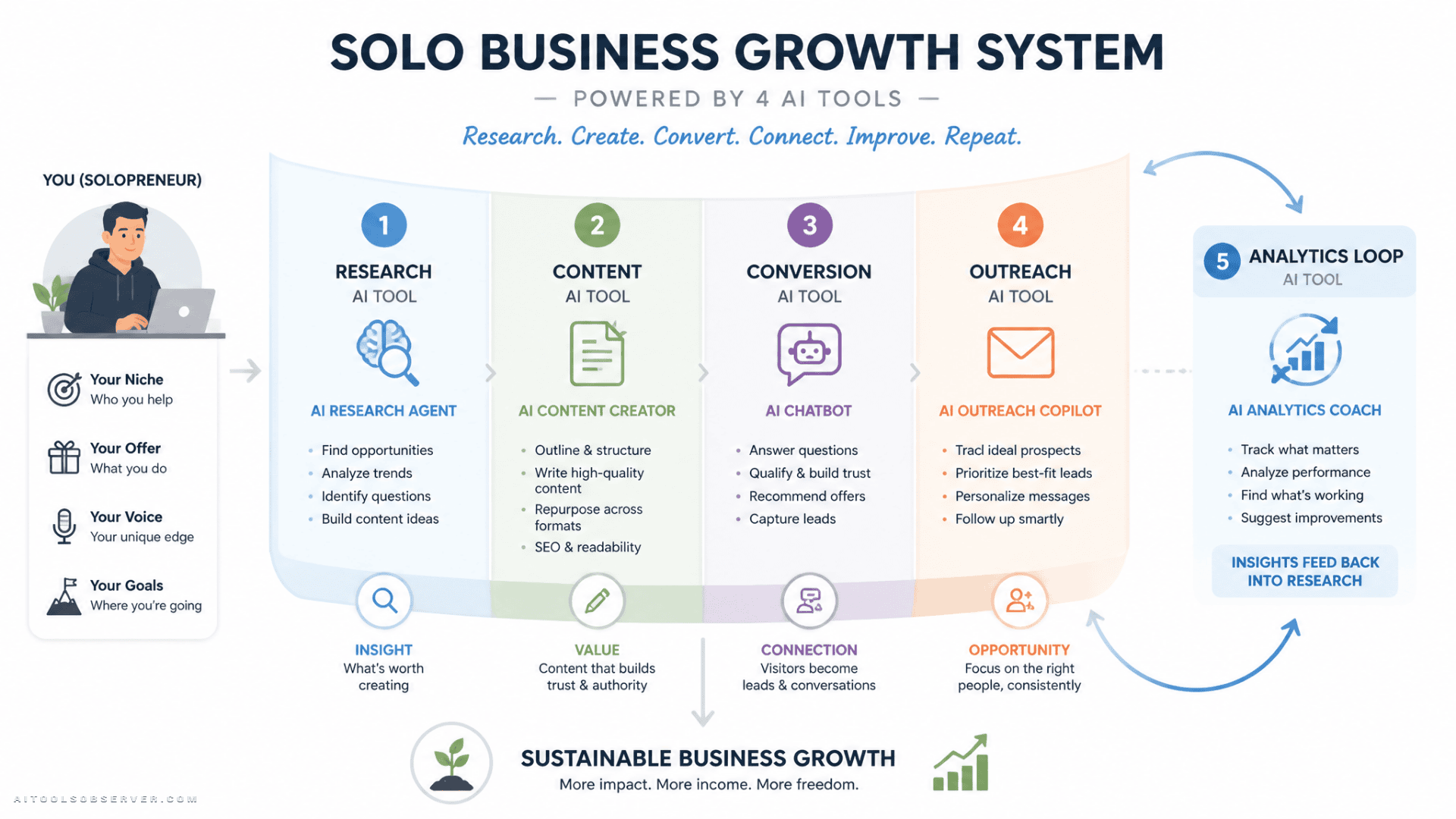
Each tool handles one layer of the funnel. But the reason this works at scale is that each layer feeds the next.
Research feeds content. Content drives traffic. The chatbot converts that traffic and captures intent data. The outreach tool scores and prioritizes follow-up. And Google AI Studio closes the loop by telling you what’s actually working so you can double down on it.
That’s not four separate tools. That’s infrastructure.
A Pax8 report on AI in small businesses found that SMBs using AI heavily generate 24% higher revenue per employee than those that don’t. For a solopreneur, that math hits differently — because you are the only employee. Every percentage point of operating leverage goes directly to your bottom line.
The Mindset Shift That Makes This Work
Ben Angel calls it Embrace Reconstruction in his book The Wolf Is at the Door. The idea is simple but uncomfortable: you cannot bolt a seven-figure engine onto a side-hustle chassis.
The founders who broke through in 2026 didn’t add AI to what they had. They tore down the version they built in year one and rebuilt it around AI first. That’s a different decision than downloading another app. It’s a commitment to rebuilding the operating system, not patching the interface.
If you’re still treating AI as a writing assistant, you’re using a Formula 1 engine to do school runs.
What to Take Away From This
The four tools — NoteGPT, Perplexity AI, Lyro AI, Instantly, and Google AI Studio — aren’t magic. They work because they’re connected. Each one feeds the next, and the whole system compounds over time in a way that no single tool ever could.
If you’re trying to figure out how to scale as a solo operator, start here: map your current workflow and find where leads are falling out. That’s where you plug in the first tool. Then build the loop.
The goal isn’t to use more AI. The goal is to build four tools that talk to each other so well that the business runs whether you’re at your desk or not.
That’s the difference between a side hustle and a scalable operation.












Comments (0) No comments yet
Want to join this discussion? Login or Register.
No comments yet. Be the first to share your thoughts!