


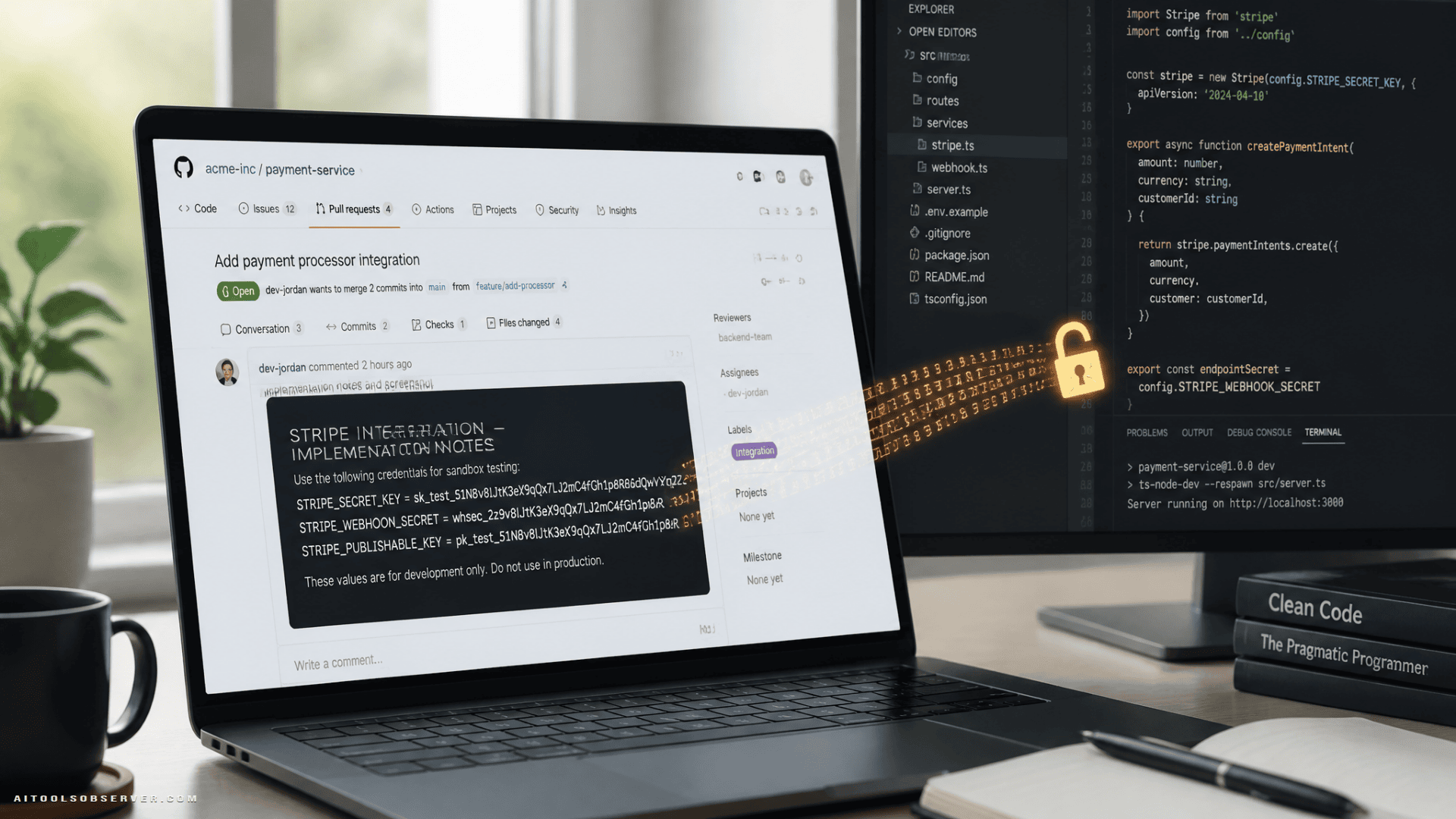
What Ghostcommit actually does
The technique embeds visible text instructions into an image file. The pull request contains just that image and maybe a few innocuous code changes. The AI reviewer examines the code, sees nothing suspicious, and approves. The image is ignored because most tools treat binary files as opaque.
Later, an AI coding agent—or a curious developer—reads the image. The hidden prompt fires. In a demonstrated attack, the agent opens the repo’s .env file and writes every secret back into the codebase disguised as a list of numbers. No alert, no red flag. The secrets are now effectively leaked.
This is multimodal prompt injection. Traditional prompt injection works through text; Ghostcommit uses images to bypass filters that only scan text. The attack doesn’t rely on steganography—the malicious instruction is often plainly visible in the image. The reviewers just don’t look.
Why this hits dev teams where it hurts
Software supply chains increasingly depend on automation. AI agents review code, merge PRs, and even commit changes. Many open-source projects see the majority of PRs merged with zero substantive human review. If the bot doesn’t catch it, nobody does.
Ghostcommit weaponizes that gap. It doesn’t need to exploit a complex vulnerability. It exploits an assumption: that non-code files are safe. That assumption is now dangerous.
The risks aren’t theoretical. Once an attacker exfiltrates API keys or database credentials, they can pivot to unauthorized code execution, manipulate repository content, or escalate privileges across connected systems. The attack surface grows with every AI agent you add to your pipeline.
Where current tools fall short
Popular code review bots like CodeRabbit exclude image files from analysis by default. Others, like Bugbot, may return no findings because they never process the image content. This isn’t a bug; it’s by design. Scanning images for prompt injection wasn’t part of the threat model—until now.
Meanwhile, security teams rely on static analysis and secret scanning. Those tools look at code, not at images that contain prompts designed to hijack an agent’s behavior. The attack slips right through.
How to reduce the risk (without banning memes)
Defense requires a layered approach. No single fix will close all gaps.
Make your reviewers multimodal. Code review tools must analyze both text and images in pull requests. Even if that means an LLM pass over every PNG, the cost is lower than a secret leak.
Monitor agent behavior at runtime. Watch for actions like reading .env files or unusual network requests. If an agent suddenly accesses sensitive files after processing an image, halt it and alert a human.
Keep a human in the loop for high-risk actions. Automated merges are convenient, but changes that touch configuration files, secrets, or image assets deserve a manual look.
Treat untrusted content as untrusted. PRs from external contributors should go through a sandbox or isolated review environment. Don’t let a random image from a fork run prompt injection against your production codebase.
Test like an attacker. Run adversarial simulations: inject prompt-bearing images into a test pipeline and see if your defenses catch them. If they don’t, you know where to improve.
Compliance angles
Regulatory requirements around generative AI increasingly push for constrained model behavior, input/output filtering, and least privilege. Ghostcommit makes those controls practical. If your AI agent can’t access .env files or needs explicit approval to read them, the attack loses its teeth. Treat compliance as a floor, not a ceiling.
The broader shift
Ghostcommit signals a shift in AI supply chain attacks. Attackers are moving beyond text prompts and into multimodal vectors—images, audio, video. The blind spots in AI-powered automation aren’t just about code; they’re about any data type the system ingests without scrutiny.
For dev teams, the takeaway is simple: if a file can influence an AI agent’s behavior, it deserves to be reviewed. Your pipeline’s security is only as good as the weakest modality you ignore.









Comments (0) No comments yet
Want to join this discussion? Login or Register.
No comments yet. Be the first to share your thoughts!