


Why these AWS launches stand out
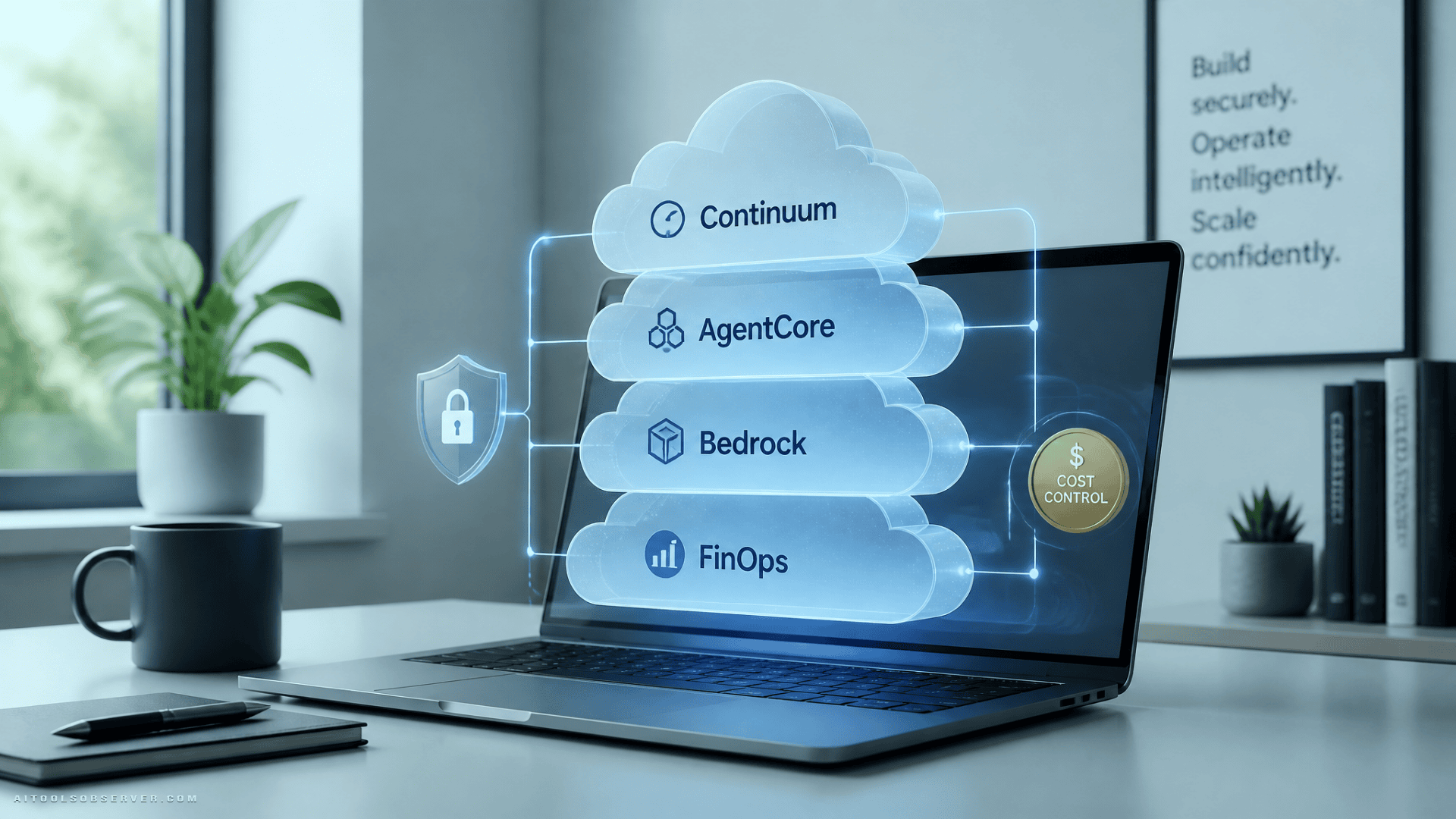
The pattern across this year’s AWS announcements is pretty clear. AWS appears to be pushing AI beyond model access and into operations: agent runtime, security, governance, lifecycle management, search, and cost control.
That matters because most enterprise AI pain is no longer “how do I call a model?” It’s “how do I make this thing reliable, governable, affordable, and not mildly terrifying?”
1) AWS Continuum
AWS Continuum is positioned around the full lifecycle of code vulnerabilities, from discovery through action and resolution.
What makes it notable is the broader context it reasons over. Based on the description, it combines structured AWS data like infrastructure, permissions, network topology, and code with unstructured internal context such as documents and communications.
Why that matters: vulnerability tooling often floods teams with findings but struggles with prioritization. Continuum appears aimed at sorting what’s real, what’s exploitable, and what should happen next.
2) AWS Security Agent
Launched as part of Continuum, AWS Security Agent focuses on proactively securing applications throughout the development lifecycle.
The practical hook is on-demand penetration testing customized to the application, plus exploitability-based verification of security risks. In plain English: not every scary-looking issue is equally dangerous, and AWS seems to be leaning into that distinction.
For DevSecOps teams, this could be the more interesting shift. Security agents are only useful if they reduce noise instead of writing fan fiction about risk.
3) Amazon Bedrock AgentCore
Bedrock AgentCore is AWS’s flagship platform for building, deploying, and operating agents at scale.
The key positioning here is flexibility. AWS frames it as working with any framework, model, or protocol, which suggests it wants to be the control plane for agentic systems rather than just a model access layer.
That’s a smart place to compete. Many teams don’t need another model menu; they need a way to manage agents without inventing their own runtime from scratch.
4) AgentCore Web Search
One of the more practical additions to AgentCore is Web Search, which lets agents pull in web information without extra infrastructure overhead.
AWS says the feature is meant to help agents ground responses in current, cited web knowledge while keeping data inside secured AWS environments. That combination matters for enterprise buyers who want fresher outputs without relaxing security posture.
This is also a quiet admission of reality: static knowledge is nice until your agent starts sounding like last quarter.
5) AgentCore with Bedrock Guardrails
AWS also integrated AgentCore with Bedrock Guardrails, adding checks around agent actions for prompt injection, harmful content, and sensitive data exposure.
That’s important because agent safety is not the same thing as chatbot safety. Once an agent can take actions, browse, call tools, or move data, the blast radius gets bigger fast.
For teams evaluating agent platforms, this kind of guardrail integration is often more important than one more benchmark slide.
6) AgentCore Harness
Harness is designed to simplify AI agent development down to two API calls.
Under the hood, AWS positions it as managed support for concurrency, memory, identity, and state management. Those are not glamorous words, but they are exactly where many agent projects become expensive science experiments.
If you’re building internal tools or customer-facing workflows with agents, this is the sort of product that may save more time than a fancier model ever will.
7) FinOps agents
AWS also introduced new FinOps agents, which fits a very obvious 2026 trend: AI costs are now someone’s full-time headache.
While the provided context doesn’t go deep on implementation details, the direction is easy to read. AWS appears to be bringing agent-style automation into cloud cost management and operational efficiency.
That could be useful for teams dealing with spiky inference workloads, growing experimentation, and the awkward moment when “just test it” becomes a line item.
8) Strands agents
Alongside FinOps agents, AWS rolled out Strands agents.
The brief context suggests AWS is broadening its agent portfolio beyond general-purpose orchestration into more specialized operational roles. That’s worth watching because the market is shifting from “agents can do anything” to “agents should do one job well.”
Specialized agents tend to be less magical in demos and more useful in production. Usually a good trade.
9) Amazon Connect Decisions
Amazon Connect Decisions made the list as one of AWS’s notable 2026 launches, and the name alone gives away the pitch: better decisioning inside customer interaction workflows.
For contact center and customer experience teams, this likely points to more AI-assisted routing, policy decisions, or workflow logic within AWS’s broader customer service stack. The bigger implication is that AWS isn’t treating AI as a separate layer anymore; it’s embedding it into business systems where decisions actually happen.
That’s where value usually shows up: not in a chatbot box, but inside workflow plumbing nobody posts about on LinkedIn.
10) Innovation for AWS Outposts and lifecycle management
The final bucket is less one product than a signal. AWS also unveiled innovation around Outposts and lifecycle management, extending its 2026 AI push into hybrid and operational environments.
This matters because enterprise AI rarely lives in one neat cloud-only lane. Some teams need on-prem or edge-adjacent deployment patterns, and many need better governance over how AI systems are deployed, updated, and maintained over time.
In other words: the hard part is no longer launching AI. It’s living with it.
What this means for buyers and builders
If you strip away the product names, AWS’s 2026 AI story looks pretty disciplined:
- Build agents more easily
- Run them at scale
- Give them web access
- Add guardrails
- Secure the software they touch
- Keep costs from drifting into comedy
That stack makes sense for enterprises that are moving from experiments to operations. It also makes AWS more interesting for teams that want AI infrastructure with a lot of built-in controls, rather than assembling five vendors and a prayer.
The practical shortlist
If you’re deciding what to pay attention to first, start here:
- For security teams: AWS Continuum and Security Agent
- For agent builders: Bedrock AgentCore, Harness, and Web Search
- For governance-focused teams: AgentCore plus Bedrock Guardrails
- For ops and finance teams: FinOps agents
- For hybrid enterprise environments: Outposts-related AI and lifecycle updates
The takeaway
The coolest AWS AI products of 2026 aren’t the ones promising robot coworkers with suspicious confidence. They’re the ones tackling the boring, expensive, failure-prone middle: security, runtime, state, governance, and cost.
If you’re comparing enterprise AI platforms, that’s the layer to watch. Demos impress. Operational tooling survives procurement.












Comments (0) No comments yet
Want to join this discussion? Login or Register.
No comments yet. Be the first to share your thoughts!