


Why this matters more than a typical AI product review
When a niche AI app performs badly, schools can simply avoid it. Google Search is different.
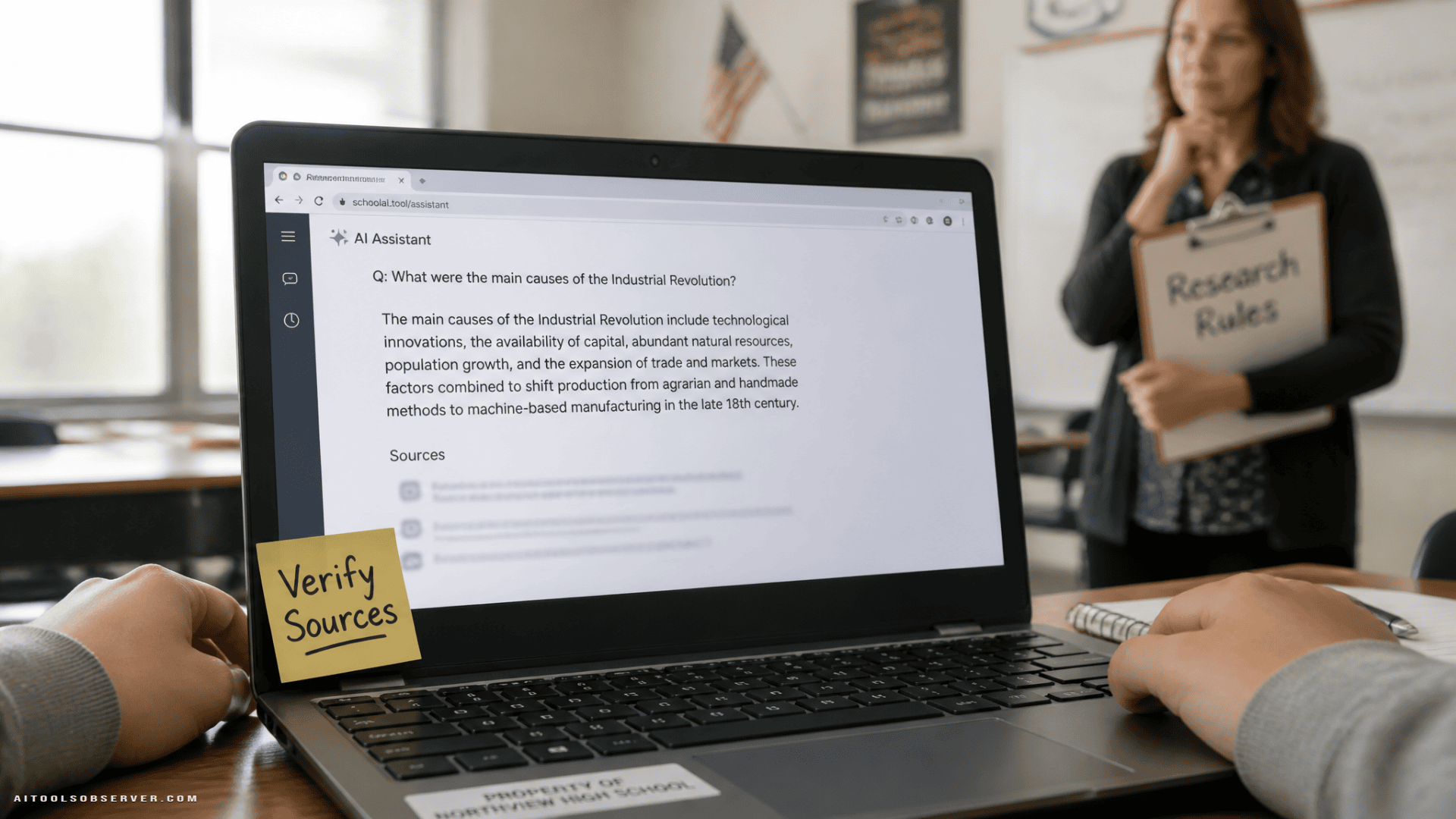
It sits close to the center of student research behavior, especially in K-12 environments where Google accounts, Chromebooks, and classroom workflows are already common. If AI-generated answers are layered into search by default, the practical question for educators becomes harder: how do you teach research skills when the search box itself is now also a chatbot, tutor, summarizer, and sometimes an unreliable one?
That is the real trend to watch. AI is no longer confined to standalone tools. It is being embedded into the basic infrastructure students use every day.
What the Common Sense Media review found
Based on the available context, Common Sense Media rated both Google’s AI Overview and AI Mode as “Unacceptable” for student use.
The concerns fell into three buckets:
- inaccurate or inconsistent answers
- weak responses to possible mental health or safety red flags
- willingness to complete homework rather than support learning
Those findings are especially notable because the testing reportedly used strong safety settings, including SafeSearch and youth-oriented account conditions. In other words, this was not a stress test of an unrestricted system. It was an evaluation of what appears to be one of the safer student-facing versions of search.
Google disputed parts of the report and said it could not replicate many of the results. That matters too. It suggests one of the biggest operational problems with AI search: outputs may vary, making oversight harder for schools and families.
The biggest issue for schools: AI search is now a moving target
Traditional search had its own literacy problem. Students still had to judge source quality, bias, and relevance. But AI search adds a new layer: now students must also evaluate the generated answer before they even click a source.
That sounds manageable in theory. In practice, it creates four classroom problems.
1. The answer looks finished even when it isn’t reliable
AI-generated summaries often present information in a confident, clean format. For students, that can feel more authoritative than a list of links.
If the answer is wrong, inconsistent, or stitched together from weak sources, many learners may not notice. Younger students are especially likely to treat the first polished answer as the correct one.
2. Source quality gets blurred
One of the sharper concerns in the report is that cited sources may include a mix of higher-quality references and content with little editorial accountability.
That blurring matters in schools. If students cannot easily tell the difference between peer-reviewed material, a reputable publication, a social post, or a video clip, research quality falls fast. The danger is not just misinformation. It’s the normalization of weak evidence.
3. Homework support can become homework replacement
The report suggests the AI tool completed assignment-style tasks without meaningful resistance.
This is a major shift. Many educators have spent the last two years adapting to AI writing assistants, study tools, and tutoring apps. But AI inside search lowers the friction even more. Students do not need to open a separate tool, sign up, or intentionally “use AI.” It is simply built into the act of looking something up.
That makes classroom policy harder to enforce because the boundary between research and answer generation gets fuzzy.
4. Safety behavior may not match educator expectations
When students search for troubling topics, schools often assume big platforms will direct them toward appropriate help or at least avoid harmful responses.
The report raises concerns that this assumption may not hold consistently. For counselors, administrators, and student support staff, that is a serious warning sign. AI search should not be treated as a dependable support layer for students in distress.
What this says about the wider AI tools market
This is bigger than Google.
The broader pattern is that AI features are being bundled into familiar products before institutions have fully updated their policies, training, or safeguards. Search, productivity suites, note-taking apps, and classroom platforms are all becoming AI delivery systems.
For schools, that creates a new procurement blind spot. Even if a district never formally approves a standalone chatbot, students may still be using AI constantly through tools the school already relies on.
That is the market shift educators and edtech leaders need to pay attention to:
- AI is becoming default, not optional
- safety claims are harder to verify in real use
- guardrails may differ across surfaces, modes, and account states
- “search” no longer means the same thing it did two years ago
What educators should do right now
Schools do not need to panic, but they do need to stop treating AI search as neutral infrastructure.
Revisit student research expectations
If students are using search tools that generate direct answers, assignments need clearer rules.
Instead of asking for “research,” define the process:
- what sources are allowed
- whether AI-generated summaries can be used
- how students must verify claims
- what citation standard they must follow
If the process is vague, students will default to the easiest path.
Separate discovery from evidence
A useful rule for classrooms is simple: AI search can help students discover a topic, but it should not be treated as the final authority.
That means students may use AI-generated results to brainstorm keywords, identify subtopics, or frame a question. But the evidence they use in an assignment should come from vetted databases, library resources, primary sources, or approved publications.
This keeps AI in a supporting role rather than letting it become the research product.
Teach “answer skepticism” explicitly
Students already need source skepticism. Now they also need answer skepticism.
A practical classroom exercise:
- run the same prompt multiple times
- compare differences in the answers
- inspect the sources
- identify what changed and what stayed stable
- discuss which answer, if any, should be trusted
This turns AI literacy from theory into direct observation. It also helps students see that polished language does not equal truth. Similar issues appear when AI hallucinates, and misleads in other decision contexts.
Update digital safety assumptions
Counselors and student support teams should not assume AI search tools will reliably recognize self-harm, substance use, or mental health crisis signals.
Students need clear, human-centered alternatives:
- school counseling contacts
- crisis procedures already approved by the school
- trusted hotlines and community resources
- adult escalation paths
In practice, that means schools should point students toward known support systems rather than expecting a search interface to handle sensitive situations correctly.
Give elementary students stricter guardrails
For younger learners, the case for tighter limits is stronger.
If a tool can produce inaccurate answers, mix weak and strong sources, and solve assignments directly, elementary students are unlikely to have the evaluation skills needed to use it safely on their own. In those settings, librarian-vetted resources, classroom databases, and guided search environments make more sense.
What school leaders should ask vendors and internal teams
This story also exposes a common edtech mistake: assuming a familiar brand equals a classroom-ready experience.
School leaders should ask sharper questions about any AI-enabled tool:
- Can AI features be disabled?
- Are they on by default?
- How are citations chosen and displayed?
- What happens when a student asks for help with homework?
- How does the system respond to self-harm, substance use, or delusional language?
- Do outputs vary significantly across repeated prompts?
- What account settings change the experience for minors?
These are not technical edge cases anymore. They are core product-evaluation questions.
The real lesson: default AI is becoming a policy problem
The deeper issue here is not one report or one company. It’s that AI features are arriving inside products schools already use, often faster than school governance can adapt.
That creates a mismatch:
- consumer AI moves fast
- school policy moves slower
- student behavior moves fastest
If educators wait for perfect certainty before responding, they will always be behind the tool.
A practical path forward
For most schools, the best next step is not a blanket yes or no on AI search. It is a narrower, more useful policy:
- younger students use vetted research tools
- older students can use AI search for discovery, not final evidence
- assignments require verification and source inspection
- staff are trained on the limits of AI safety responses
- AI literacy is taught through hands-on comparison, not abstract warnings
That approach matches the reality of the current market. AI search can be useful, but usefulness is not the same as readiness for children.
The smart move for educators is to treat AI search like any other powerful but imperfect tool: allowed only with clear boundaries, active instruction, and better alternatives ready when the stakes are high.












Comments (0) No comments yet
Want to join this discussion? Login or Register.
No comments yet. Be the first to share your thoughts!