


Why the Old Tricks No Longer Work
For years, the go-to advice was simple: look for extra fingers, warped ears, or text that dissolves into gibberish. Those were reliable tells because early AI made obvious structural errors.
That window is closing fast.
“Training on visual artifacts, like looking for a sixth finger or odd earrings, has had limited success, partly because the AI is getting too good,” explains Prof. Dawel.
Fraudsters also know to filter out images with obvious flaws before using them.
The researchers behind this work used StyleGAN3 — one of the most realistic AI face generators available — to build their test pool. The results were humbling for most participants before training began.
The 6 Visual Cues That Actually Work
These aren’t hard technical rules. They’re perceptual qualities — subtle signals your brain can learn to read with practice. Researchers found that teaching people to notice these six characteristics is what drove accuracy improvements.
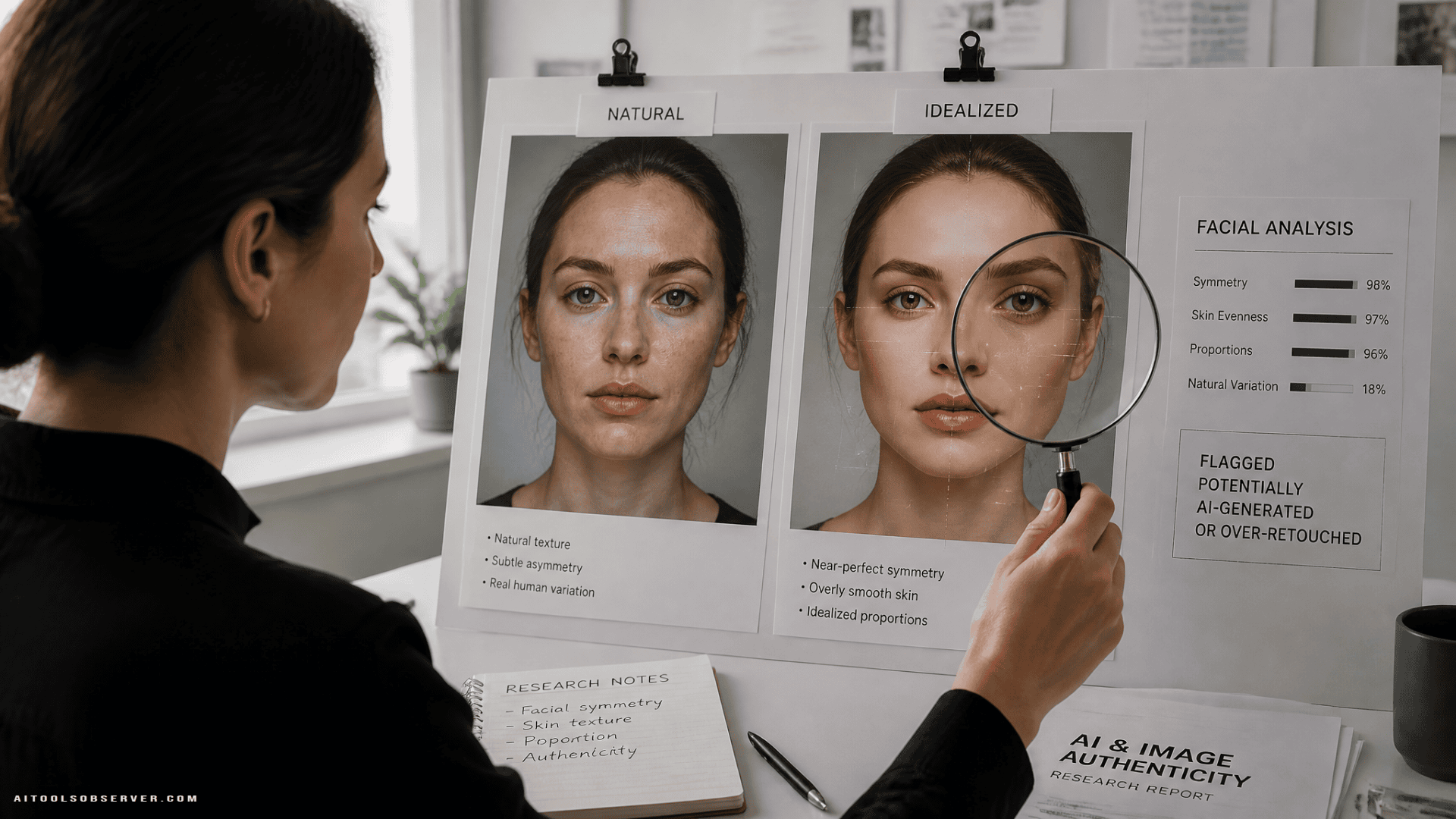
1. Symmetry
Real human faces are slightly asymmetrical. A drooping eyelid, an uneven smile, a jawline that sits a little off-center — these are normal. AI-generated faces often look too balanced, too geometrically clean.
If a face looks almost perfectly symmetrical, that’s worth a second look.
2. Proportionality
Deepfakes tend to cluster around idealized proportions. Very large noses, protruding ears, or unusual facial ratios are uncommon in AI-generated images. Real faces carry more variation.
When a face looks proportionally “correct” in an almost textbook way, treat that as a soft signal.
3. Attractiveness
This one is more subjective, but it’s consistent. As Dr. Sutherland puts it: “AI tends to look more attractive.” Generative models are trained on vast datasets that skew toward conventionally appealing faces, so the output tends to be pleasant-looking in a generic, polished way.
If a face looks almost too photogenic without being a recognizable public figure, that’s worth noting.
4. Distinctiveness
Ask yourself: would this face stand out in a crowd? AI faces tend to cluster toward the average. They look generic — familiar in a way that’s hard to place, but not particularly memorable.
Real people have quirks. AI faces often don’t.
5. Expressiveness
AI-generated faces tend to show less emotional expression. They often appear neutral or mildly pleasant, but rarely convey the kind of nuanced emotion — tension around the eyes, a slight furrow — that real faces carry even in still photos.
A face that looks emotionally flat or oddly composed may be worth scrutinizing.
6. Memorability
This is closely tied to distinctiveness. After viewing an AI-generated face, people often struggle to recall it clearly. The face doesn’t “stick.” Real faces, even unremarkable ones, tend to leave more of an impression.
If you feel like you’ve already forgotten what a face looked like while still looking at it, pay attention to that feeling.
The Training Effect: How Your Brain Catches Up
Here’s what makes this research genuinely useful: the improvement isn’t about memorizing rules. It’s about pattern recognition.
Researchers exposed participants to both real and AI-generated faces, then told them which was which. Over repeated exposure, accuracy climbed from roughly 40% to 80%. A small number of participants reached close to 100%.
That process mirrors how generative AI models themselves learn — feed them enough labeled data, and accuracy improves even when the underlying mechanism isn’t fully understood.
There’s also a confidence dimension. Earlier research had shown that overconfident people made the most errors. After training, participants became better calibrated — more confident when they were actually correct, and more uncertain when they weren’t. That kind of self-awareness matters. If you can’t tell when you’re right, the skill isn’t actionable.
One Important Caveat
AI models are not equally good at generating all types of faces. They tend to perform worse on non-white faces, older faces, and younger faces — because training datasets have historically skewed toward young white subjects.
This means a face that looks slightly “off” in texture or proportion may not be AI at all. And a face that looks convincingly real may still be generated. The six cues above work best as a cluster of signals, not individual checkboxes.
Why This Matters Beyond Curiosity
The stakes here are real.
Global consultancy Deloitte has projected that losses from AI deepfake scams in the US alone could reach significant figures in the coming years. One widely cited case involved an employee at a Hong Kong-based firm who transferred a large sum to fraudsters after a video call featuring a deepfake recreation of their boss.
On the political side, an Associated Press investigation as far back as 2019 identified a LinkedIn profile — complete with a convincing AI-generated photo — that appeared to be a fabricated persona connected to foreign intelligence operations.
Deepfakes aren’t a future problem. They’re already being used in fraud, espionage, and influence operations.
The Practical Takeaway
You don’t need a forensics background to get better at this. You need deliberate practice and the right mental framework.
Start with the six cues above — symmetry, proportionality, attractiveness, distinctiveness, expressiveness, and memorability. Use them together, not in isolation. Look for a cluster of signals rather than a single smoking gun.
There are websites where you can test and sharpen these skills with real examples. The research team behind this work also invites volunteers to participate in ongoing studies.
The uncomfortable truth is that AI is almost certainly reading the same published research that trains humans to detect it — and adjusting. The gap between human detection and AI generation is narrowing. But for now, the skill is learnable, the improvement is measurable, and the effort is worth it.
Observe carefully. Choose what to trust wisely.


















Comments (0) No comments yet
Want to join this discussion? Login or Register.
No comments yet. Be the first to share your thoughts!