


The Glow-Up That Rewrote History
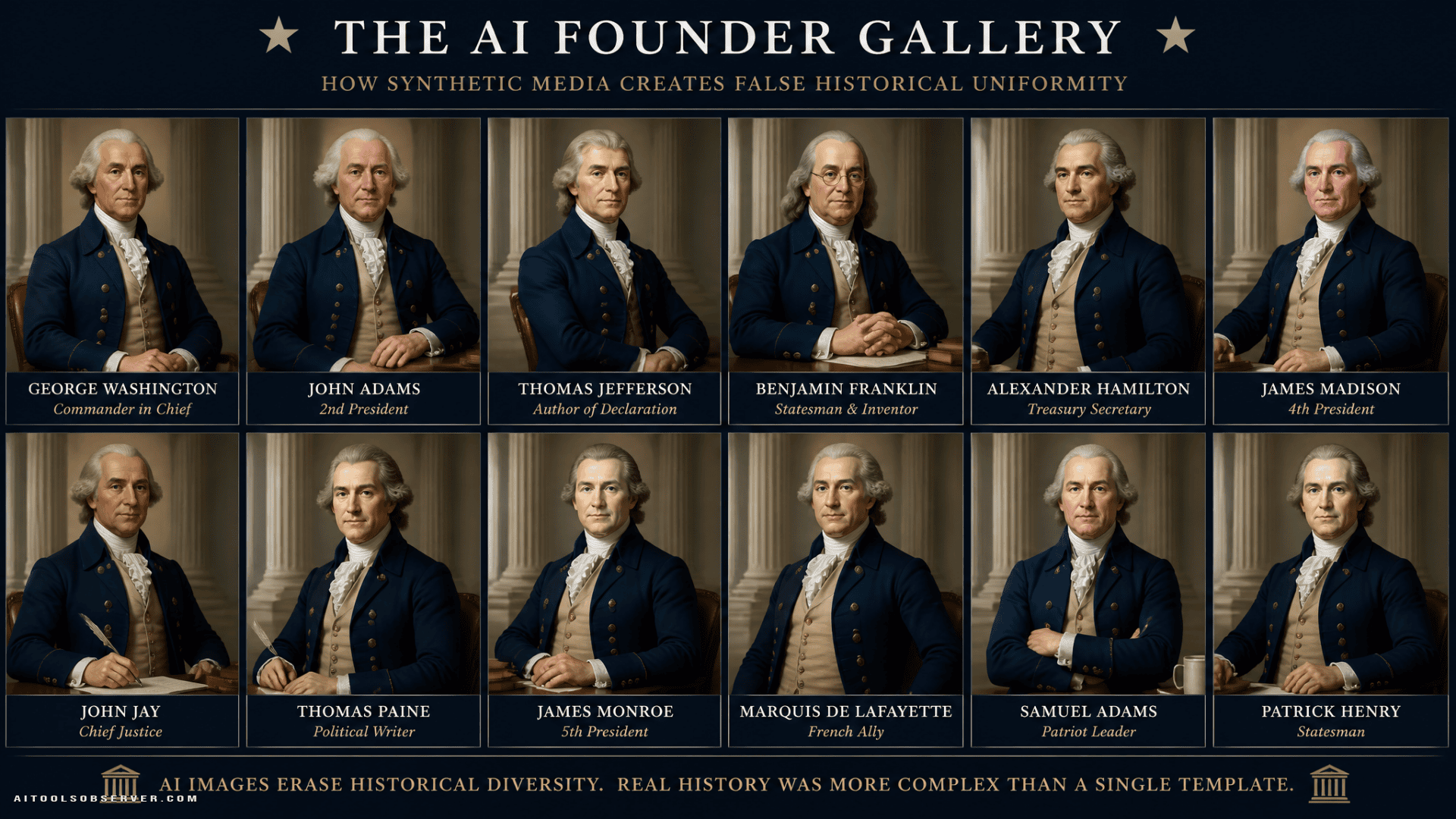
Every founder in the gallery has been processed through what historians are now calling a kind of corporate makeover. Benjamin Rush — a man whose 1812 portrait showed brittle hair and a long, downturned nose — now appears with flowing curls, porcelain skin, and a LinkedIn-ready pose. His new look is identified by a Google SynthID watermark as the product of generative AI.
He’s not alone. Dozens of Revolutionary-era figures received similar treatment. The result is less “18th-century America” and more “tech startup pitch deck with tricorn hats.”
What the AI Actually Changed
The alterations aren’t random. They follow a pattern, and that pattern is telling.
Every man wears a near-identical blue coat — despite historical portraits showing them in brown, black, gray, and other colors. Their hairstyles converge on Gilbert Stuart’s canonical portrait of George Washington, complete with the puffed sides and characteristic queue. Some rows of founders — Francis Lightfoot Lee, George Clymer, George Read — simply look like repeated Washington face filters.
The poses are anachronistic too. Crossed arms, chin-stroking, fingers cradling cheekbones — these are modern CEO stances, not 18th-century portrait conventions. The neoclassical columns in the backgrounds are favored by the current administration, not by Revolutionary-era painters.
Historian Zara Anishanslin of the University of Delaware put it plainly:
“It’s almost like modern CEO imagery that’s being grafted onto these 18th-century founders.”
The Details That Historians Noticed
Thomas Jefferson’s eyes were changed from dark brown to clear blue. Abigail Adams received what one observer described as an artistic rhinoplasty and lip filler, her face squared off and her eyes enlarged to anime proportions — bearing no resemblance to Benjamin Blyth’s 1766 pastel portrait of her.
Dolley Madison appears as an adult woman. She would have been 8 years old during the Revolution.
Benjamin Franklin’s portrait appears based on a Duplessis painting in which Franklin deliberately wore a plain gray coat to signal republican simplicity against French pomp. The AI version puts him in the same blue coat as everyone else. The symbolism, intentional in the original, is gone.
The One Exception
Phillis Wheatley — the only Black figure in the gallery — wears a pastel blue gown instead of the uniform darker blue worn by everyone else. She stands apart visually in a way that historians found immediately notable.
“That light blue gown really sticks out,” Anishanslin said. “It’s meant to set her apart from the others.”
Whether intentional or an artifact of the AI’s training data, the effect is the same: she’s visually separated from the cohort she’s supposedly part of.
Why This Matters Beyond Aesthetics
The SynthID watermarks on the men’s portraits confirm Google AI involvement. The women’s portraits didn’t carry the same watermark, but AI detection tools flagged synthetic elements there too.
This isn’t a Bridgerton situation — a show that plays fast and loose with Regency-era costumes for entertainment. Freedom 250 presents itself as a history site. It’s meant to educate the public about the semiquincentennial. The distinction matters.
When a government-affiliated organization uses generative AI to standardize the faces of historical figures — smoothing noses, swapping eye colors, dressing everyone in matching suits — it’s not just an aesthetic choice. It’s an editorial one. The AI isn’t illustrating history. It’s rewriting it with a particular visual vocabulary: uniform, corporate, and suspiciously contemporary.
What This Signals for AI Tools in Public Contexts
For anyone tracking the AI tools ecosystem, this is a useful case study in what happens when generative image tools meet institutional authority.
The tools themselves — Google’s generative AI, SynthID watermarking — worked exactly as designed. The watermarks are there. The synthetic elements are detectable. The problem isn’t the technology failing. It’s the technology being used to produce something that looks authoritative while quietly departing from the historical record.
A few things worth watching as this pattern spreads:
- SynthID watermarking is becoming a de facto disclosure layer for AI-generated media, but it only helps if audiences know to look for it.
- AI face editing tools are now accessible enough that organizations can apply them at scale to entire portrait galleries — not just individual images.
- The gap between “AI-assisted” and “AI-fabricated” is closing fast in public communications, and most audiences aren’t equipped to tell the difference.
The Takeaway
Generative AI is good at making things look credible. That’s the feature. In entertainment, it’s useful. In a government-affiliated history gallery, it’s a different kind of problem.
The founders got a glow-up. What got left behind was the actual history — the gray coats, the hooked noses, the deliberate symbolism that real portrait painters embedded in their work. AI smoothed all of that out in favor of something more uniform, more modern, and considerably less true.
If you’re building with generative image tools, or evaluating platforms that use them, Freedom 250 is now a reference point for what synthetic media looks like when it’s deployed without editorial accountability. The watermark was there. Nobody checked.

















Comments (0) No comments yet
Want to join this discussion? Login or Register.
No comments yet. Be the first to share your thoughts!