



The Problem Physical AI Labs Are Trying to Solve

Training a robot to perform a household task is fundamentally different from training a language model. Text data is abundant and cheap. Embodied action data — the kind that captures how a human hand applies pressure when scrubbing a surface, or how a body shifts weight while mopping a floor — is scarce, expensive, and technically difficult to collect.
Video alone is insufficient. A camera records what happens, but not the force applied, the depth of the environment, or the precise joint angles of the worker’s body. Physical AI models need all of these signals, synchronized to the millisecond, to generalize across the messy variability of real-world environments.
This is the gap Human Archive is positioning itself to fill.
Hardware Architecture: Beyond the iPhone Rig

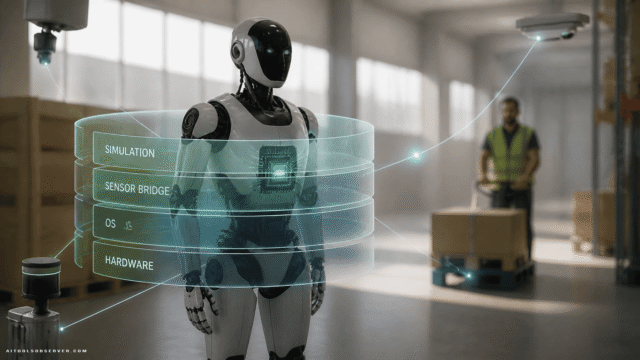
Human Archive’s data collection infrastructure has evolved rapidly. The company began with iPhones and off-the-shelf camera rigs — pragmatic choices for early validation, but insufficient for the sensor density that serious robotics training demands.
Today, the startup operates more than 50 deployed devices across seven distinct hardware product lines. The core stack includes:
- RGB-D cameras — color imagery paired in real time with depth information
- Egocentric headsets — first-person perspective recordings aligned with the worker’s field of view
- Chest and wrist cameras — capturing fine-grained hand and arm movements from multiple angles simultaneously
- Tactile gloves — measuring contact force and grip dynamics
- Full-body motion capture suits — recording skeletal movement across the entire kinematic chain
The critical engineering challenge is not collecting each data stream individually — it is synchronizing them. Human Archive has built proprietary pipelines to align signals from all these sources into a single coherent temporal record. That synchronization is, arguably, the company’s most defensible technical asset.
Why Synchronization Is the Competitive Moat
Zach DeWitt, a partner at Wing VC, articulated the differentiation clearly: no other organization has managed to synchronize headset RGB-D, force feedback, full-body motion capture, and chest and wrist camera data at scale. That combination is novel enough that major AI labs and universities are reportedly queuing to run experiments on the forthcoming dataset release.
The implication for buyers is significant. A robotics lab training a manipulation policy does not just need video of a human cleaning a countertop — it needs to know exactly how much force the hand exerted, where the depth boundary of the surface was, and how the shoulder rotated to reach the far corner. Human Archive’s multi-modal stack provides all of that in a single, time-aligned record.
Human Archive is also closing the feedback loop internally. The company is developing methods to fine-tune AI models on its own data and test those models on physical robots, allowing it to demonstrate dataset quality through task performance rather than through abstract benchmarks alone.
The Gig Economy as a Data Collection Network

The operational model is built on India’s home services sector. Human Archive has partnered with smaller startups in the space — after being rejected by larger players including Urban Company, Snabbit, and Pronto — to embed data collection into routine service visits.
The consent mechanism works as follows: when a worker arrives at a customer’s home, the app presents a choice. The customer can pay a discounted rate in exchange for consenting to data collection, or pay the standard rate for an unrecorded visit. According to the company, customers have broadly preferred the discounted option, partly because video recordings can help resolve disputes about service quality.
Workers are compensated at a base rate of $1 per hour for participating in data collection. Competing platforms reportedly pay between $2.63 and $4.20 per hour. Human Archive acknowledges the gap but attributes it to its on-the-ground operational presence in India, which it argues reduces overhead costs.
Compliance, Privacy, and the Regulatory Lens

Data collection in private homes, involving workers who may not fully understand how their recordings are used, raises legitimate ethical questions. Human Archive states that its commercial contracts comply with India’s Digital Personal Data Protection (DPDP) Act. The company displays privacy policy notices and consent information detailing the purpose and processing of collected data. All recordings are anonymized, and faces are blurred.
Nevertheless, India’s Ministry of Electronics and Information Technology has reportedly begun examining the consent mechanisms and data-collection practices of startups operating in this space. The scrutiny is not surprising — the intersection of gig labor, private residential spaces, and commercial AI training is genuinely novel regulatory territory.
For businesses evaluating Human Archive as a data supplier, compliance posture matters. A dataset built on contested consent mechanisms carries downstream legal and reputational risk, regardless of its technical quality.
Expansion Beyond India: Southeast Asia and the U.S.

Human Archive is not limiting its ambitions to the Indian market. The company has begun expanding into Southeast Asia and is piloting programs in the United States, where it aims to offer home services — cleaning, cooking — in exchange for data collection by participating workers.
The U.S. pilot is early-stage, but the strategic logic is clear. Robotics labs deploying in Western markets will want training data that reflects Western home environments, object layouts, and task conventions. Indian household data, while valuable, may not generalize perfectly to a San Francisco apartment or a Chicago kitchen.
The company is also building a platform to allow anyone to participate in data collection and earn income — a broader vision of a distributed, global data workforce contributing to the physical AI supply chain.
What This Means for AI Tool Adopters and Builders
For teams building or evaluating physical AI systems, Human Archive represents a specific type of vendor: a specialized data marketplace focused on embodied, multi-modal human behavior. The relevant questions when assessing such a supplier are precise.
Data quality: Is the synchronization between modalities verified, and at what temporal resolution? Human Archive’s internal model training and robot evaluation pipeline is a meaningful signal here — it suggests the company is accountable to downstream task performance, not just data volume.
Compliance depth: Does the consent framework hold up under the regulatory environment where the end product will be deployed? DPDP compliance is necessary for Indian operations, but U.S. or EU deployment may require additional scrutiny.
Coverage and diversity: Does the dataset reflect the variability of environments, body types, and task sequences that a deployed robot will encounter? Geographic expansion is a direct response to this concern.
Worker compensation ethics: The wage gap between Human Archive and competitors is a reputational variable that enterprise buyers — particularly those with ESG commitments — will need to evaluate.
The Broader Race for Embodied Training Data

Human Archive is one of several startups competing to supply the physical AI training data market. Others are collecting egocentric data from factory floors and industrial environments. The differentiation Human Archive is pursuing — consumer home environments, multi-modal sensor fusion, gig worker scale — is a specific and defensible niche, but only if the technical synchronization holds and the partnership network expands.
The rejection by Urban Company, Snabbit, and Pronto is a real constraint. Large home services platforms have the worker density and geographic coverage that would accelerate data collection significantly. Without them, Human Archive must aggregate volume through smaller partners, which is slower and operationally more complex.
Closing Reflection
The ambition behind Human Archive is not small. It is attempting to build the data infrastructure layer for physical AI — the equivalent of what large-scale web crawls were for language models, but for embodied human motion in real-world environments.
Whether it succeeds will depend on three things: the technical integrity of its synchronization pipeline, the ethical defensibility of its data collection practices, and the breadth of partnerships it can secure. The first appears genuinely differentiated. The second is under active regulatory scrutiny. The third remains the open variable.
For anyone building or procuring physical AI systems, this is a space worth watching closely — because the quality of the training data will determine, more than any other factor, whether the robots actually work.








Comments (0) No comments yet
Want to join this discussion? Login or Register.
No comments yet. Be the first to share your thoughts!