



What NVIDIA Actually Released

The announcement centers on new skills added to the NVIDIA Agent Toolkit — a framework that lets coding agents call into NVIDIA’s core physical AI libraries directly. These libraries span the full development pipeline:
- NVIDIA Cosmos — world foundation models for physical world reasoning and generation
- NVIDIA Omniverse — simulation environments and digital twin infrastructure
- NVIDIA Isaac — robotics simulation and robot learning
- NVIDIA Metropolis — vision AI for inspection and video intelligence
- NVIDIA Alpamayo — autonomous driving development
- NVIDIA Jetson — edge AI deployment
Each skill defines which tools to call, what outputs to produce, and how to validate results. The effect is that a coding agent can now orchestrate an entire physical AI development pipeline — from synthetic data generation through simulation, training, evaluation, and deployment — without requiring a human to manually configure each step.
Security and governance are handled through NVIDIA NemoClaw and the NVIDIA OpenShell runtime, which enforce policy-based controls on local or cloud hardware.
Why This Matters: Agents Moving Into the Physical World

The broader context here is important. AI agents have already demonstrated value in software development — writing code, running tests, managing repositories. NVIDIA is now extending that same agentic logic into physical AI: the systems that operate in the real world, under physical constraints, with real consequences for failure.
Jensen Huang framed it directly: when agents can call NVIDIA libraries and frameworks natively, the iteration speed for building robots, autonomous vehicles, and industrial systems accelerates fundamentally. The bottleneck shifts from manual workflow configuration to the quality of the agent’s instructions.
This is a structural change in how physical AI gets built, not merely a tooling update.
Robotics and Edge AI

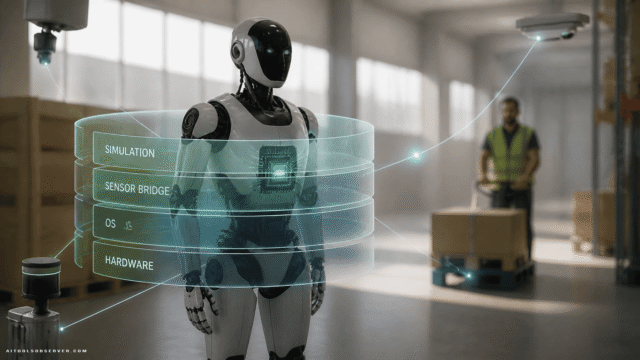
Robot developers can now use agent skills to automate the full development pipeline — from generating perception and mobility training data, through simulation and navigation training, to tuning Jetson-based edge systems for deployment. What previously required coordinated manual effort across multiple tools becomes a sequence of agent-callable steps.
Autonomous Vehicles

AV developers can direct agents to reconstruct fleet-captured data into simulation environments, generate photorealistic driving scenarios at scale, and run closed-loop reinforcement learning. Li Auto, Afari, and DeepRoute.ai are already operating at this scale — generating over 1,000 neural scene reconstructions and more than 300,000 renders and simulations per day using NVIDIA Omniverse NuRec models.
Vision AI and Automated Inspection

For manufacturing inspection and video intelligence, agent skills cover synthetic training data generation, model fine-tuning, automated labeling, and the construction of video AI agents capable of searching, summarizing, and analyzing live or recorded footage. The productivity numbers from early adopters are notable and worth examining in detail.
Industrial Digital Twins and Healthcare

Industrial teams can convert engineering CAD data into simulation-ready OpenUSD assets with significantly less manual setup. Healthcare teams can build hospital-environment digital twins, generate sim-to-real data, and run software-in-the-loop policy testing before any physical deployment — a critical safety step for clinical automation.
The Manufacturing Numbers: What Early Adopters Report

The most concrete evidence of impact comes from electronic manufacturing, where synthetic data generation skills have been in active use.
| Company | Skill Used | Reported Gain |
|---|---|---|
| Pegatron | Defect Image Generation | 67% reduction in model training and deployment time |
| Delta Electronics | Defect Image Generation | 17% improvement in defect detection rate |
| Inventec | Defect Image Generation | 30% reduction in defect data collection effort |
| Foxconn | Defect Image Generation | ~3% boost in first pass yield |
These are not marginal improvements. A 67% reduction in training and deployment time at Pegatron’s scale represents a substantial operational shift. Delta Electronics’ 17% detection improvement on excess soldering — a defect with direct quality and cost implications — demonstrates that synthetic data can meaningfully close real-world performance gaps.
Industry Adoption Across the Stack
The breadth of adoption signals that this is not a pilot program. NVIDIA lists confirmed users across every major domain:
Manufacturing and inspection: TSMC, Pegatron, Foxconn, Delta Electronics, Inventec
Industrial software and digital twins: Cadence, Dassault Systèmes, Siemens, Synopsys, PTC
Semiconductor fabrication: SK hynix, implementing fab digital twins as part of its Autonomous Fab 2030 roadmap, and collaborating with NVIDIA and SK Telecom to validate Agent Toolkit for manufacturing-specific physical AI
Autonomous vehicles: Li Auto, Afari, DeepRoute.ai
Robotics: Agile Robots, Agility, FieldAI, Hexagon Robotics, NEURA Robotics, Skild AI, Universal Robots
Healthcare robotics: Foxconn (Nurabot, Scrub Nurse Collaborative Robot) and Compal (PolyMedX, advancing toward hospital-wide orchestration)
The diversity here matters. NVIDIA is not positioning this stack for a single vertical — it is building infrastructure that cuts horizontally across every domain where physical AI is being deployed.
Availability and Cloud Integration

NVIDIA physical AI agent tools and skills are openly available now through GitHub and skills.sh, compatible with any coding agent. Synthetic data skills — Neural Reconstruction, Video Augmentation, and Defect Image Generation — are also available as Physical AI Launchables on NVIDIA Brev: preconfigured environments designed for faster onboarding and immediate experimentation.
Cloud integration is already in motion. Microsoft, CoreWeave, and Nebius are incorporating these agent skills and tools into their cloud services, enabling developers to scale synthetic data generation and deployment without managing underlying infrastructure.
What This Means for AI Tool Decision-Makers

For teams evaluating physical AI tooling, this release changes the calculus in several ways.
First, the open-source availability lowers the barrier to entry significantly. Developers can access the full skill set without licensing costs, and the GitHub-first distribution model means integration into existing agent workflows is straightforward.
Second, the cloud partnerships with Microsoft, CoreWeave, and Nebius mean teams do not need NVIDIA hardware on-premise to benefit. Synthetic data pipelines and simulation workloads can run at cloud scale immediately.
Third, the breadth of the stack — from Cosmos world models through Omniverse simulation to Jetson edge deployment — means teams can adopt individual components or orchestrate the full pipeline depending on their maturity and use case.
The risk to monitor is complexity. A stack this broad, spanning multiple frameworks and platforms, requires careful integration work. The agent skills are designed to reduce that burden, but teams should evaluate whether their existing agent infrastructure can consume these skills effectively before committing to full pipeline automation.
The Larger Signal

NVIDIA is making a deliberate architectural bet: that the next phase of AI development will be driven by agents orchestrating physical systems, not just software. By open-sourcing the skill layer and making its entire physical AI stack agent-callable, NVIDIA is positioning itself as the foundational infrastructure for that transition.
The manufacturing productivity numbers, the AV simulation volumes, and the breadth of named adopters suggest this bet is already paying off in practice. The question for the rest of the industry is how quickly teams can move from manual physical AI workflows to agent-orchestrated pipelines — and whether NVIDIA’s open stack becomes the default substrate for that shift.
The infrastructure is now openly available. The pace of adoption will determine how fast physical AI development transforms.










Comments (0) No comments yet
Want to join this discussion? Login or Register.
No comments yet. Be the first to share your thoughts!