


AI Integration Moves from Peripheral to Core

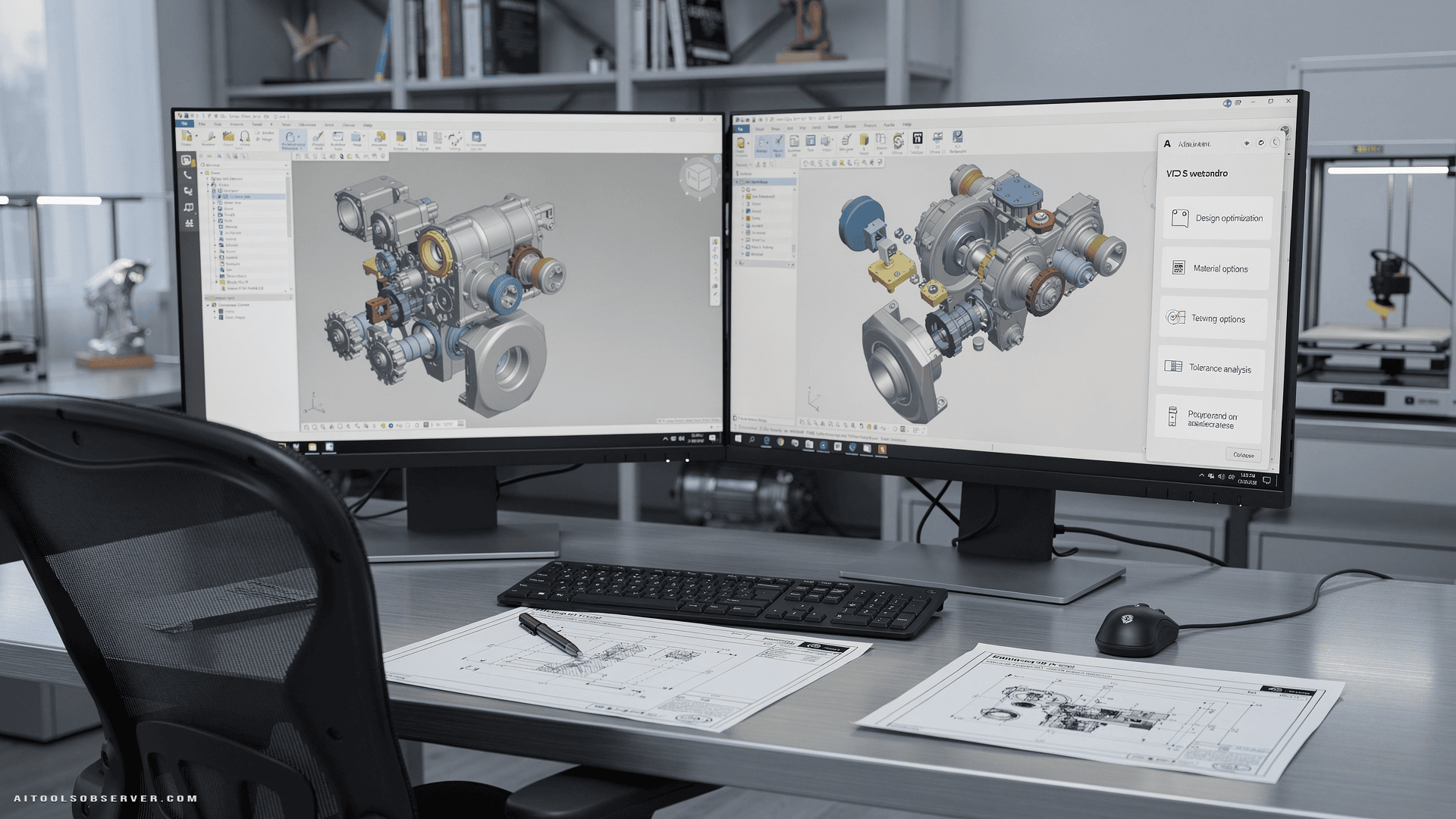
The most significant shift in IronCAD 2027 is the deliberate embedding of AI tools directly into the modeling environment — not as add-ons, but as functional components of the design process.
IronCAD AI Chat Bot
The AI Chat Bot provides in-interface answers to both IronCAD-specific and broader technical questions. It is available at no cost to trial and commercial users through December 31, 2026 — a time-limited but meaningful opportunity for teams to evaluate its practical utility before committing to a licensing decision.
IronCAD AI Design Assistant

This tool draws on catalog data — including metadata, engineering parameters, materials, and Smart Attachments — to translate text prompts into initial 3D assembly models. The output is a starting point for refinement, not a finished design, which is precisely the right framing. It accelerates the early-stage modeling phase without overpromising on automation.
IronCAD AI Drawing Assistant
The Drawing Assistant applies annotations, dimensions, and standards to existing drawings using catalog parts as reference. For teams producing high volumes of 2D documentation, this directly reduces the manual detailing burden and improves consistency across drawing sets.
Python Integration
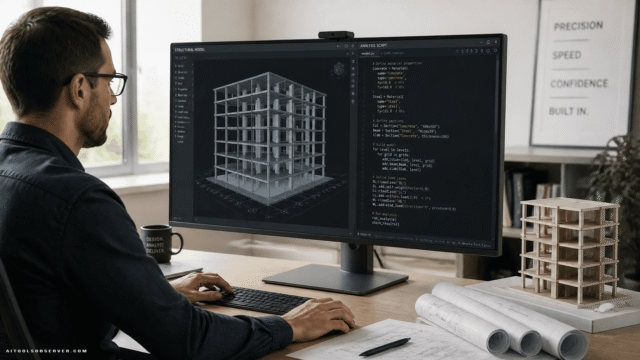
Native support for the official python-ironcad package opens the IronCAD API to automation, batch processing, and custom tooling. For developers and power users, this is a meaningful capability expansion — scripting workflows that previously required manual repetition can now be systematized.
Modeling and Assembly: Targeted, Practical Improvements
Beyond AI, IronCAD 2027 delivers a focused set of updates to core modeling and assembly functionality.
Performance has been improved for large industrial assemblies, with faster load and save operations and smoother model interaction. For teams working with complex machinery designs, this is not a minor convenience — it directly affects how quickly design iterations can be tested and revised.
Flexible assembly support allows subassemblies to be marked as flexible, enabling the same component to appear in different configurations within a single project. This is particularly relevant for modular product developers managing variant-heavy design libraries.
Skeleton design introduces top-down design tools built around a central lightweight skeleton model. Managing reference geometry across a large design from a single source of truth reduces the risk of cascading errors when dimensions or constraints change.
Sketching and modeling tools have also been updated — sweeps, extrusions, fillets, offsets, external references, and patterns have all received refinements suited to complex machinery and fabrication work.
Sheet Metal, Drafting, and Usability
IronCAD’s sheet metal and ICD drafting environment receives updates to bend parameters, annotation tools, bulk view templates, dimensioning workflows, and DWG export. These changes reflect the practical needs of fabrication shops where drawing accuracy and export compatibility are non-negotiable.
Additional usability improvements include piping tools, the “Copy with Mates” function for component replication with constraints, one-handed camera controls, and TriBall updates. These are incremental but compound in value for users who spend extended hours inside the modeling environment.
Availability and Access
IronCAD 2027 is available now. The AI Chat Bot is free through December 31, 2026. The AI Design Assistant and AI Drawing Assistant are accessible for trial use and through custom customer projects. Licensing, demonstrations, and implementation details are available directly through IronCAD at ironcad.com.
What This Means for CAD Tool Evaluators
IronCAD 2027 is a release that rewards close examination. The AI features are practically scoped — they address documentation consistency and early-stage modeling acceleration rather than making sweeping claims about autonomous design. The Python integration signals a commitment to extensibility that will matter to teams building internal tooling or managing large-scale batch workflows.
For industrial CAD buyers currently evaluating their toolchain, this update positions IronCAD as a platform that is actively closing the gap between traditional parametric modeling and AI-assisted design — methodically, and with clear industrial use cases in mind.







Comments (0) No comments yet
Want to join this discussion? Login or Register.
No comments yet. Be the first to share your thoughts!