


What Actually Changed
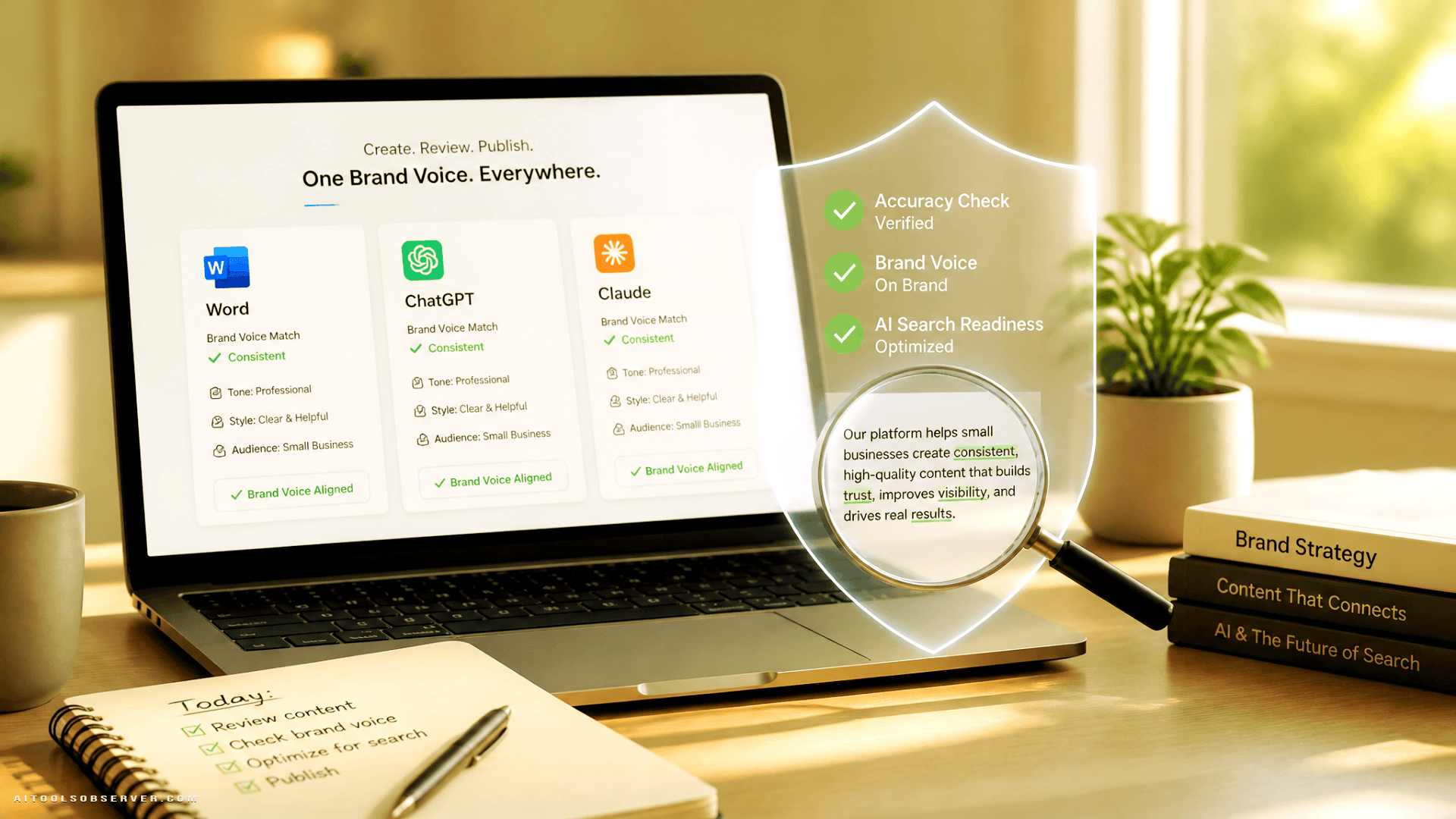
The core update brings Markup AI’s quality layer into three new environments: Microsoft Word, ChatGPT, and Claude. The platform was already available in Google Docs. Now it covers a much wider slice of where marketing content actually gets created.
The release also introduces Content Guardian Agents, described as always-on guardrails that check content — whether human- or AI-written — against brand voice and style guidelines before it goes out.
Five specific use cases anchor the update:
- High-volume content review across product launches, campaigns, and multi-asset initiatives
- Brand voice consistency when messaging refreshes or repositioning happens
- AI search readiness — structuring content so it can be cited and surfaced by AI-generated answers
- Accuracy checks that flag outdated information or unsupported claims in AI-generated drafts
- Brand drift prevention by turning individual editorial judgment into repeatable, team-wide standards
Why This Matters Now
The problem Markup AI is targeting is real and growing. Generative AI has made it cheap and fast to produce content at scale. A team that once spent a week on a campaign can now ship dozens of assets in a day. But that speed creates a new risk: content that sounds generic, drifts from brand standards, or contains errors that slip through because no one has time to review everything manually.
As CEO Matt Blumberg put it, marketers used to worry about writing enough content. Now the challenge is maintaining the judgment that makes content worth reading in the first place.
That’s a meaningful shift in what “content quality” means operationally. It’s no longer just about grammar or tone — it’s about whether content is accurate, on-brand, and structured in a way that AI search engines can understand and cite.
The AI Search Angle Is Worth Paying Attention To
One of the more forward-looking pieces of this release is the AI search readiness feature. As more users discover brands through AI-generated answers in tools like ChatGPT, Perplexity, or Google’s AI Overviews, content that isn’t structured to be cited simply won’t show up.
Markup AI appears to be positioning Content Guardian Agents as a way to help marketers evaluate whether their content meets that bar — not just for human readers, but for the AI systems that increasingly mediate discovery.
This is an emerging area, and the standards for what makes content “AI search ready” are still developing. But the direction is clear: content governance now has to account for machine readability alongside human readability. Teams already focused on AI search visibility may find this shift especially relevant.
Who This Is Built For
Markup AI for Marketers is clearly aimed at enterprise and mid-market teams — organizations where multiple writers, contractors, and AI tools are all contributing to a shared content output, and where brand consistency can’t depend on one editor reading everything.
The integration into Word, ChatGPT, and Claude is a practical choice. Rather than asking teams to change their workflow, Markup AI is inserting a quality layer into the tools they’re already using. That’s a lower-friction adoption path than asking teams to migrate to a new platform.
The Practical Takeaway
If your team is producing AI-assisted content at scale and you’re starting to notice inconsistencies in tone, accuracy issues slipping through, or uncertainty about whether your content will surface in AI search — this is the category of tool worth evaluating.
Markup AI isn’t the only player working on AI content governance, but this release is a concrete step toward making brand standards enforceable across the full stack of tools modern marketing teams use. The question to ask before adopting any tool in this space: does it fit where your content actually gets created, or does it require you to change how you work to use it?
In this case, the answer appears to be the former.










Comments (0) No comments yet
Want to join this discussion? Login or Register.
No comments yet. Be the first to share your thoughts!